
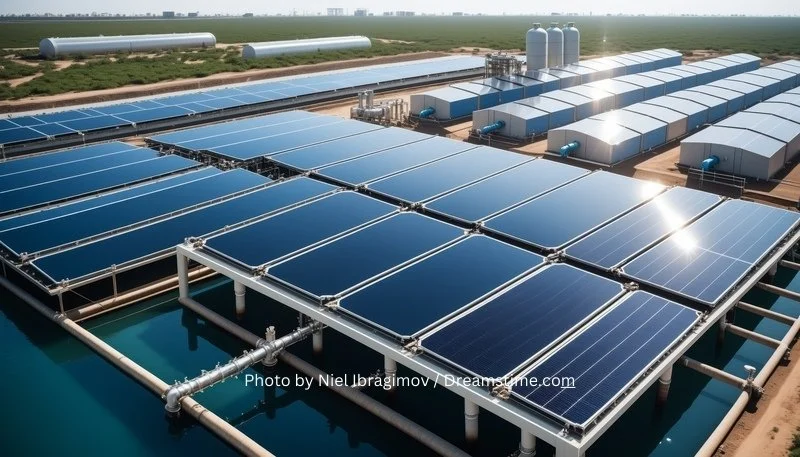
Aerial view of a solar energy farm featuring large panels over water, connected to a series of industrial buildings. The setup is surrounded by dry, open land under a clear sky.
Unlocking the Universe’s Most Abundant Element:
Why Green Hydrogen is Essential to Our Zero-Emission Rescue Mission
By the Sustainable Energy Mission Team
Transitioning away from fossil fuels requires more than just generating clean electricity—it requires a reliable way to store, transport, and deploy zero-emission energy across heavy industry, shipping, and community power grids. As part of our nonprofit’s Seven Rescue Missions, advancing Sustainable Energy stands at the forefront of protecting our planet's climate and ecosystems. Among the most promising pillars of this transition is Green Hydrogen—a clean energy carrier capable of powering our world with nothing more than water as a byproduct.
The Hydrogen Paradox:
Everywhere in the Universe, Yet Locked Away on Earth
Hydrogen is the simplest and most abundant element in the universe, powering the stars and making up roughly 75% of all normal matter. When used in a fuel cell to generate electricity, hydrogen combines with oxygen and leaves behind only pure water vapor—producing zero greenhouse gases or air pollutants.
However, there is a catch: on Earth, hydrogen almost never exists by itself in a pure, breathable gas form (H2). Because hydrogen atoms are chemically reactive, they are always tightly bundled with other elements:
· Bonded with oxygen to form water (H2O).
· Bonded with carbon to form fossil hydrocarbons like natural gas/methane (CH4) and coal.
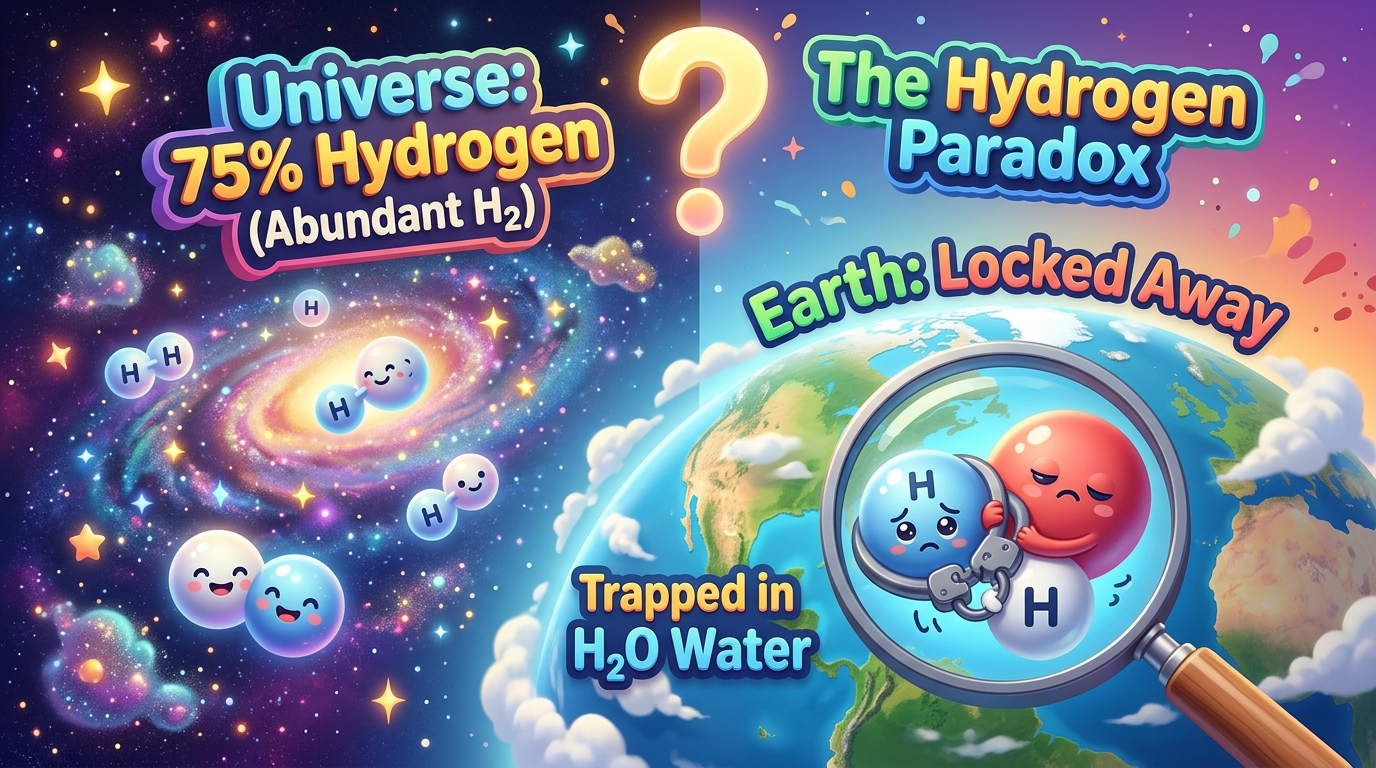
The Hydrogen Paradox overview / AI image by Magnific.
At the Anode (Fuel Electrode):
Pure hydrogen gas (H2) enters the anode catalyst layer, where each molecule splits into positively charged protons (H+) and negatively charged electrons (e-). The electrolyte membrane permits only the protons to pass through, forcing the electrons to travel through an external circuit—generating the steady electrical current that powers electric drive motors, regional microgrids, or off-grid community heating systems.
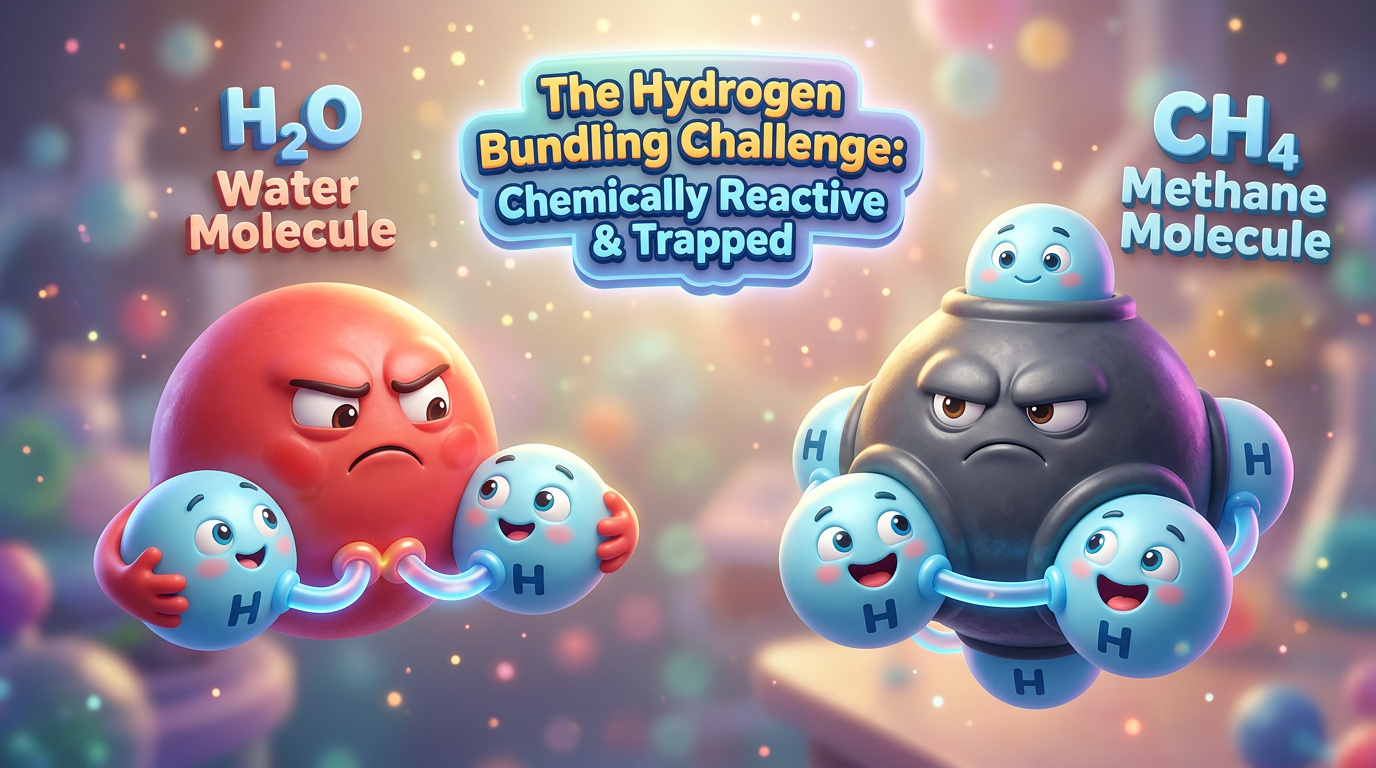
The Hydrogen Bundling Challenge / AI image by Magnific.
Because you cannot simply drill a well or mine for pure hydrogen the way we harvest wind or sunlight, hydrogen acts as an energy carrier rather than a primary energy source. To make it feasible for human use, we must first invest energy to break those tight molecular bonds, isolate the pure hydrogen gas, and safely compress or store it until it is needed.
How Green Hydrogen is Generated: Breaking the Bond with Clean Energy
For hydrogen to truly serve as a zero-emission resource, the energy used to separate it must also be 100% clean. Green Hydrogen achieves this through a process called water electrolysis.
Using electricity generated exclusively from renewable sources—such as solar, wind, or hydro power—an electrolyzer passes an electric current through water (H2O) via positively and negatively charged electrodes (an anode and a cathode). That electrical energy breaks the strong chemical bond between hydrogen and oxygen, splitting water into two separate gases:
The Electrolysis Formula (Splitting Water to Store Clean Energy):
2H2O(liquid)+Renewable Electricity→2H2(gas)+O2(gas)
At the Cathode (Negative Electrode):
Hydrogen ions combine with electrons to form pure hydrogen gas (H2), which is captured and stored as clean fuel.
At the Anode (Positive Electrode):
Water molecules are oxidized to release pure oxygen (O2), which can be safely vented into the air or repurposed for medical and industrial applications.
When that stored green hydrogen is later fed into a fuel cell to power a vehicle, ship, or backup microgrid, the exact reverse reaction occurs—releasing electricity while returning clean water to the environment:
2. The Fuel Cell Formula (Releasing Energy with Zero Emissions):
2H2(gas)+O2(gas)→2H2O(water vapor)+Clean Electricity & Heat
Gray Hydrogen (The Fossil Fuel Baseline)
How It Is Made: Extracted from natural gas (methane, CH4) using high-temperature steam in a process called Steam Methane Reforming (SMR).
The Chemical Reaction:
CH4+2H2O(steam)→CO2↑+4H2
(Performed in two stages: CH4+H2O→CO+3H2, followed by the water-gas shift reaction CO+H2O→CO2+H2).
Environmental Impact: Gray hydrogen currently makes up the vast majority of global hydrogen production because fossil gas has historically been inexpensive. However, all resulting carbon dioxide (CO2) is vented directly into the atmosphere, alongside upstream methane leaks from gas extraction—making it a major contributor to global warming.
At the Cathode (Air/Oxygen Electrode):
Ambient oxygen (O2) is drawn into the cathode, where it reacts with the returning electrons from the electrical circuit and the protons that crossed through the membrane. This electrochemical recombination produces pure, demineralized water vapor (H2O) and recoverable thermal heat as the only byproducts—completely eliminating carbon emissions, soot, and greenhouse gases.
To see a step-by-step visual animation of how hydrogen and oxygen ions interact across the anode and cathode catalysts, explore Fuel Cells Structure and Half Equations.
Not All Hydrogen is Created Equal: Gray vs. Blue vs. Green Hydrogen
While all hydrogen molecules (H2) are chemically identical once isolated, the climate impact of hydrogen depends entirely on where it comes from and what energy is used to extract it. Scientists and energy policymakers use a color code to distinguish between production pathways.
The diagram below illustrates how Grey Hydrogen, Blue Hydrogen, and Green Hydrogen differ in their inputs, industrial processes, and environmental footprints. Notice how Grey and Blue pathways rely on natural gas (CH4) and generate carbon dioxide (CO2), whereas Green Hydrogen uses green electricity and water to emit only oxygen (O2):
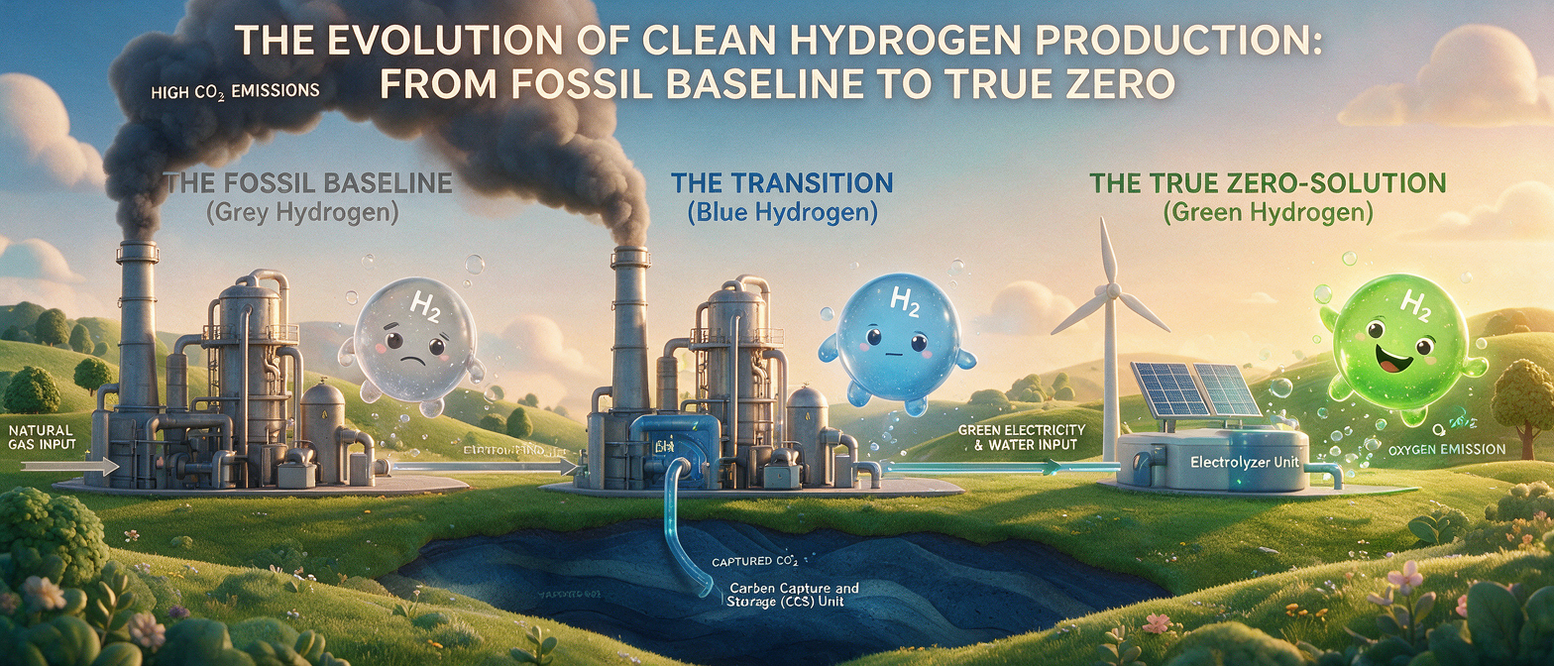
Evolution of clean hydrogen production / AI image by Magnific.
Blue Hydrogen (The Transitional Compromise)
How It Is Made: Produced using the exact same fossil natural gas and Steam Methane Reforming (SMR) reaction as gray hydrogen, but paired with Carbon Capture and Storage (CCS) equipment to trap the resulting CO2 and pump it deep underground.
Environmental Impact: While marketed as a lower-carbon bridge fuel, blue hydrogen still perpetuates fossil fuel extraction. Furthermore, carbon capture systems do not capture 100% of emissions, require extra energy to run, and remain vulnerable to upstream methane leakage across the natural gas supply chain.
Green Hydrogen (The True Zero-Emission Solution)
How It Is Made: Produced by splitting water (H2O) via electrolysis powered by 100% renewable energy (solar, wind, or hydro).
Environmental Impact: Zero carbon dioxide is produced during extraction or use. The entire lifecycle is circular: renewable electricity splits water into hydrogen and oxygen, and consuming the hydrogen turns it right back into water.
| Feature | Gray Hydrogen | Blue Hydrogen | Green Hydrogen |
|---|---|---|---|
| Primary Feedstock | Natural Gas (CH4) + Steam | Natural Gas (CH4) + Steam | Water (H2O) |
| Energy Source | Fossil Fuels | Fossil Fuels | 100% Renewables (Solar, Wind, Hydro) |
| Extraction Method | Steam Methane Reforming (SMR) | SMR + Carbon Capture & Storage (CCS) | Water Electrolysis |
| Core Chemical Equation | CH4 + 2H2O → CO2 + 4H2 | CH4 + 2H2O → CO2 (stored) + 4H2 | 2H2O → 2H2 + O2 |
| Byproduct Released | High CO2 emissions + Methane leaks | Uncaptured CO2 + Methane leaks | Pure Oxygen (O2) only |
| Sustainability Verdict | Polluting; unsustainable | Partial mitigation; relies on fossil gas | True zero-emission energy |
Looking Ahead: Overcoming the Next Hurdles
Understanding how green hydrogen is born is the first step in our Sustainable Energy mission. Yet once we split water to create pure green hydrogen, two major engineering questions immediately follow: How do we lower the electricity cost of electrolysis, and how do we safely store and transport the smallest molecule in the universe?
In Part 2 of our series, we will explore the newest scientific breakthroughs driving down production costs and transforming how green hydrogen is stored for communities and industries worldwide.
Executive Technical Brief:
Next-Generation Water Splitting, Electrolysis Topologies, and the Capillary Breakthrough Driving Green Hydrogen Toward Commercial Parity
By the Sustainable Energy Mission Team
Scaling green hydrogen as a zero-emission energy carrier for hard-to-abate sectors requires overcoming two fundamental Levelized Cost of Energy (LCOE) roadblocks: high capital expenditure (CapEx) and system-level electrical inefficiencies. While over 80% of global hydrogen supply is still derived from fossil fuels, rapid advancements in electrochemical cell architecture and direct solar water splitting are reshaping the production landscape.
To transition green hydrogen from niche pilot programs to broad market feasibility, energy leaders must evaluate both established industrial electrolysis topologies and emerging breakthroughs that eliminate parasitic energy losses.
The Spectrum of Green Hydrogen Production Topologies
Modern water-splitting technologies span mature industrial electrolysis systems, advanced membrane chemistries, and direct solar-driven reactors. Each pathway carries distinct operational parameters, material dependencies, and grid-integration profiles:
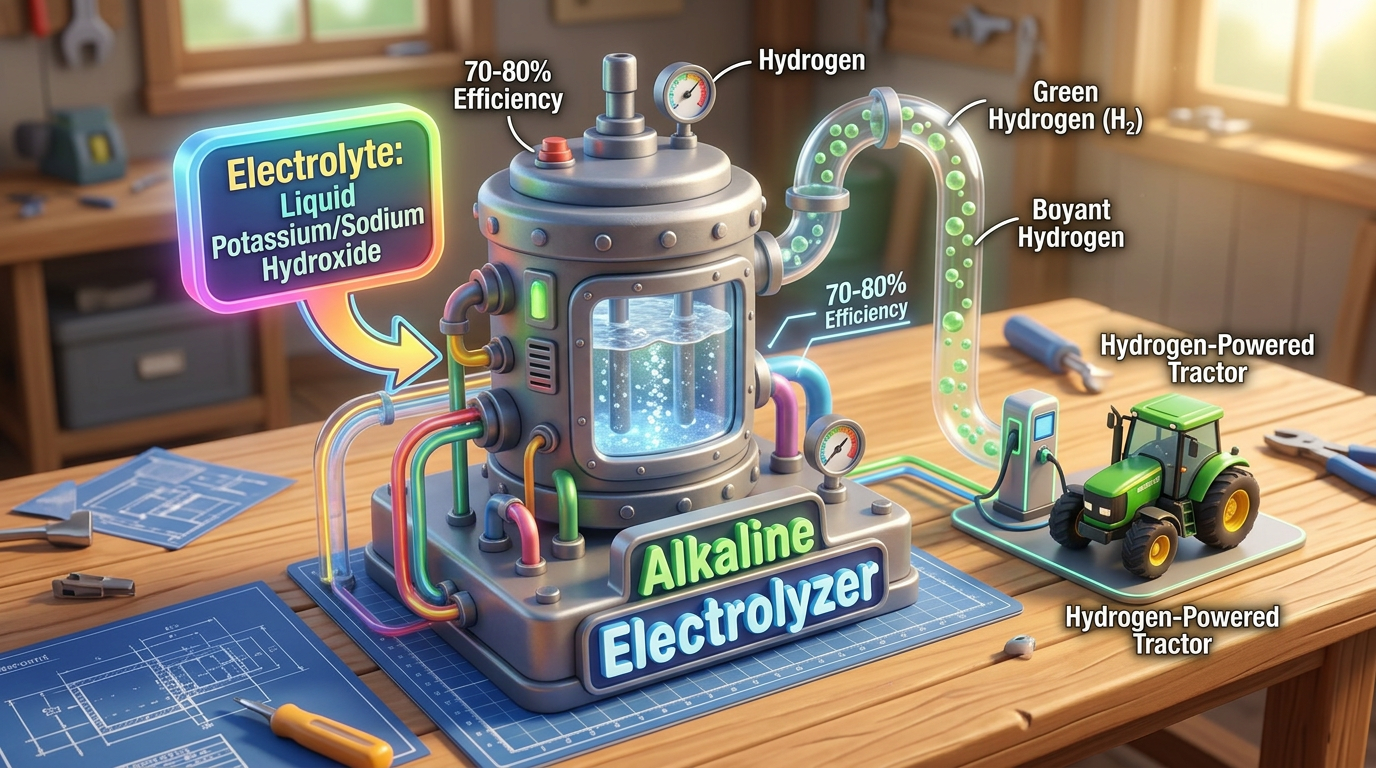
Alkaline electrolysis system / AI image by Magnific.
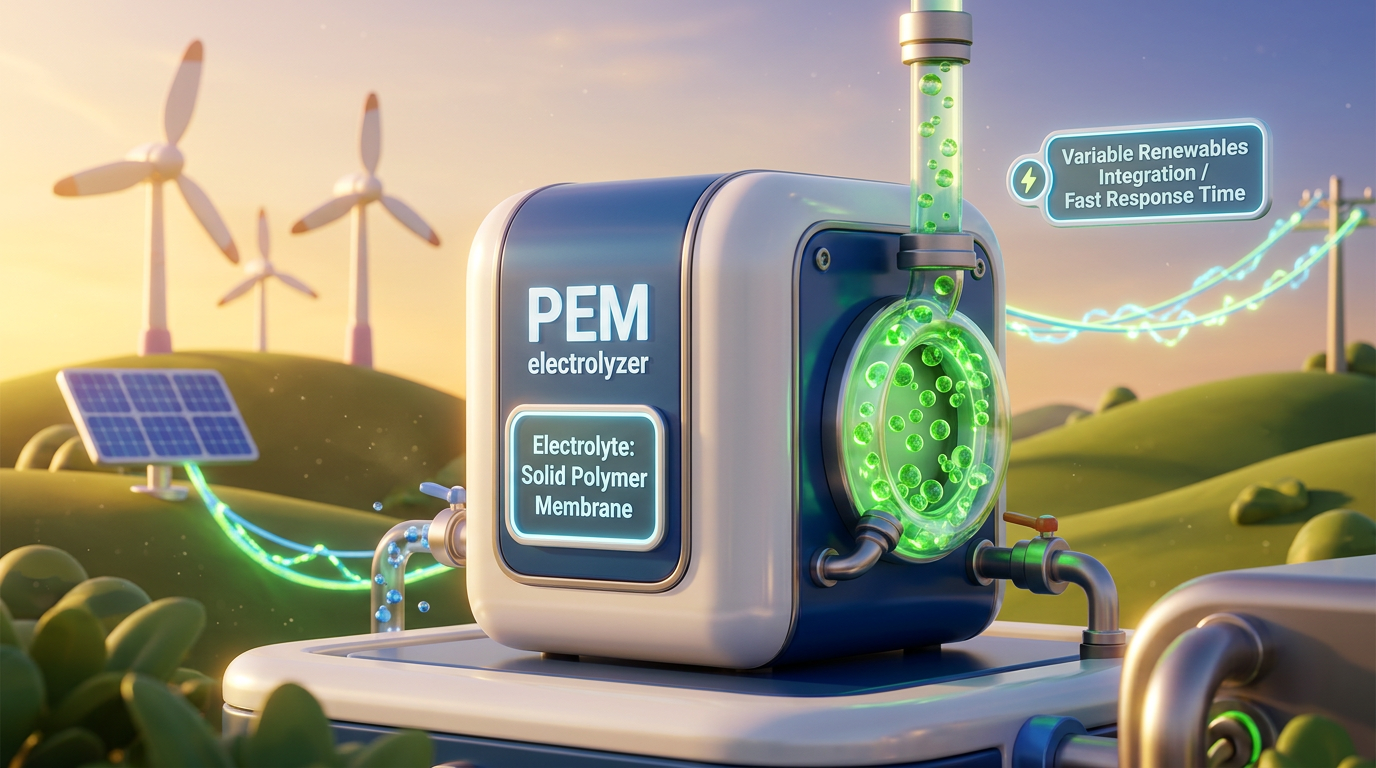
PEM electrolysis technology / AI image by Magnific.
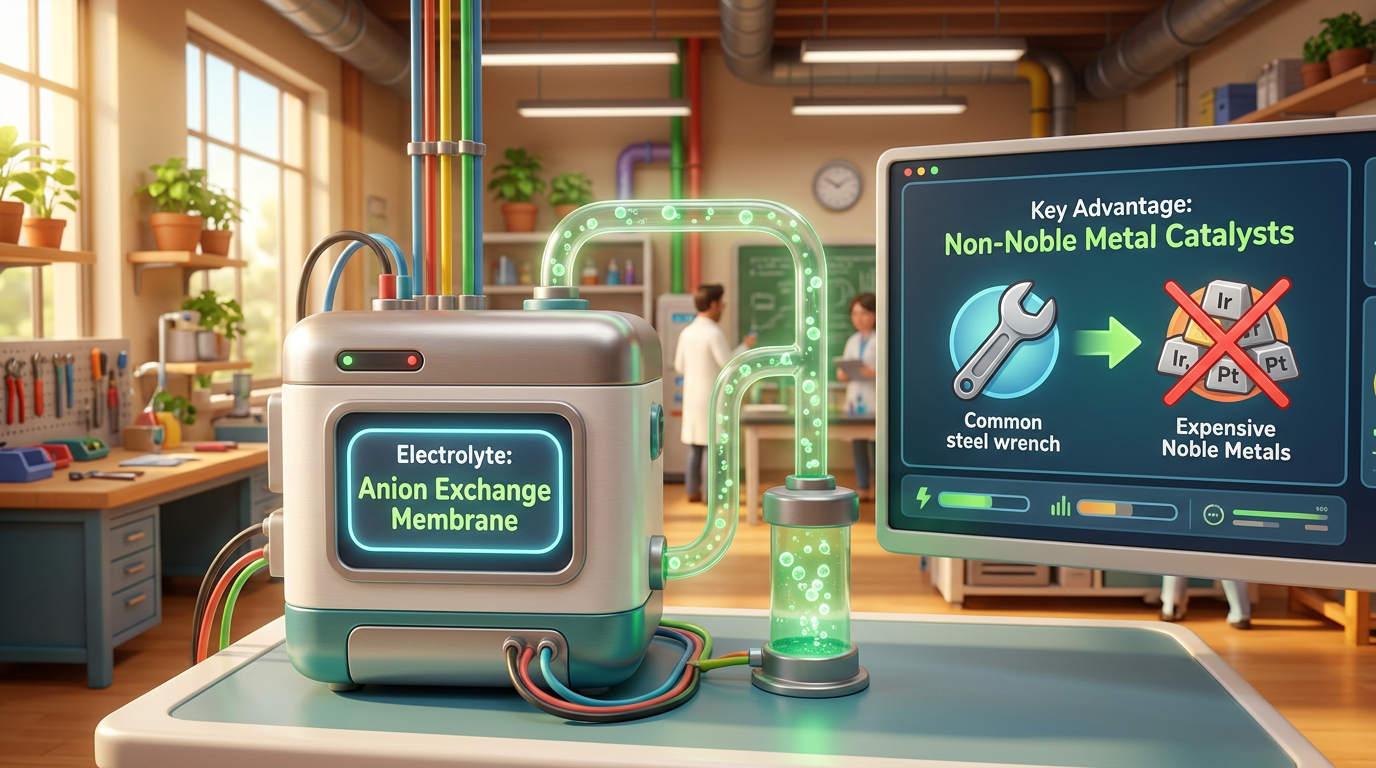
Anion exchange membrane electrolysis / AI image by Magnific.
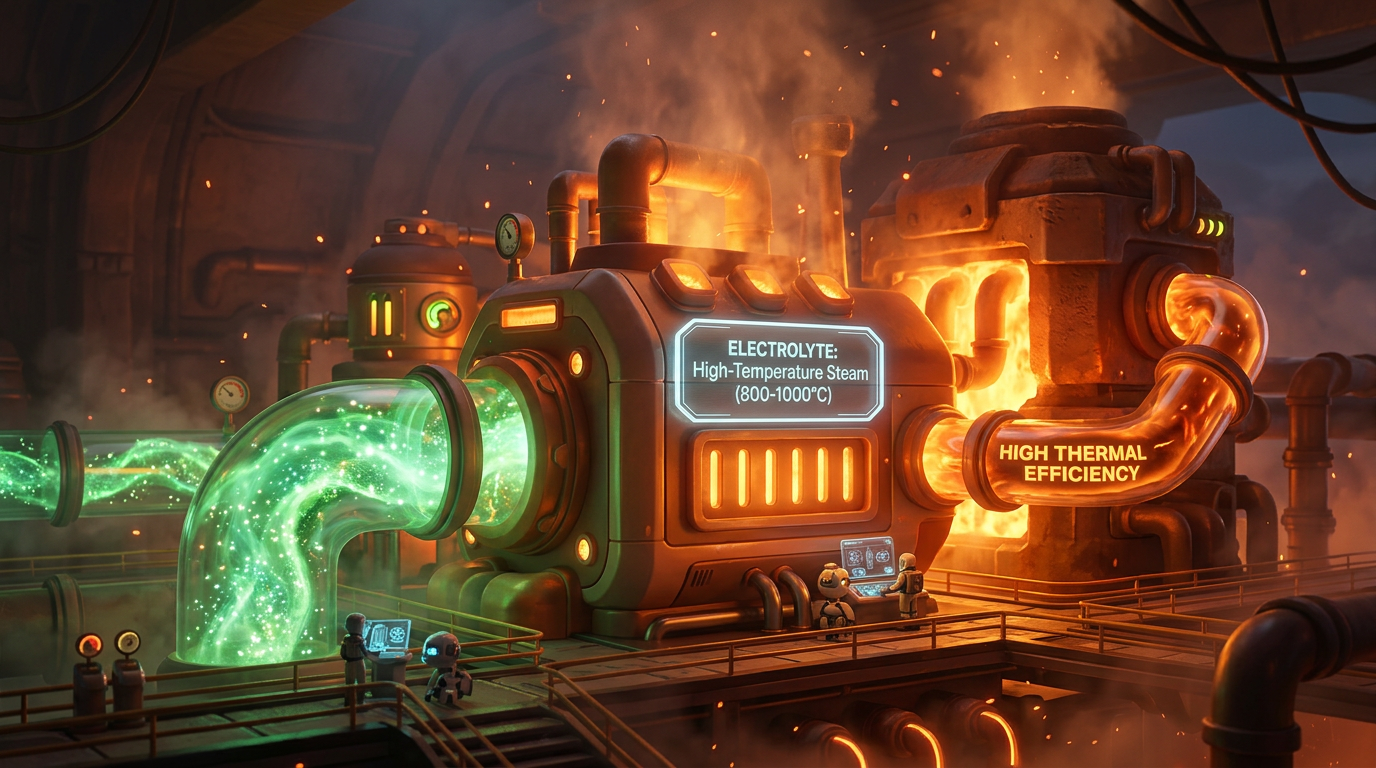
Solid oxide electrolysis system / AI image by Magnific.
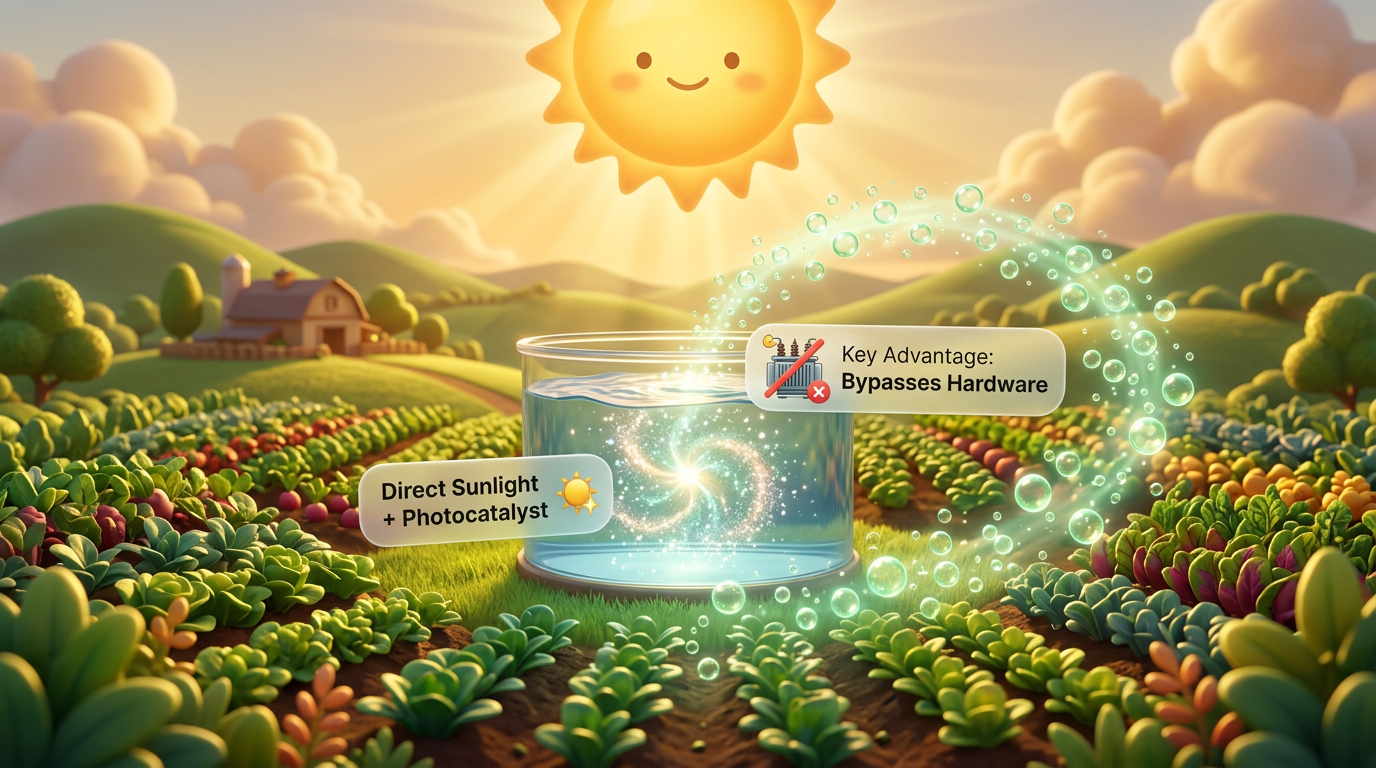
Photocatalytic water splitting / AI image by Magnific.
Alkaline Electrolysis:
This proven, mature industrial method utilizes a liquid potassium or sodium hydroxide electrolyte and operates at 70–80% efficiency.
Polymer Electrolyte Membrane (PEM) Electrolysis:
Rather than liquid electrolytes, PEM systems use solid polymers to operate at high current densities, making them ideal for coupling with variable renewable energy sources. Because they operate in harsh acidic environments, however, PEM architectures require scarce and costly Platinum Group Metals (such as iridium and platinum) alongside titanium components.
Anion Exchange Membrane (AEM) Electrolysis:
Advanced by research institutes such as KIST, emerging AEM systems operate in alkaline environments using cheaper, non-noble metal catalysts instead of precious metals. While this lowers material costs, current AEM designs still face trade-offs in operating lifespan compared to PEM systems.
Solid Oxide Electrolysis (SOEC):
Operating as a high-temperature steam electrolysis process between 800°C and 1,000°C, SOEC achieves high thermal efficiency and supports syngas co-production capabilities.
Photocatalytic Water Splitting (PWS):
Moving beyond traditional electricity-fed electrolyzers, PWS reactors—such as those tested in Australia by Spark Hydrogen—use sunlight directly to split water without requiring separate electrical generation equipment. By targeting the operating energy requirement directly, photocatalysis offers a streamlined pathway for solar-to-hydrogen generation.
| Production Topology | Electrolyte / Medium | Operating Profile & Efficiency | Key Advantages | Primary Bottlenecks |
|---|---|---|---|---|
| Alkaline Electrolysis | Liquid potassium or sodium hydroxide | Mature baseline; 70–80% efficiency | Proven industrial track record and non-noble metal compatibility | Lower current density and bubble-induced resistance on submerged electrodes |
| PEM Electrolysis | Solid polymer membrane (Acidic) | High current density; conventional systems require ~52.5 kWh/kg H2 | Fast response time suited for variable wind and solar integration | Relies on scarce Platinum Group Metals (iridium, platinum) and titanium |
| AEM Electrolysis | Anion exchange membrane (Alkaline) | Emerging alkaline membrane architecture | Replaces expensive Platinum Group Metals with lower-cost non-noble catalysts | Shorter operating lifespan requiring further durability validation |
| Solid Oxide (SOEC) | High-temperature steam (800–1,000°C) | High thermal efficiency | Capable of high-efficiency steam splitting and syngas co-production | Requires concentrated high-temperature thermal inputs |
| Photocatalytic (PWS) | Direct sunlight + photocatalyst | Direct solar water splitting | Bypasses separate photovoltaic and electrolyzer hardware entirely | Currently transitioning from prototype reactor tests to pilot scale |
The Core Efficiency Bottleneck: The Physics of the "Bubble Problem"
For decades, conventional electrolysis systems have struggled to close the economic gap with fossil fuels because of internal energy losses during the water-splitting reaction. In standard submerged-electrode configurations—including conventional PEM and alkaline cells—the primary culprit behind energy waste is the "bubble problem".
As water splits into hydrogen and oxygen, non-conductive gas bubbles nucleate and cling directly to the submerged surfaces of the anode and cathode. These insulating gas layers mask active catalytic sites on the electrodes and drive up internal electrical resistance. Because of this parasitic resistance, conventional commercial electrolyzers require approximately 52.5 kWh of electricity to produce a single kilogram of hydrogen (H2), driving up the operational electricity burden and generating excess waste heat.
The Capillary-Fed Breakthrough: Unlocking Market Feasibility
A major engineering breakthrough developed by Australian cleantech firm Hysata resolves this bottleneck by redesigning how water is delivered to the electrodes. Rather than submerging the electrodes in liquid where bubbles trap and accumulate, Hysata’s capillary-fed electrolyzer draws electrolyte upward from a bottom reservoir through a porous, hydrophilic separator via natural capillary action.
This architectural shift transforms both cell physics and plant economics for the general market:
Eliminating Bubble Resistance:
Because the electrolyte is fed directly through the porous separator without submerging the electrodes, pure hydrogen and oxygen gases are released uninhibited without forming insulating bubble layers.
Hysata capillary-fed electrolyzer / AI image by Magnific.
Decentralized Healthcare Microgrids:
Live multi-vector facilities—such as the Reinier de Graaf hospital in the Netherlands and the Viamed San José hospital in Spain—utilize onsite solar arrays to power electrolyzers during peak daylight hours, storing clean hydrogen for backup power while capturing byproduct oxygen directly for clinical patient care.
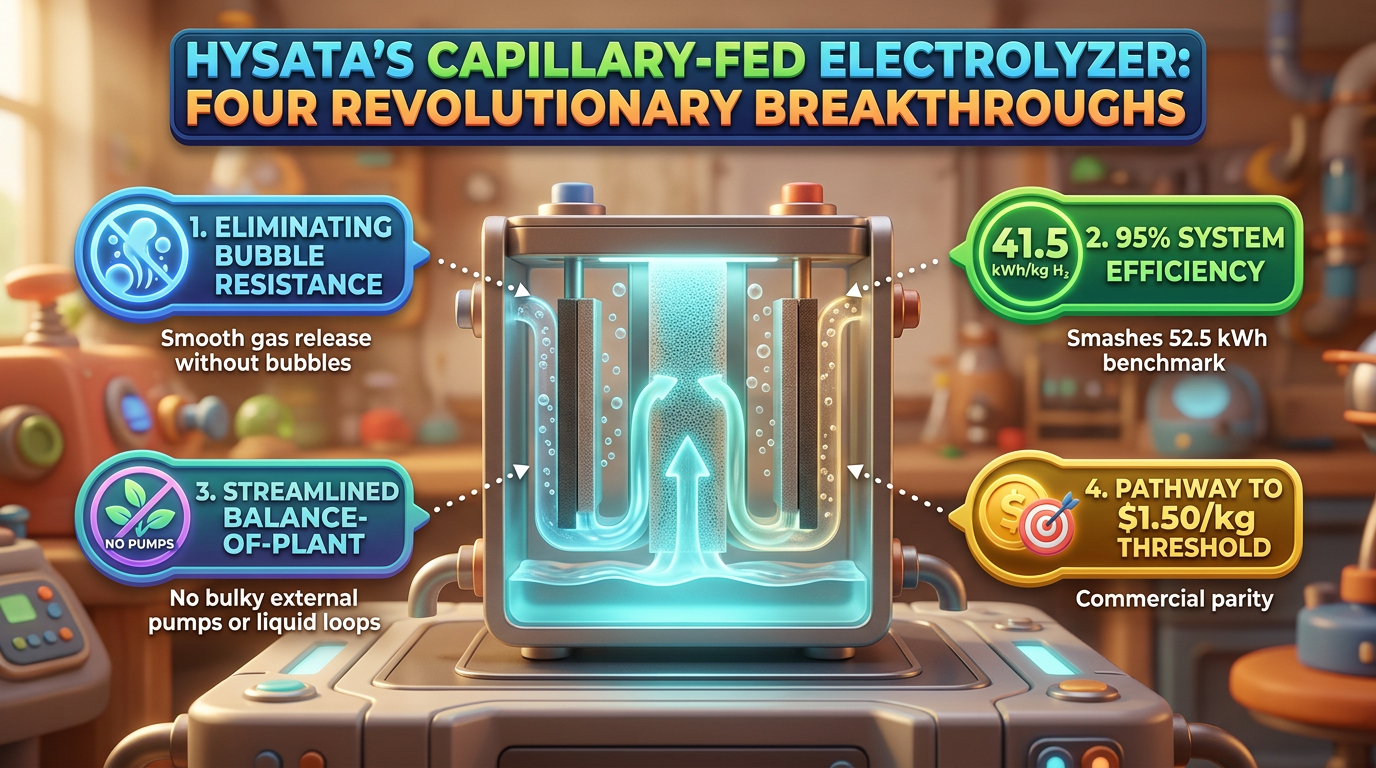
95% System Efficiency:
By removing parasitic bubble resistance, the capillary-fed system achieves 95% efficiency, consuming only ~41.5 kWh/kg H2 compared to the conventional ~52.5 kWh/kg benchmark.
Streamlined Balance-of-Plant (BoP):
Eliminating two-phase bubbly liquid flows allows engineers to strip out expensive external pumps, liquid circulation loops, and gas-liquid separators. This dramatically lowers both initial capital expenditure (CapEx) and ongoing operational drag.
Strategic Deployment and Market Outlook
Technological breakthroughs in electrolysis are already pairing with innovative renewable integration models worldwide:
Direct Offshore Wind & Marine Coupling:
In Germany, H2Mare is testing off-grid green hydrogen production by directly coupling electrolyzers to megawatt-scale offshore-capable wind turbines, complementing major regional initiatives like Ørsted’s "Green Fuels for Denmark" and Scotland’s Orkney Islands tidal-to-hydrogen energy network.
Pathway to the $1.50/kg Threshold:
Combining lower electricity consumption per kilogram with simplified balance-of-plant engineering pushes green hydrogen production closer to the commercial parity target of $1.50/kg. Backed by major Australian government and utility grants alongside a $111 million Series B funding round, this technology is now advancing into large-scale manufacturing.
Navigating Sector Headwinds:
While policy incentives such as the U.S. Inflation Reduction Act help narrow the cost gap against subsidized fossil fuels, the broader electrolyzer sector still contends with margin compression, market oversupply, and the urgent need for dedicated renewable power buildouts.
By pairing ultra-high-efficiency capillary electrolysis and direct solar water splitting with dedicated renewable infrastructure, green hydrogen is steadily overcoming its historical efficiency barriers—positioning itself as a cornerstone of our global zero-emission energy transition.
Powering Our World with Green Hydrogen:
From Global Mobility and Off-Grid Homes to Next-Generation Storage and Safety Engineering
By the Sustainable Energy Mission Team
Producing clean green hydrogen through advanced electrolysis is only the first half of the zero-emission equation. To replace fossil fuels in our daily lives, we must reliably deliver, store, and deploy this energy across the sectors that need it most. As part of our nonprofit’s Sustainable Energy rescue mission, Part 3 of our series explores how green hydrogen is actively transforming global transportation and off-grid living, how worldwide refueling networks and delivery pipelines operate, and the engineering breakthroughs solving hydrogen’s toughest storage and safety challenges.
Green Hydrogen in Action:
Transforming Global Mobility and Off-Grid Living
Because hydrogen packs roughly three times more energy by weight than gasoline and emits only pure water vapor when consumed in a fuel cell, it is uniquely suited for heavy-duty transport and remote power systems where battery weight or charging downtime is a barrier:
Buses and Heavy-Duty Trucks:
Municipal transit buses and long-haul freight trucks are leading commercial hydrogen adoption. While battery-electric trucks require massive, heavy battery packs and lengthy recharging stops, hydrogen fuel cell buses and trucks refuel in minutes and travel hundreds of miles without losing cargo capacity. Major regional initiatives, such as Ørsted’s "Green Fuels for Denmark" offshore wind project and Scotland’s Orkney Islands network, actively convert excess wind and tidal electricity into green hydrogen to fuel local bus and truck fleets.
Trains and Rail Networks:
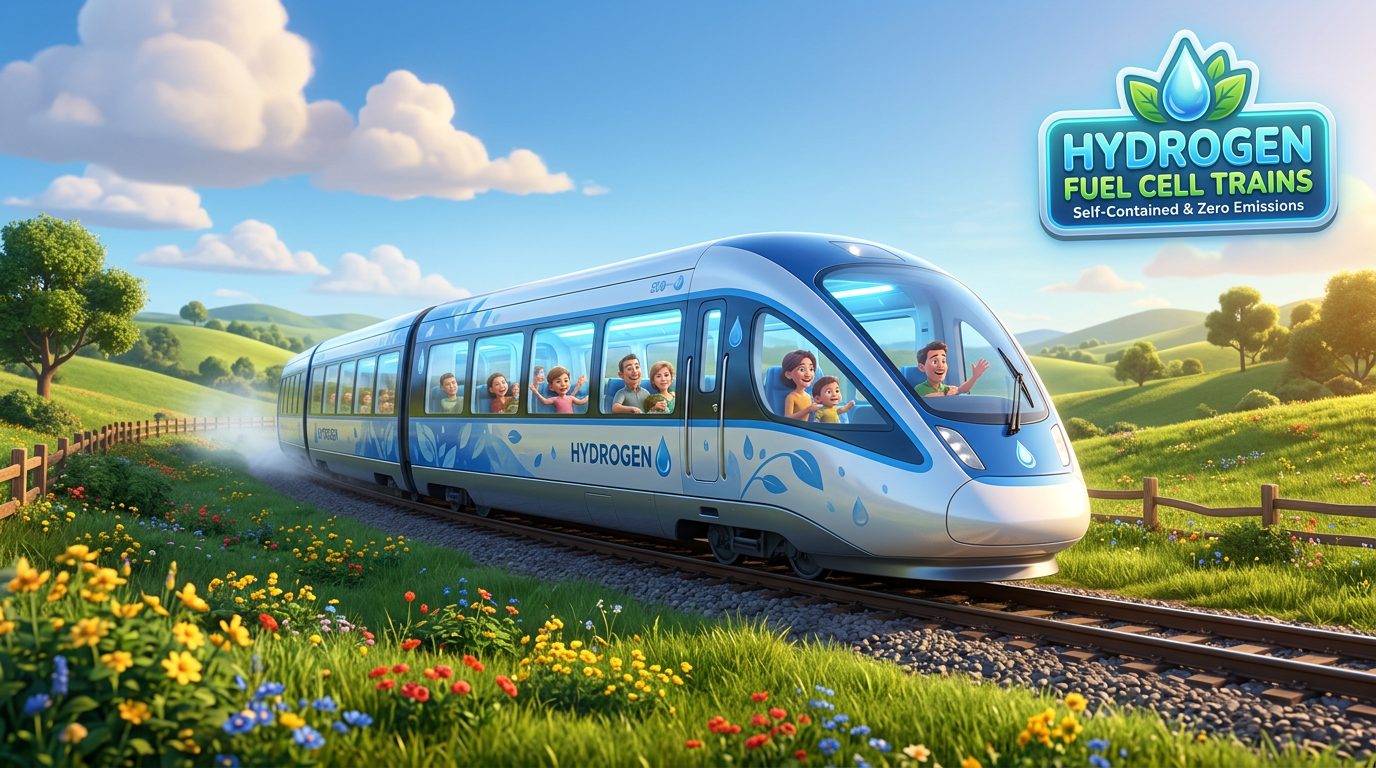
On non-electrified rail lines, hydrogen fuel cell trains (hydrail) are replacing polluting diesel locomotives. Instead of spending billions to install overhead electrical wires across rural tracks, rail operators deploy self-contained hydrogen trains that run silently with zero tailpipe emissions.
Ships, Ferries, and Submarines:
Global maritime shipping is one of the hardest sectors to decarbonize. Green hydrogen is now powering passenger ferries and maritime vessels through compressed fuel cells, chemical carriers like ammonia (tested in the ShipFC project), and solid hydrogen compounds (such as Amsterdam’s Neo Orbis ferry project). Beneath the waves, German fuel-cell submarines have successfully relied on solid-state metal hydride storage for silent, long-duration underwater propulsion.
Airplanes and Aviation:
Aviation requires ultra-lightweight fuel with high gravimetric energy density. Aerospace engineers are developing hydrogen-powered regional aircraft—such as the Green Fuels for Denmark aviation pathways—using liquid cryogenic hydrogen to power either modified jet turbines or high-output fuel cell electric propellers.
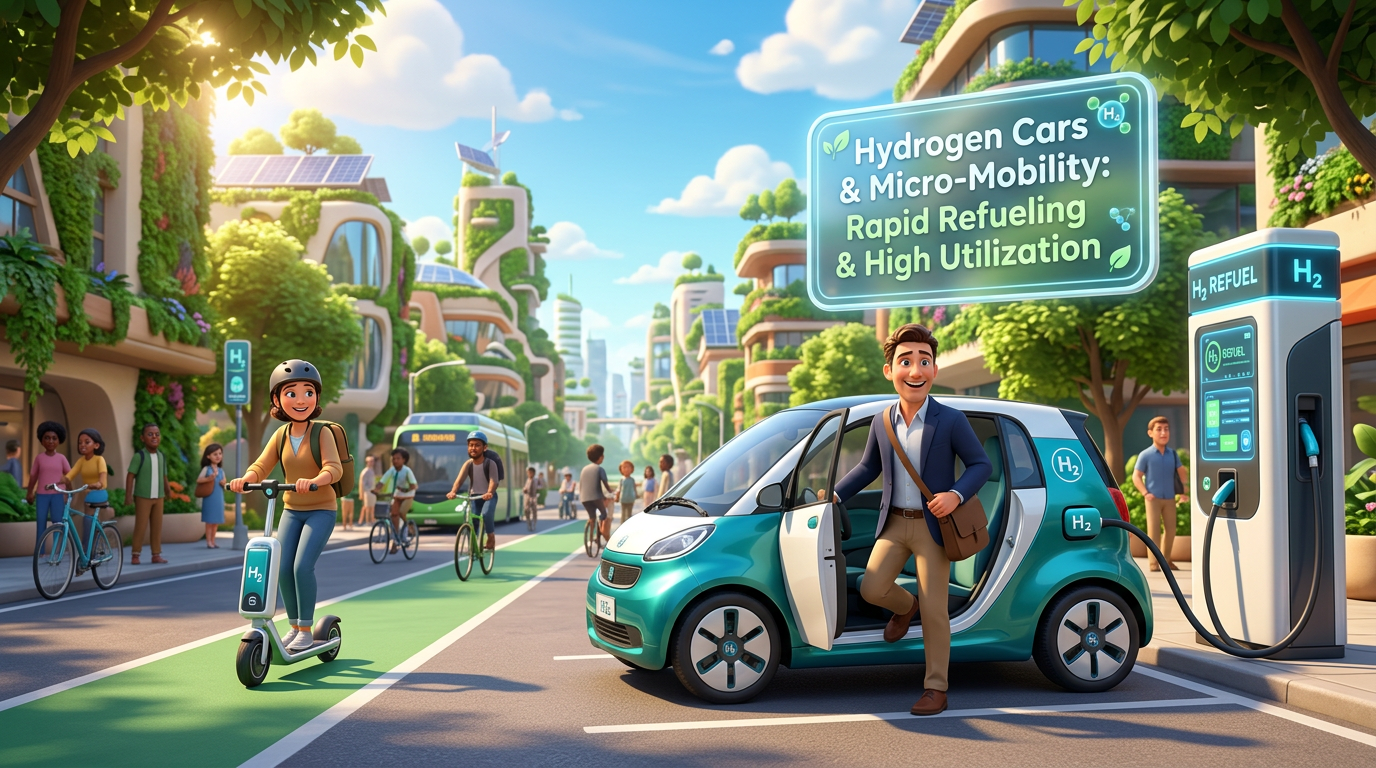
Passenger Cars and Micro-Mobility:
While battery-electric vehicles dominate light-duty consumer commuting due to higher round-trip grid efficiency, hydrogen fuel cell cars (and emerging cartridge-based micro-mobility scooters and utility vehicles) offer rapid refueling for high-utilization fleets, taxis, and regions lacking home-charging infrastructure.
Off-Grid Households and Community Microgrids:
Beyond mobility, green hydrogen serves as a seasonal battery and heat resource for remote, off-grid homes and critical facilities. During sunny summer days or windy seasons, excess solar and wind energy runs an onsite electrolyzer to generate hydrogen. That stored hydrogen provides year-round backup electricity and space heating—with waste heat recovered from the fuel cell and storage unit feeding directly into household hot water systems and boilers (as demonstrated in Alpine off-grid homes, Scotland's Orkney Islands, and European hospital microgrids).
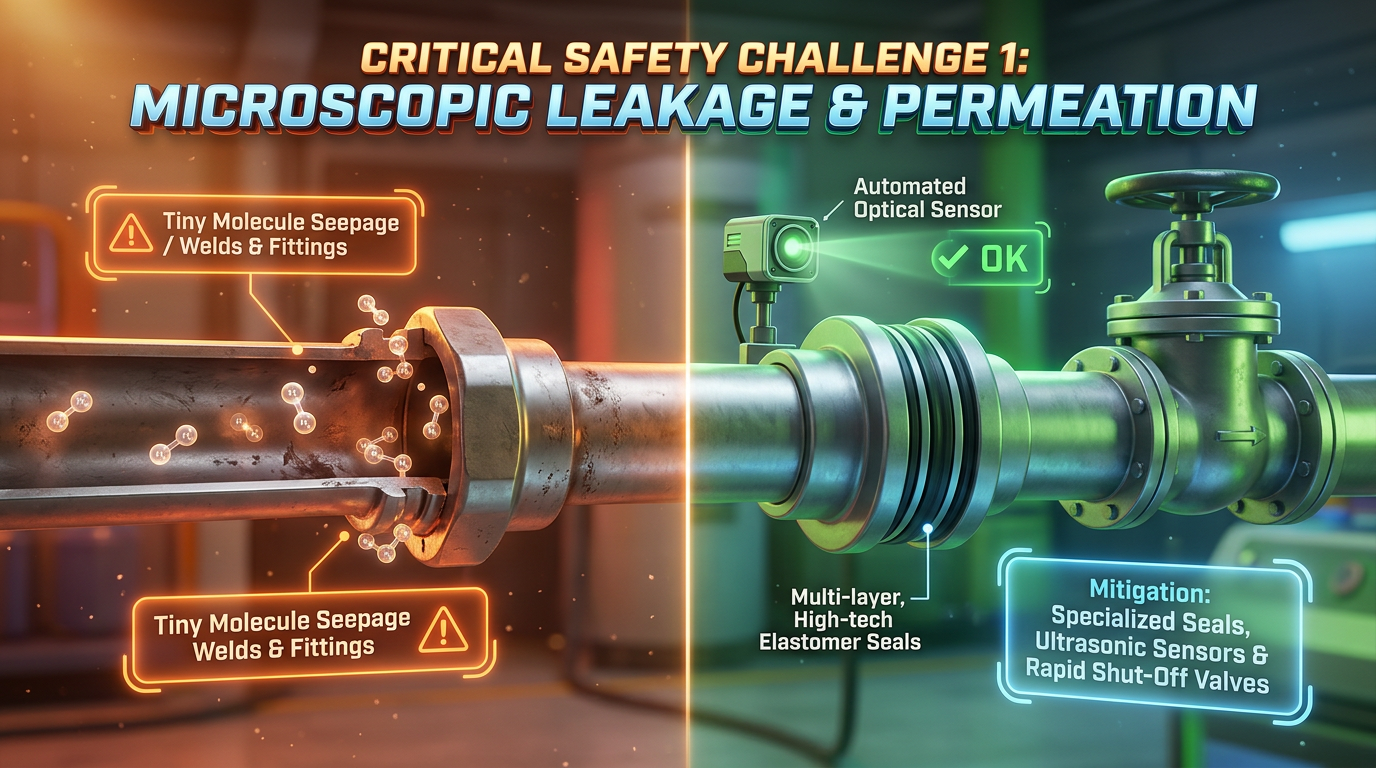
Microscopic leakage and permeation / AI image by Magnific.
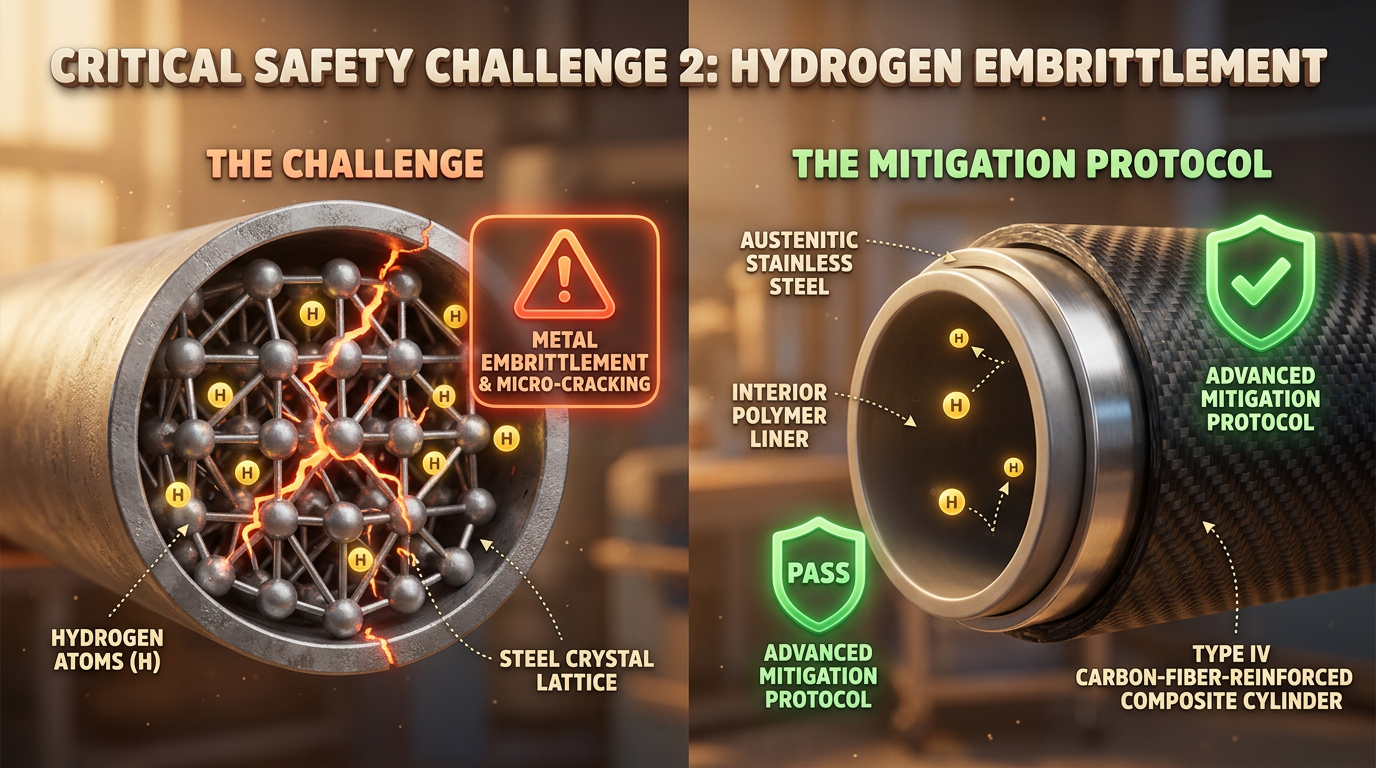
Hydrogen embrittlement of metals / AI image by Magnific.
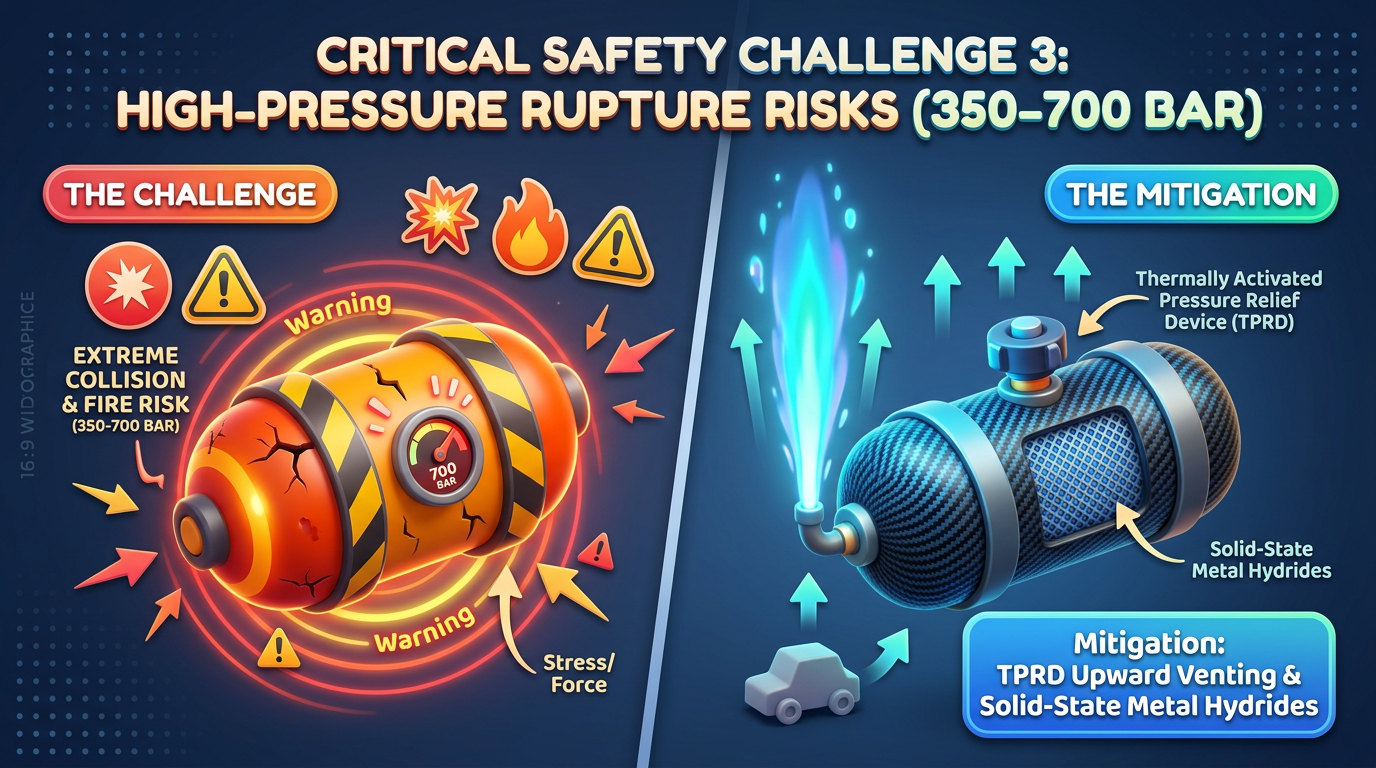
High-pressure rupture risks / AI image by Magnific.
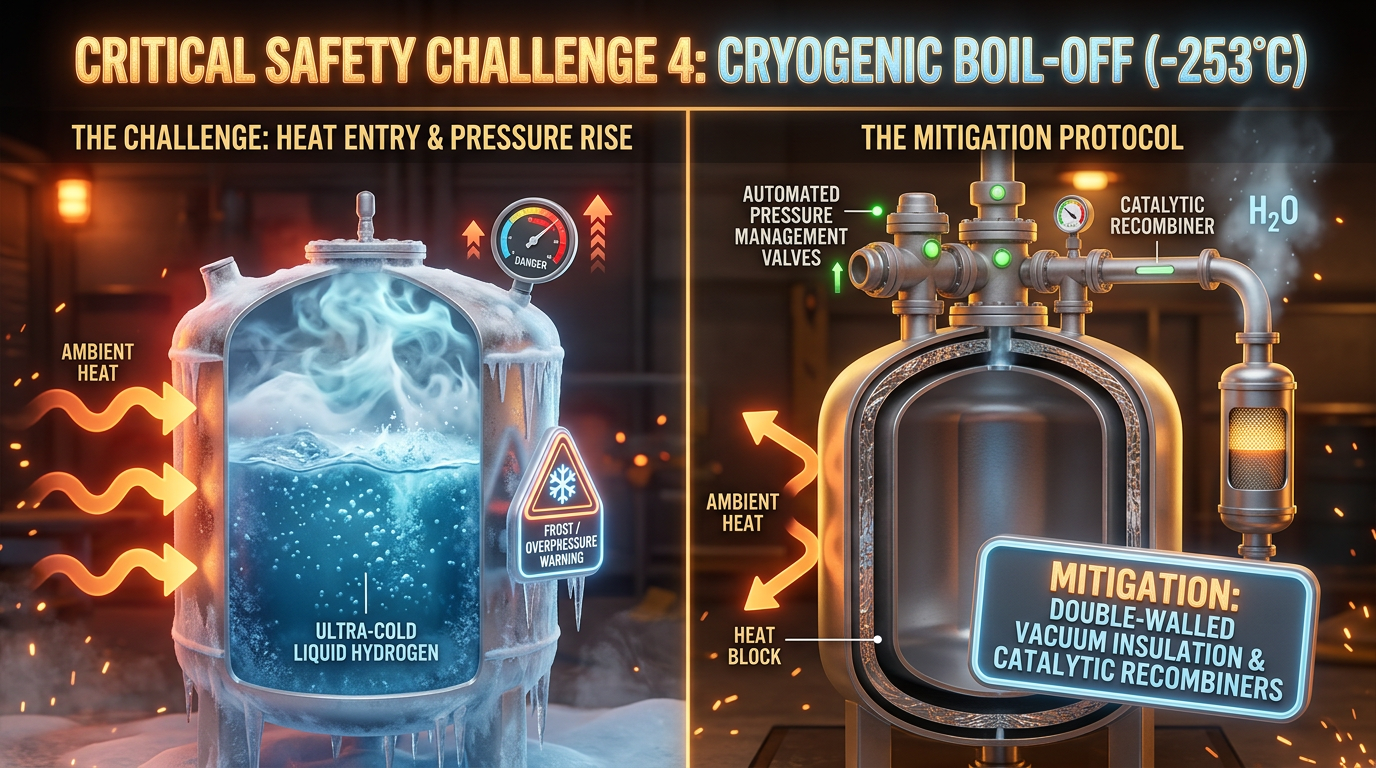
Cryogenic boil-off and thermal hazards / AI image by Magnific.
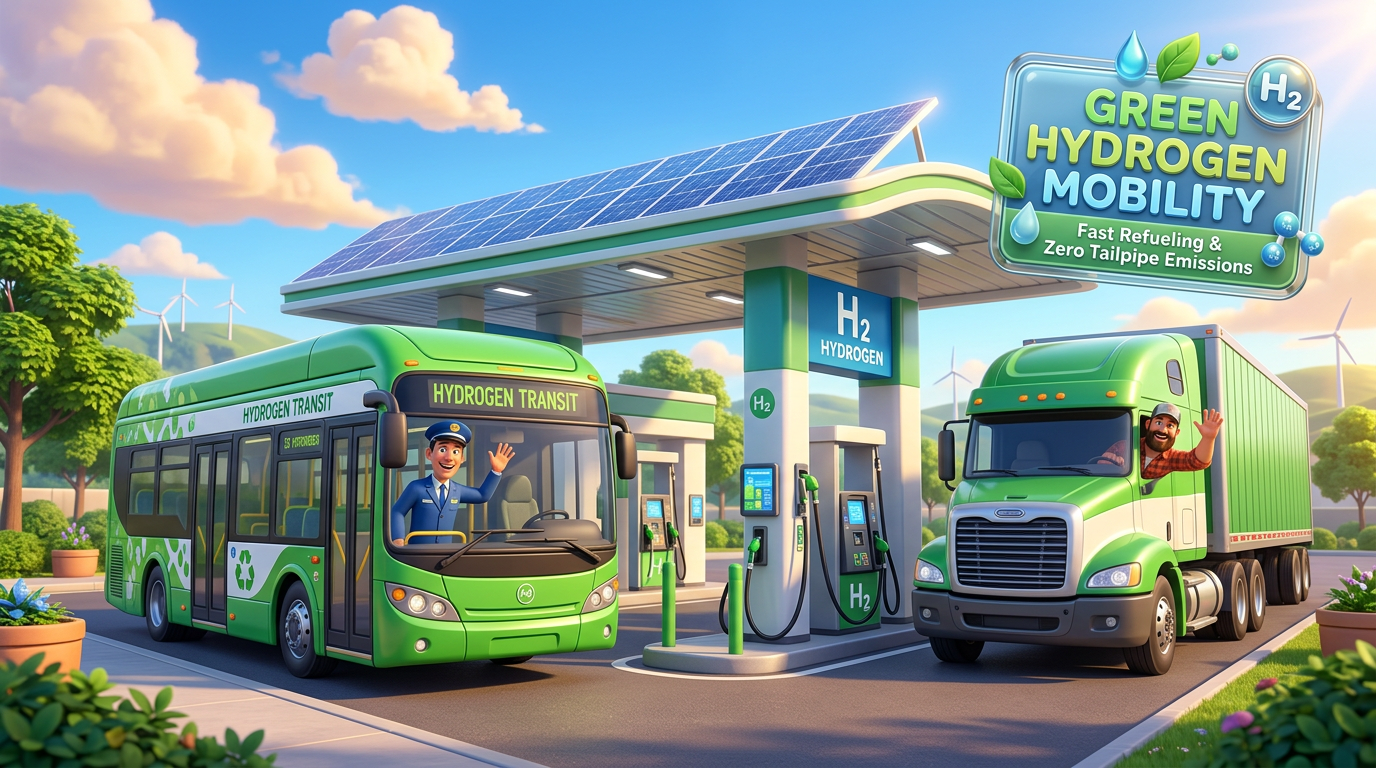
Hydrogen buses and heavy-duty trucks / AI image by Magnific.
Hydrogen aviation and aircraft / AI image by Magnific.
Global Delivery Logistics and Refueling Station Infrastructure
Because renewable hydrogen is often generated at remote solar farms or offshore wind arrays (such as Germany’s H2Mare direct wind-to-hydrogen turbine trials), bridging the gap between production sites and end-users requires a multi-tiered delivery and refueling network:
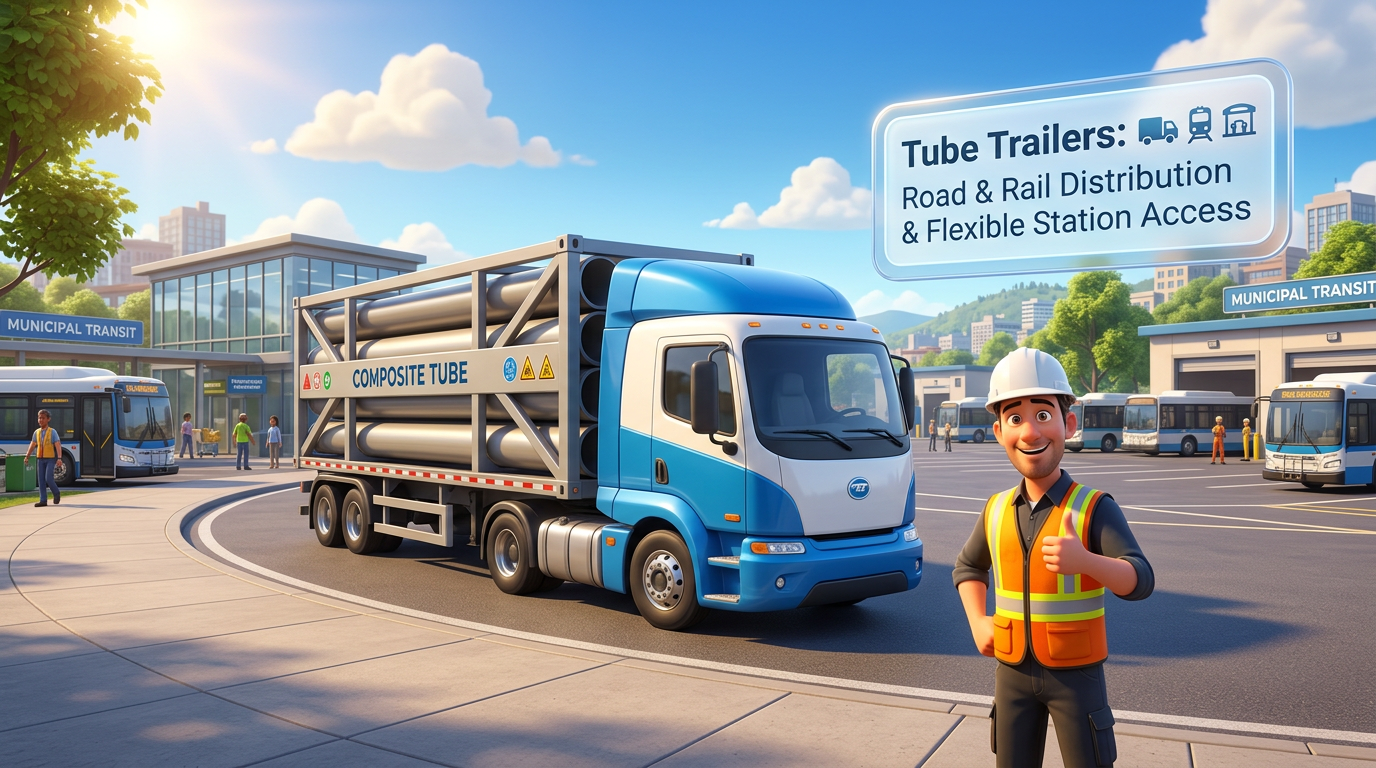
Hydrogen distribution via tube trailers / AI image by Magnific.
Tube Trailers (Road & Rail Distribution):
For local and medium-distance distribution, hydrogen is compressed into high-pressure cylindrical steel or composite tube trailers and trucked directly to municipal bus depots and public refueling stations. While flexible and widely used in regions like California to expand station access quickly, tube trailers carry limited volume per trip.
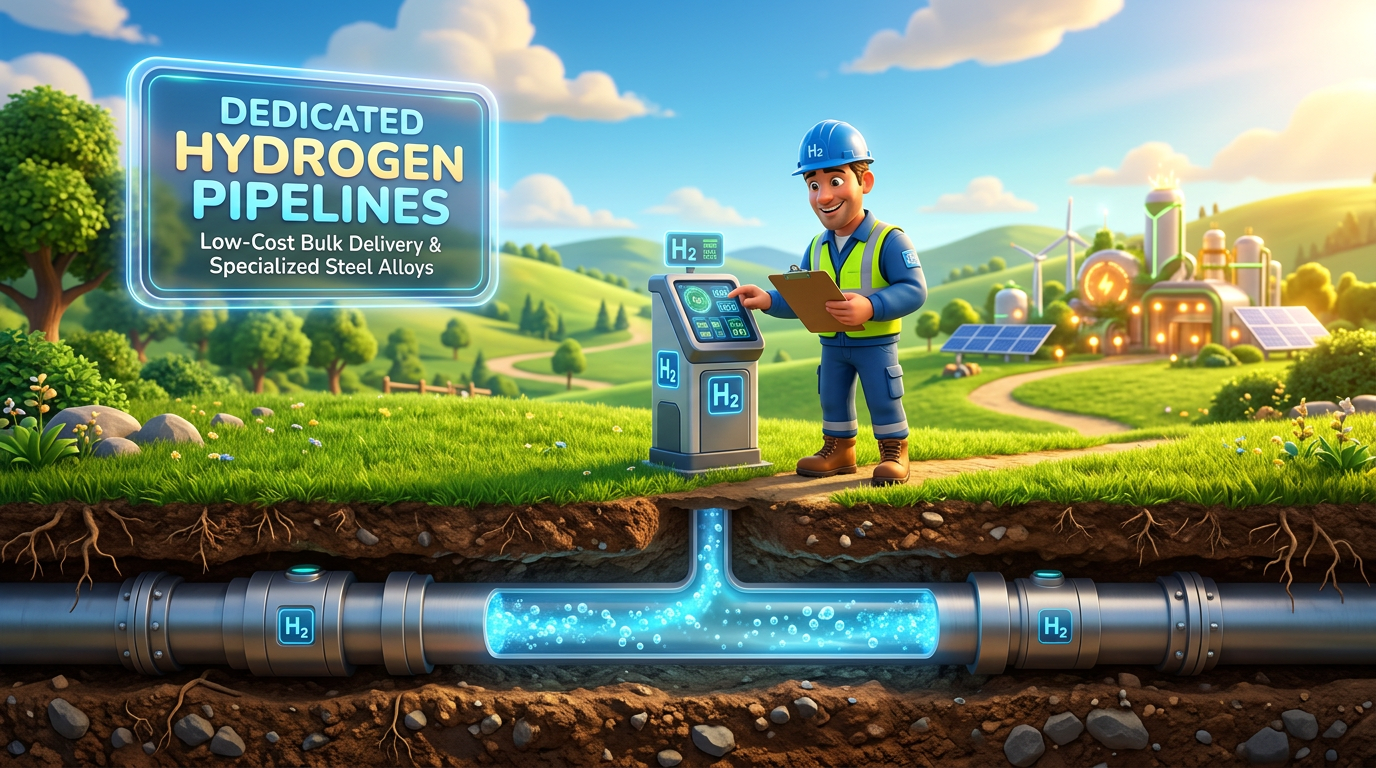
Dedicated hydrogen pipeline infrastructure / AI image by Magnific.
Dedicated Hydrogen Pipelines:
For short-to-medium regional corridors and industrial hubs, pipelines represent the lowest-cost bulk delivery method. However, standard natural gas pipes require specialized interior coatings or upgraded steel alloys to prevent hydrogen gas from degrading the metal.
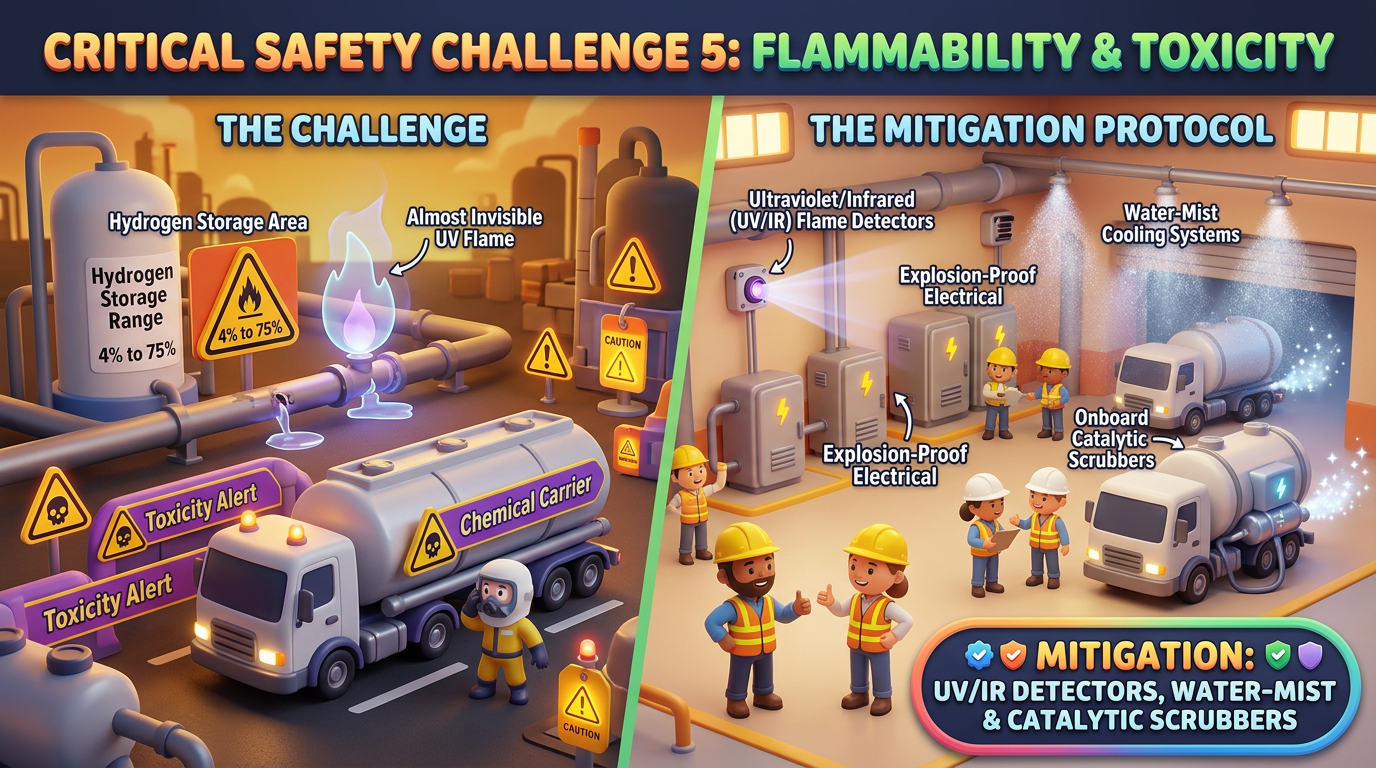
Flammability and chemical carrier toxicity / AI image by Magnific.
Hydrogen trains and rail networks / AI image by Magnific.
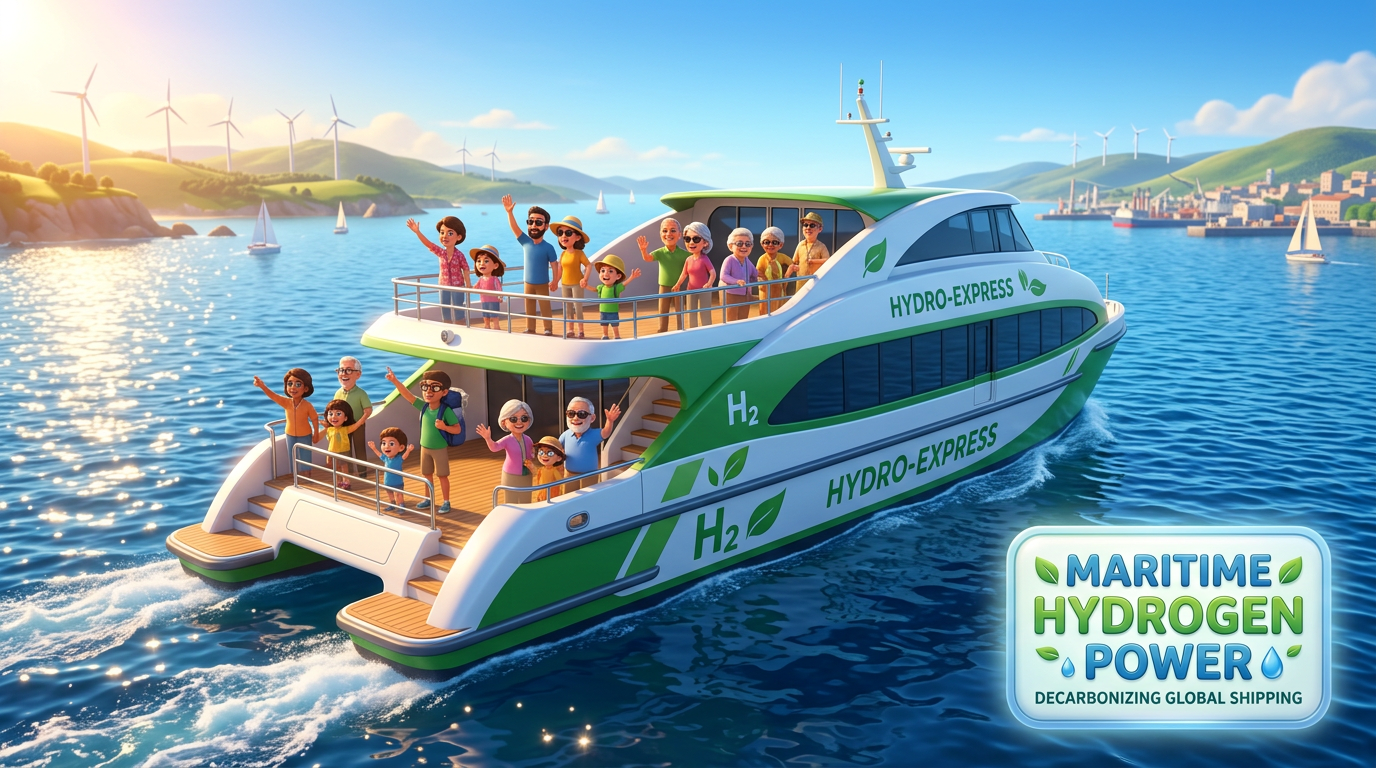
Hydrogen marine vessels and ferries / AI image by Magnific.
Hydrogen passenger cars and micro-mobility / AI image by Magnific.

Off-grid households and community microgrids / AI image by Magnific.
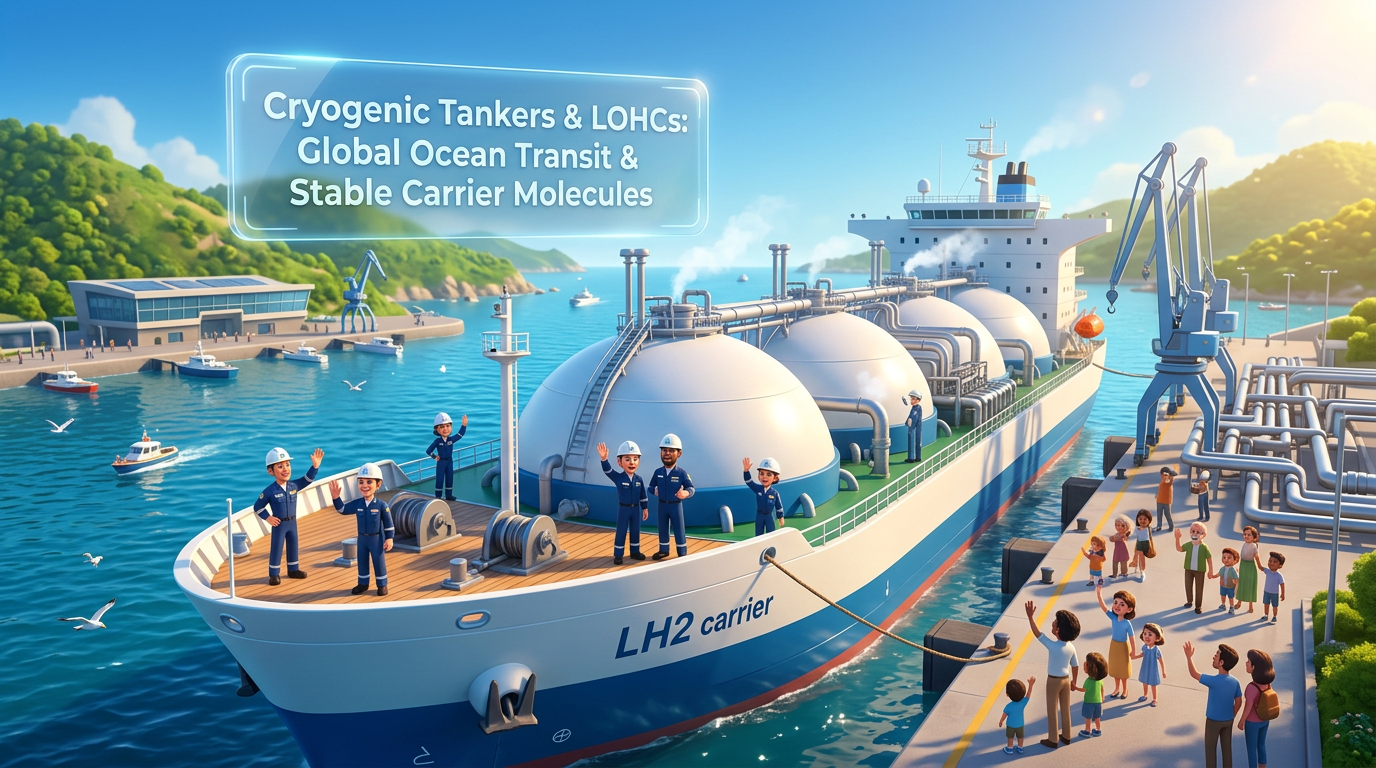
Cryogenic tankers and global shipping carriers / AI image by Magnific.
Cryogenic Tankers and Chemical Carriers (Global Shipping):
To move massive volumes of green hydrogen across oceans—such as Germany’s strategy to import green hydrogen from solar-rich partner nations—hydrogen is either super-cooled into liquid cryogenic ships or bound into stable Liquid Organic Hydrogen Carriers (LOHCs) and ammonia that can be pumped like conventional liquid fuels at ambient pressures.
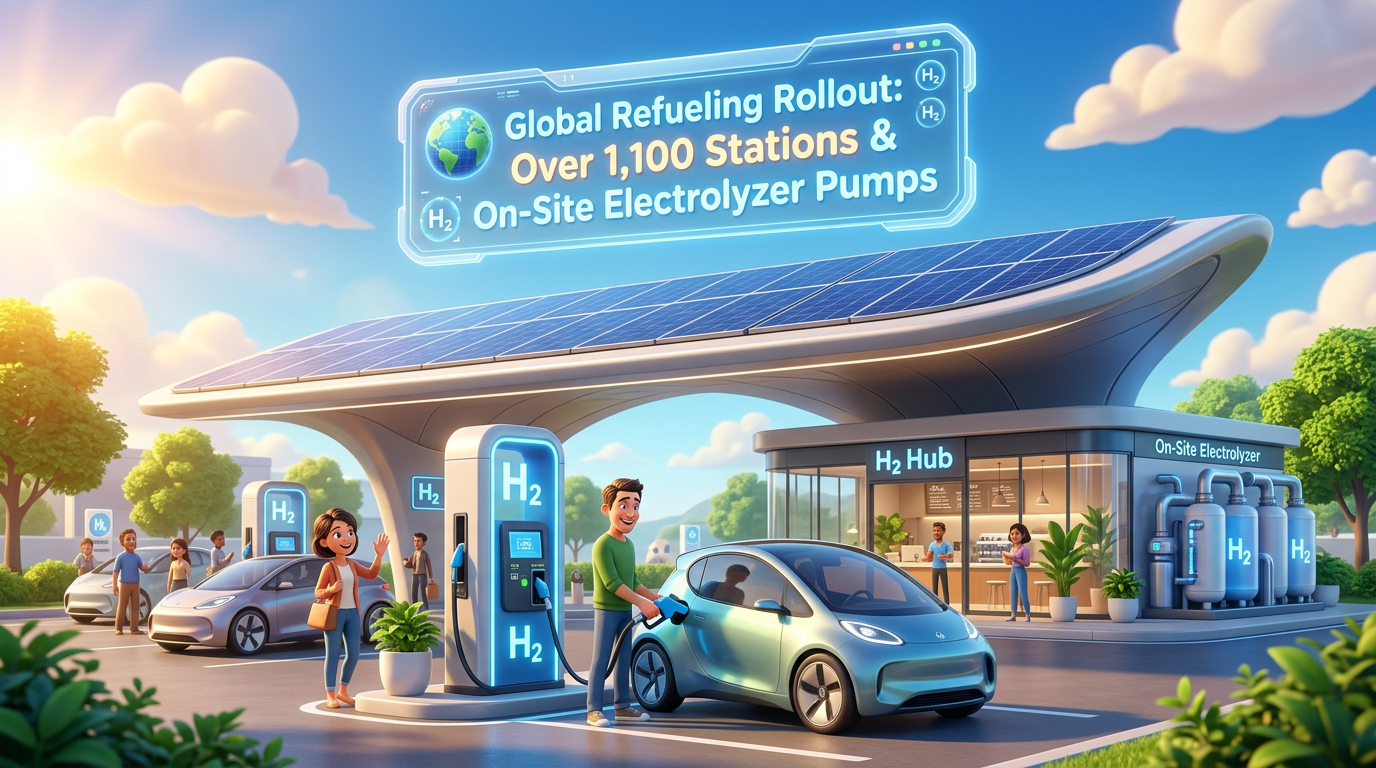
Global hydrogen refueling station rollout / AI image by Magnific.
Global Refueling Station Rollout:
Over 1,100 hydrogen refueling stations operate globally, concentrated heavily along freight and transit corridors in East Asia (Japan, South Korea, and China), Europe (led by Germany’s national hydrogen network and EU mandates requiring refueling hubs along major highway corridors), and North America (centered in California and emerging heavy-duty freight hubs). Furthermore, onsite electrolyzer refueling stations—which generate green hydrogen right at the pump using local solar or grid power—are rapidly expanding to eliminate trucking delivery bottlenecks altogether.
The Storage Challenge: Matching the Form to the Application
Because hydrogen is the smallest, lightest molecule in the universe, it has a very low volumetric density at room temperature. Storing enough hydrogen in a compact space requires specialized physical or material-based storage methods tailored to each use case:
| Storage Method | Storage Form & Conditions | Primary Applications | Key Advantages | Limitations |
|---|---|---|---|---|
| Compressed Gas | High-pressure gas cylinders at 350 to 700 bar (5,000–10,000 psi) | Passenger cars, transit buses, heavy-duty trucks, tube trailers | Mature, fast refueling; standard across commercial mobility | Bulky carbon-fiber reinforced tanks; requires compression energy |
| Cryogenic Liquid (LH2) | Super-cooled liquid at -252°C to -253°C in insulated vessels | Aviation (airplanes), bulk marine shipping, long-haul rail/trucks | High density (~70 kg/m3) without extreme pressure | Energy-intensive cooling; inevitable "boil-off" evaporation losses |
| Solid-State Metal Hydrides | Hydrogen atoms absorbed into a solid metal alloy crystal lattice at low pressure | Off-grid household storage, backup power, submarines, forklifts | Highest volumetric density (>80 kg/m3); inherently safe low pressure; zero boil-off | Heavy metal framework makes it too weighty for small passenger cars |
| Mechanochemical Paste (Powerpaste) | Room-temperature magnesium hydride (MgH2) paste in cartridges | Off-grid generators, light vehicles, portable/household backup | 1.9 kWh/L (10x lithium-ion density); unpressurized; reacts with water to double H2 yield | Requires cartridge swapping and magnesium hydroxide recycling loops |
| Chemical Carriers (LOHCs & Ammonia) | Chemically bound in liquid oils, ammonia, or boron nitride powder | Maritime shipping (ShipFC), international bulk transport | Stable transport at ambient or mild conditions without cryogenic cooling | Requires energy and catalysts at the destination to "crack" and release H2 |
Critical Safety Challenges and Engineering Mitigation Protocols
Deploying hydrogen safely across public roads, ports, and residential neighborhoods requires rigorous engineering to manage its unique physical properties. Below are the five primary safety challenges and the industry mitigation standards securing modern deployments:
1. Microscopic Leakage and Permeation
The Challenge: As the smallest molecule in existence, gaseous hydrogen can slip through tiny microscopic seals, welds, and fittings that would easily contain natural gas or propane.
Mitigation Implemented: Systems utilize specialized elastomeric and metal-to-metal seals, welded joint minimization, and automated ultrasonic and catalytic optical leak sensors. If a sensor detects even trace parts-per-million of hydrogen, automated shut-off valves immediately isolate the storage bank. Because hydrogen is 14 times lighter than air, outdoor and vented leaks rise and dissipate upward rapidly rather than pooling on the ground like gasoline vapors.
2. Hydrogen Embrittlement of Metals
The Challenge: Over time, individual hydrogen atoms can diffuse directly into the crystal lattice of standard steel pipelines and storage tanks—a phenomenon known as hydrogen embrittlement that causes metal to become brittle and crack under stress.
Mitigation Implemented: Engineers construct pipelines and pressure vessels using embrittlement-resistant austenitic stainless steels, interior polymer or aluminum liners, and Type IV carbon-fiber-reinforced composite cylinders.
3. High-Pressure Rupture Risks (350–700 Bar)
The Challenge: Storing gas at up to 700 times atmospheric pressure in vehicles and refueling stations introduces mechanical rupture hazards during severe collisions or fires.
Mitigation Implemented: Vehicle tanks are wrapped in multi-layer carbon fiber engineered to withstand ballistic impacts and extreme crush forces. Every cylinder is equipped with Thermally Activated Pressure Relief Devices (TPRDs)—if a fire occurs, the valve vents the hydrogen upward in a controlled manner before the tank structure can weaken. For household and indoor settings, high pressure is avoided entirely by utilizing low-pressure solid-state metal hydrides (such as GKN and Lavo systems) or unpressurized Powerpaste cartridges, which cannot explosively rupture.
4. Cryogenic Boil-Off and Thermal Hazards (-253°C)
The Challenge: Liquid hydrogen is so cold that direct contact causes severe cryogenic frostbite, and any ambient heat entering the tank causes the liquid to evaporate ("boil off"), gradually building internal pressure.
Mitigation Implemented: Cryogenic vessels use double-walled vacuum super-insulation paired with automated boil-off pressure management valves and catalytic recombiners that safely convert vented boil-off gas into harmless water vapor.
5. Flammability and Chemical Carrier Toxicity
The Challenge: Hydrogen gas has a wide flammability range in air and ignites with a nearly invisible ultraviolet flame. Additionally, certain alternative chemical carriers—such as sodium borohydride (NaBH4) or concentrated ammonia—pose skin and inhalation toxicity risks if spilled.
Mitigation Implemented: Facilities install ultraviolet/infrared (UV/IR) flame detectors, explosion-proof electrical components, water-mist cooling systems, and high-velocity roof ventilation. On ammonia-powered ships (ShipFC), onboard catalytic scrubbers prevent toxic ammonia or nitrogen oxide residues from escaping into the air. Meanwhile, for consumer and off-grid power, non-toxic alternatives like Fraunhofer’s magnesium Powerpaste and Class-0 boron nitride powders eliminate toxic chemical handling altogether.
Empowering a Safe, Zero-Emission Future
From transoceanic ships and zero-emission commuter trains to self-sufficient off-grid homes, green hydrogen is proving that no sector is beyond the reach of decarbonization. By combining ultra-efficient electrolysis with solid-state hydrides, mechanochemical pastes, and rigorous safety engineering, our global energy system can safely store and deliver clean power wherever humanity lives and travels.

The Circular Economy of a 10 GW Green Hydrogen Hub—
Monetizing Water, Oxygen, and Medical Co-Products for Financial Return and Community Stewardship
By the Sustainable Energy Mission Team
When energy executives and municipal planners evaluate green hydrogen, financial models too often treat electrolysis as a single-output expense—focusing solely on the Levelized Cost of Energy (LCOE) and capital expenditure (CapEx) required to produce hydrogen fuel. However, viewing green hydrogen strictly as a combustion or fuel-cell replacement overlooks one of its greatest strategic advantages: every stage of the green hydrogen lifecycle generates high-value, zero-emission co-products.
By splitting water with solar electricity and later recombining hydrogen in fuel cells, a green hydrogen hub operates as a closed-loop circular resource engine. At a 10 GW utility scale, valorizing the three core outputs of this cycle—Distilled Water (H2O), High-Purity Oxygen (O2), and Molecular Hydrogen (H2)—unlocks hundreds of millions of dollars in secondary revenue, offsets hydrogen production costs, and delivers transformative water, agricultural, and healthcare stewardship to surrounding communities.
The Stoichiometric Mass Balance of a 10 GW Solar Hydrogen Site
To understand the financial and community impact of a 10 GW green solar hydrogen facility, executives must examine the exact chemical mass balance across both production (electrolysis) and utilization (fuel cell power generation):
During Production (Electrolysis):
Splitting 9 kilograms (9 liters) of water (H2O) produces 1 kilogram of green hydrogen (H2) and 8 kilograms of high-purity oxygen (O2).
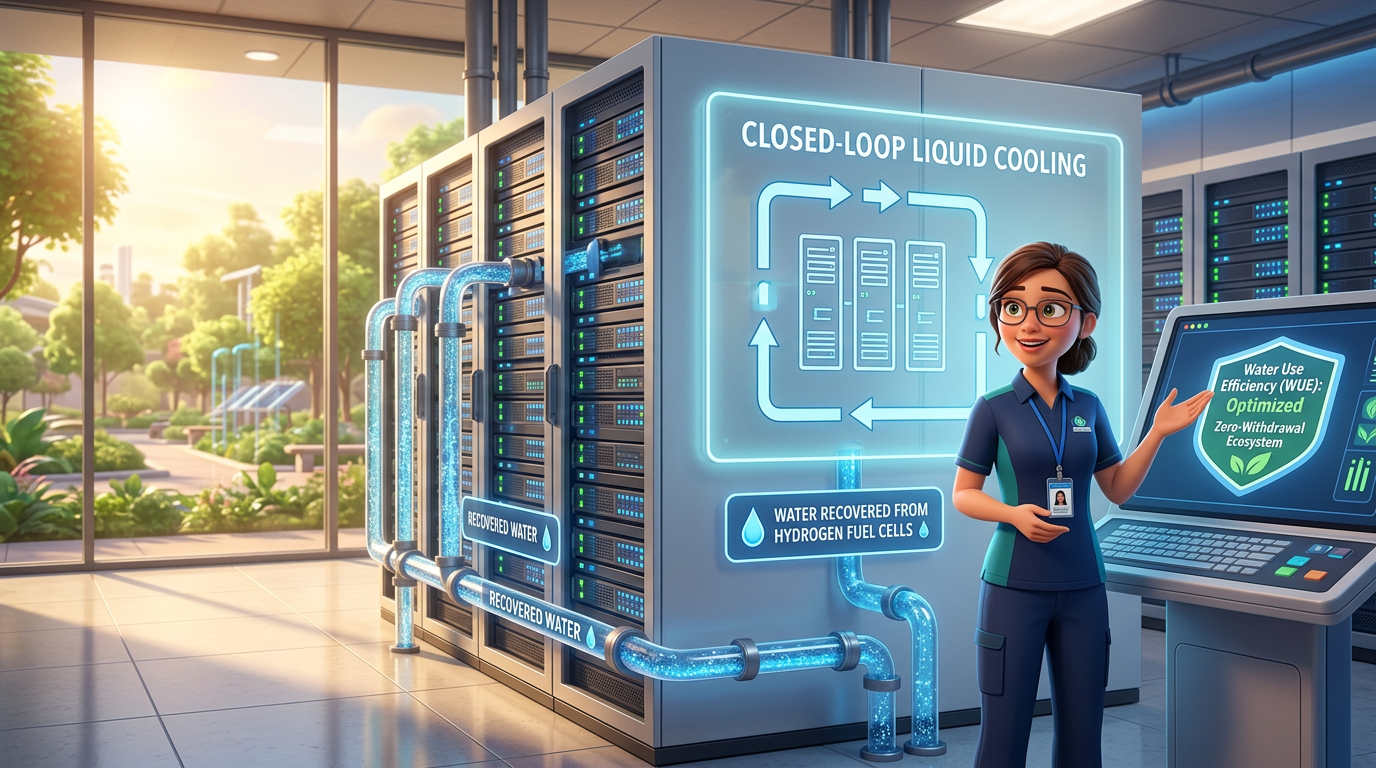
Closed-loop data center liquid cooling / AI image by Magnific.
During Utilization (Fuel Cell Recombination):
Consuming 1 kilogram of green hydrogen (H2) with 8 kilograms of oxygen generates clean electricity and heat while returning 9 kilograms (9 liters) of ultra-pure water (H2O).
Comparing conventional commercial electrolysis (~52.5 kWh/kg H2) against next-generation capillary-fed electrolysis (~41.5 kWh/kg H2) reveals the massive daily resource output of a 10 GW site under both Solar-Only Daylight Operation (assuming a 27% solar capacity factor, or 6.5 peak sun hours/day = 65,000 MWh/day) and 24/7 Continuous Baseload Operation (solar paired with wind/storage = 240,000 MWh/day):
| 10 GW Facility Operating Profile | Electrolysis Topology | Daily Green H2 Produced | Daily Byproduct Oxygen (O2) Generated | Daily Pure Water (H2O) Recovered via Fuel Cells |
|---|---|---|---|---|
| Solar-Only Daylight (6.5 hrs/day; 65 GWh) | Conventional (~52.5 kWh/kg) | 1,238 metric tons/day | 9,905 metric tons/day | 11,143 metric tons/day (11.14M Liters / 2.94M Gal) |
| Solar-Only Daylight (6.5 hrs/day; 65 GWh) | Capillary-Fed (~41.5 kWh/kg) | 1,566 metric tons/day | 12,530 metric tons/day | 14,096 metric tons/day (14.10M Liters / 3.72M Gal) |
| 24/7 Baseload Hybrid (24 hrs/day; 240 GWh) | Conventional (~52.5 kWh/kg) | 4,571 metric tons/day | 36,571 metric tons/day | 41,143 metric tons/day (41.14M Liters / 10.87M Gal) |
| 24/7 Baseload Hybrid (24 hrs/day; 240 GWh) | Capillary-Fed (~41.5 kWh/kg) | 5,783 metric tons/day | 46,265 metric tons/day | 52,048 metric tons/day (52.05M Liters / 13.75M Gal) |
Byproduct #1: Ultra-Pure Water (H2O) Recovery and Community Water Security
When green hydrogen produced by a 10 GW solar hub is utilized in stationary fuel cells to power industrial campuses, data centers, or regional microgrids, the chemical exhaust is not toxic smoke—it is 11.1 million to 52.0 million liters per day of pure, deionized water.
In water-stressed regions where desalination or municipal water withdrawal is a contentious ESG issue, capturing fuel-cell water turns an energy facility into a net water steward across three critical sectors:
Closed-Loop Facility and Data Center Liquid Cooling:
Modern AI and cloud computing data centers—as well as the power electronics within electrolysis and fuel-cell plants—require massive volumes of ultra-pure cooling water to prevent mineral scaling and corrosion in heat exchangers. Because water recovered from hydrogen fuel cells is inherently distilled and free of dissolved minerals, it can be routed directly into facility cooling loops and data center liquid-cooling towers. This creates a zero-water-withdrawal cooling ecosystem, sparing local aquifers from industrial depletion.
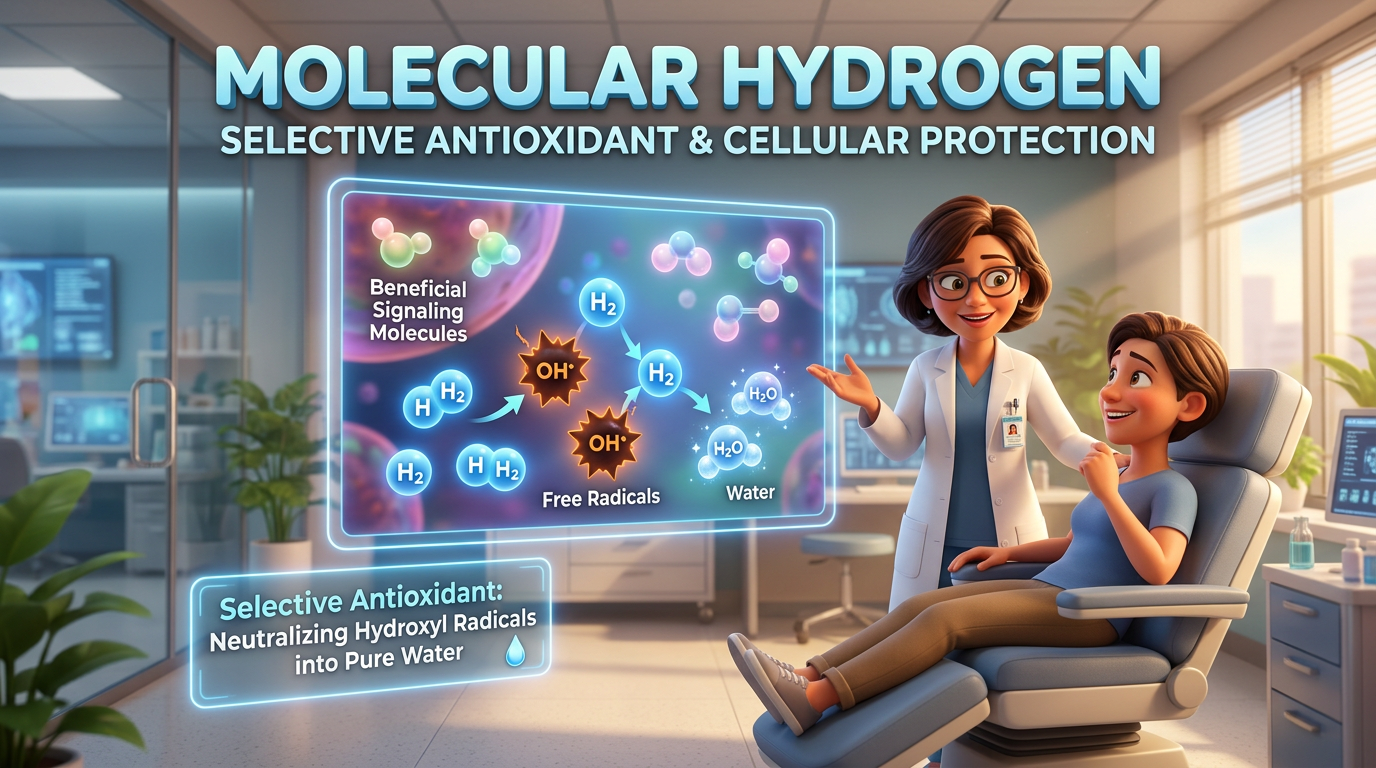
Selective antioxidant and cellular protection / AI image by Magnific.
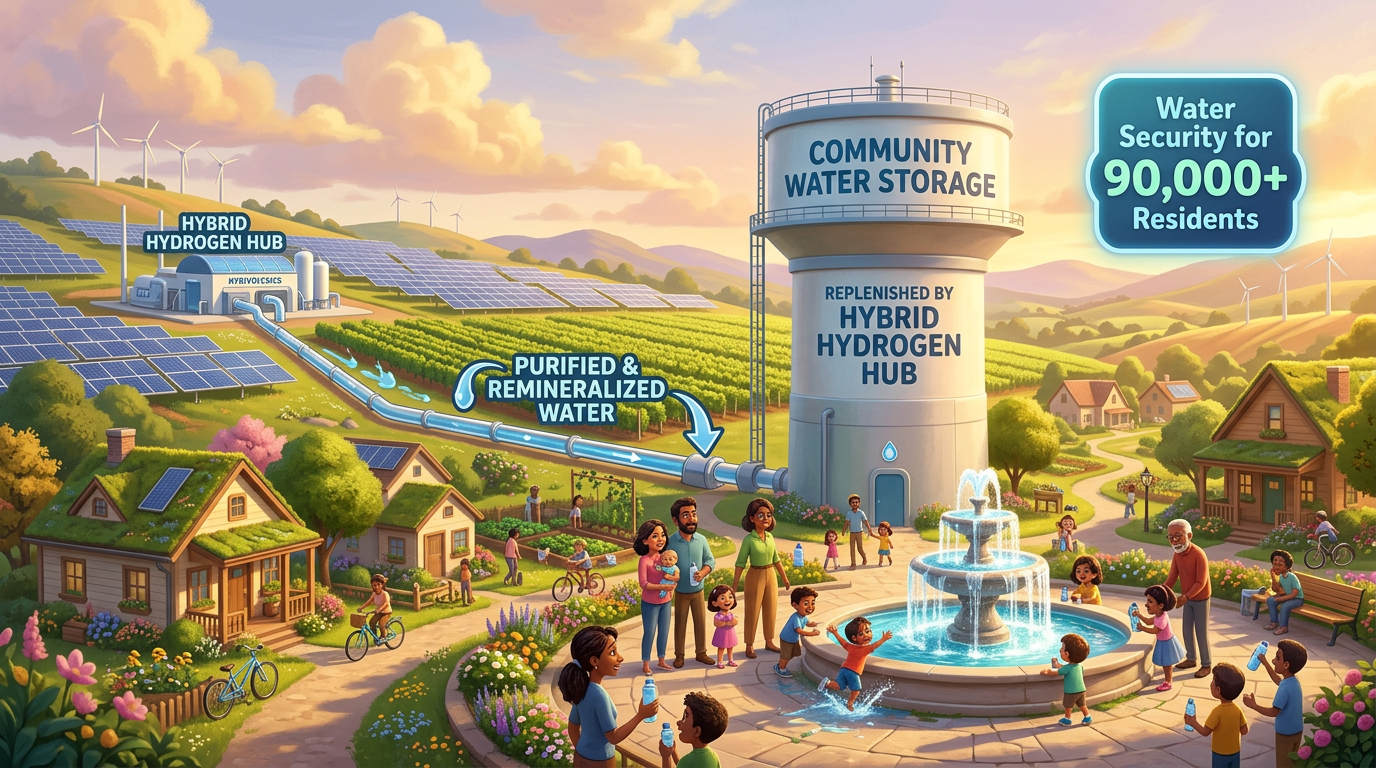
Local community water storage replenishment / AI image by Magnific.
Replenishing Local Community Water Storage:
At 14.1 million liters per day (solar-only baseline) to 52.0 million liters per day (24/7 baseline), a 10 GW hydrogen utilization hub generates enough pure water to meet the daily domestic drinking and sanitation needs of 90,000 to 340,000 residents (based on 150 liters per person per day). After standard post-treatment remineralization, this water can be fed directly into municipal storage reservoirs to strengthen regional water resilience.
Byproduct #2: High-Purity Oxygen (O2) Monetization
Historically, many green hydrogen projects have simply vented byproduct oxygen into the atmosphere. Yet electrolysis produces eight times more oxygen by weight than hydrogen—yielding 9,905 to 12,530 metric tons of ultra-pure O2 every single day on a solar-only schedule (and up to 46,265 metric tons/day at 24/7 capacity).
Capturing, compressing, and monetizing this oxygen transforms project economics and supports vital regional infrastructure:
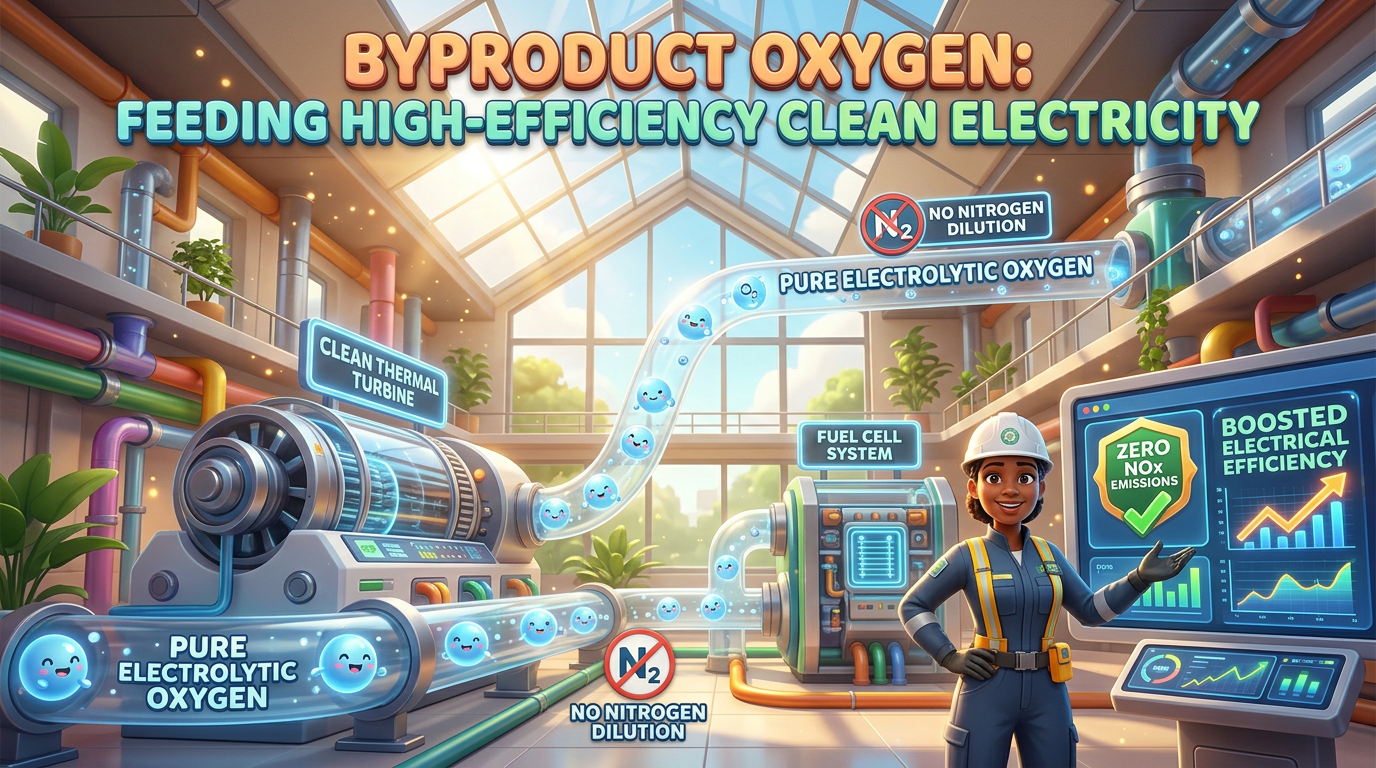
High-efficiency clean electricity generation / AI image by Magnific.
Feeding High-Efficiency Clean Electricity Generation:
Instead of feeding ambient air (which is 78% nitrogen) into stationary fuel cells or clean thermal turbines, routing pure electrolytic oxygen back into oxy-fuel power generation and closed-loop fuel cells significantly boosts electrical conversion efficiency. Eliminating nitrogen dilution increases flame and reaction temperatures, reduces equipment footprint, and completely eliminates toxic nitrogen oxide (NOx) emissions.
Selective Antioxidant and Cellular Protection:
Unlike conventional antioxidants that can indiscriminately block beneficial cellular signaling molecules, molecular hydrogen acts as a selective antioxidant. Clinical research (supported by over 1,500 peer-reviewed biomedical studies) demonstrates that H2 selectively neutralizes only the most cytotoxic free radicals—specifically hydroxyl radicals (⋅OH) and peroxynitrite (ONOO−)—converting them harmlessly into water inside the cell while preserving normal metabolic function.
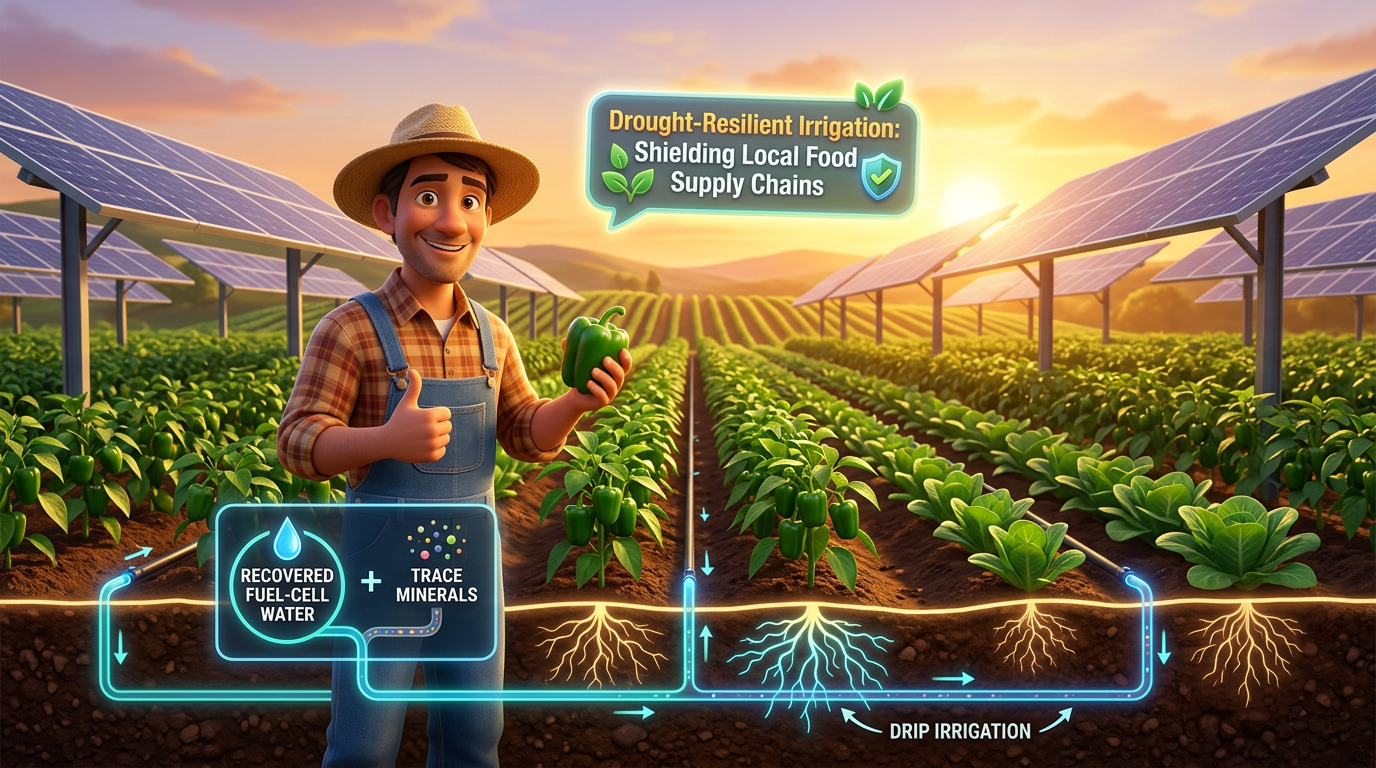
Drought-resilient farmland irrigation / AI image by Magnific.
Drought-Resilient Irrigation for Nearby Farmland:
Agricultural regions adjacent to solar-hydrogen hubs frequently compete with energy facilities for groundwater. By blending recovered fuel-cell water with trace agricultural minerals, a 10 GW solar-only site generating 14.1 million liters of water daily can supply precision drip irrigation across thousands of hectares of neighboring farmland, shielding local food supply chains against seasonal droughts.
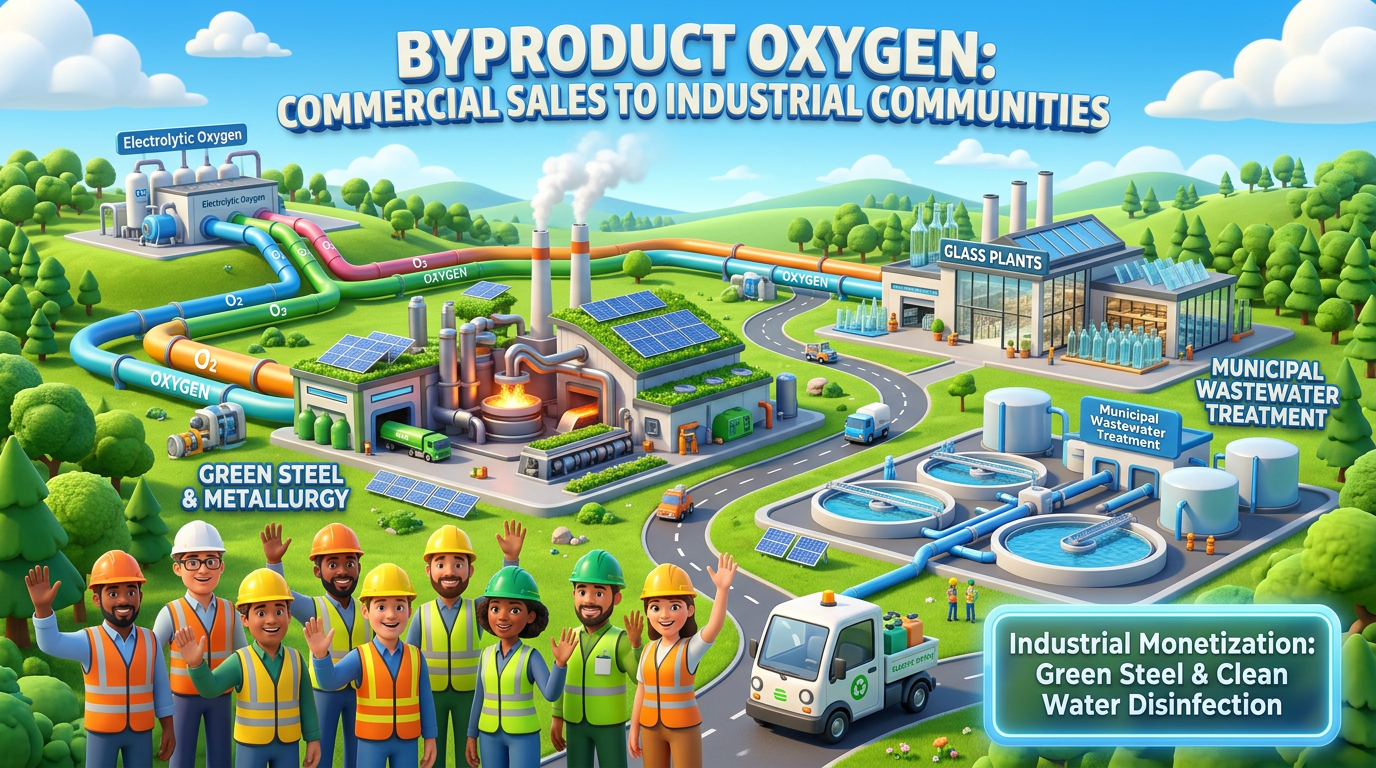
Commercial sales to industrial communities / AI image by Magnific.
Commercial Sales to Nearby Industrial Communities:
Heavy industries surrounding an energy hub require vast quantities of oxygen typically produced via energy-intensive cryogenic air separation units. Electrolytic oxygen can be piped or trucked directly to:
o Green Steel & Metallurgy: Feeding electric arc furnaces and smelting operations to cut fuel consumption.
o Chemical, Glass, and Cement Plants: Enhancing high-temperature furnace efficiency and enabling clean carbon capture.
o Municipal Wastewater Treatment & Aquaculture: Using pure O2 for biological aeration and ozone (O3) water disinfection, accelerating sewage treatment while lowering municipal power bills.
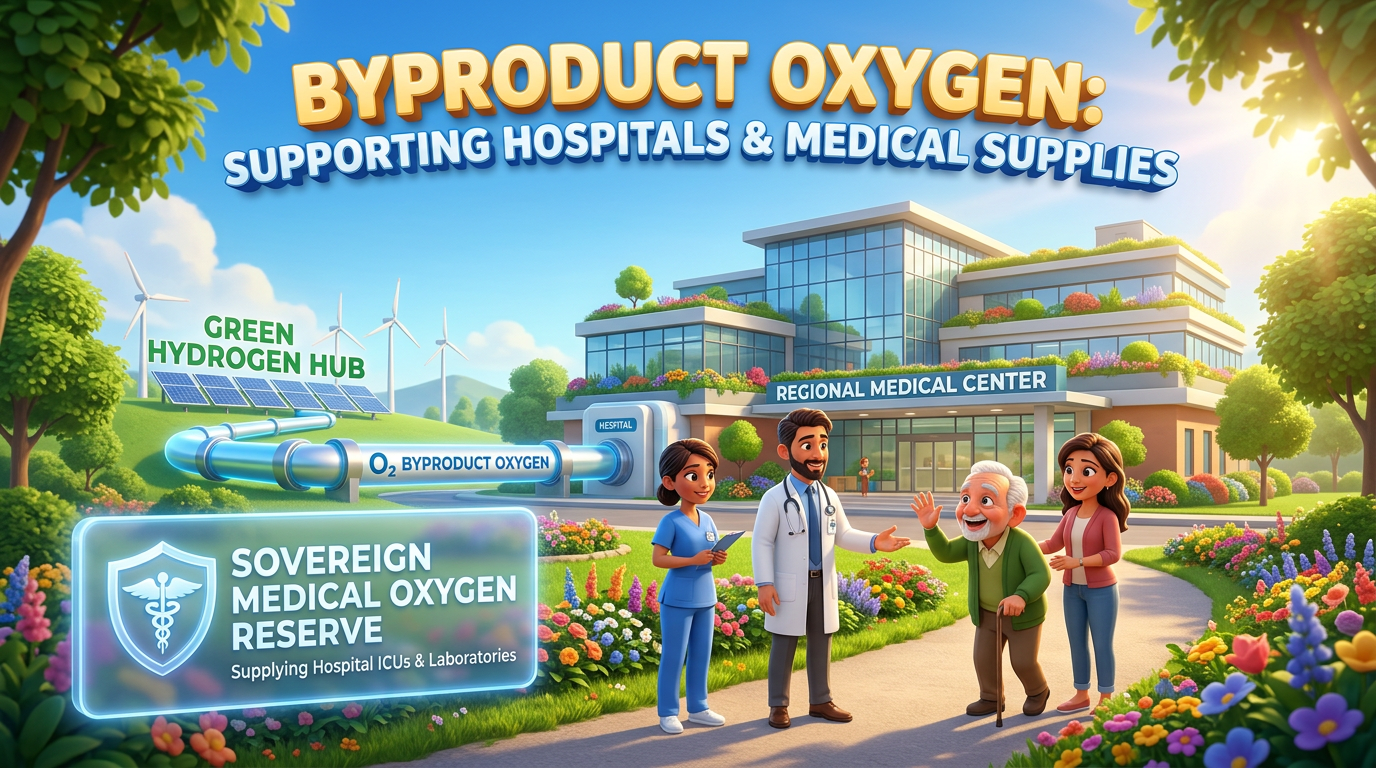
Supporting hospitals and medical supplies / AI image by Magnific.
Supporting Hospitals, Laboratories, and Medical Supplies:
Electrolysis naturally produces high-purity oxygen free from atmospheric hydrocarbons. As demonstrated in real-world European deployments like the Viamed San José hospital in Murcia, Spain—where onsite solar panels power an electrolyzer and the byproduct oxygen is captured directly for clinical patient procedures—regional green hydrogen hubs can serve as a sovereign medical oxygen reserve. A fraction of the daily oxygen output from a 10 GW hub can supply every hospital ICU ventilator, surgical anesthesia system, hyperbaric chamber, and scientific laboratory across an entire nation.
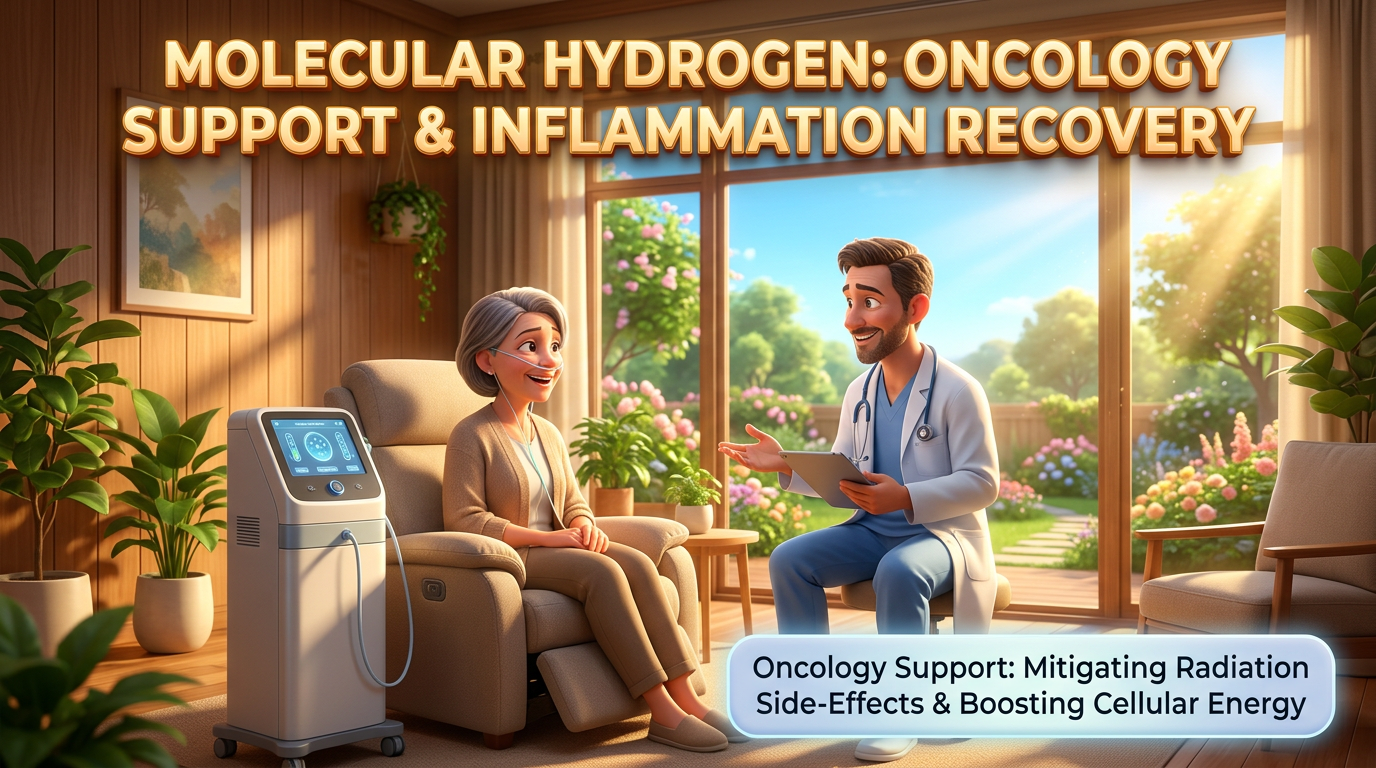
Oncology support and anti-inflammatory recovery / AI image by Magnific.
Oncology Support, pH Balance, and Anti-Inflammatory Recovery:
In oncology and critical care, molecular hydrogen inhalation and hydrogen-enriched medical saline are studied as adjunct therapies to mitigate severe oxidative organ damage and inflammation caused by radiation therapy and chemotherapy, while supporting blood acid-base homeostasis and mitochondrial ATP energy production.
Executive Financial Summary: How Byproduct Valorization Drives ROI
For institutional investors, utility executives, and government partners, integrating byproduct valorization fundamentally changes the balance sheet of a 10 GW green hydrogen deployment:
| Value Stream | Daily Output (10 GW Solar-Only Capillary Site) | Market / Cost-Offset Benchmark | Strategic Financial & ESG Impact |
|---|---|---|---|
| Primary Product: Green Hydrogen (H2) | 1,566 metric tons/day (~571,600 tons/year) | Target production parity: ~$1.50/kg | Decarbonizes heavy transport, shipping, aviation, and seasonal grid storage. |
| Medical & Specialty H2 Allocation | < 1% of total output (Ultra-high purity 99.999%) | High-margin medical & laboratory gas pricing | Supplies hospitals, neurology clinics, and biotech labs with therapeutic H2. |
| Byproduct: Pure Oxygen (O2) | 12,530 metric tons/day (~4.57 million tons/year) | $0.10 to $0.20+/kg bulk industrial; $1.00–$3.00+/kg medical grade | Selling or utilizing O2 can offset ~$0.80 to $1.09 per kg of H2, slashing effective hydrogen LCOE below fossil gas. |
| Byproduct: Pure Water (H2O) via Fuel Cells | 14,096 metric tons/day (14.1M Liters/day) | Eliminates desalination & deionized water CapEx/OpEx | Provides free zero-mineral cooling water for data centers, drought irrigation for farms, and potable community storage. |
Stewardship That Pays for Itself
4. Product #3: Molecular Hydrogen (H2) in Advanced Medicine and Healthcare
While green hydrogen is widely recognized for zero-emission transportation, industrial heat, and microgrid storage, molecular hydrogen (H2) itself is emerging as a breakthrough therapeutic resource in clinical medicine and biotechnology.
Because H2 is the smallest, lightest molecule in the universe and is electrically neutral, it possesses unique biophysical capabilities inside the human body that larger pharmaceutical molecules cannot match:

Crossing the blood-brain barrier / AI image by Magnific.
Crossing the Blood-Brain Barrier for Neurological Care:
Because of its microscopic molecular size, inhaled or dissolved H2 rapidly diffuses across cell membranes, enters mitochondria, and crosses the blood-brain barrier. Medical centers and neurology clinics are actively utilizing molecular hydrogen therapy to reduce neuroinflammation and cellular apoptosis following ischemic stroke, traumatic brain injury (TBI), cardiac arrest, and neurodegenerative conditions such as Alzheimer’s and Parkinson’s disease.
Transitioning to green hydrogen is no longer a trade-off between environmental responsibility and financial viability. When designed as an integrated circular ecosystem, a utility-scale solar hydrogen hub does far more than generate clean fuel: it monetizes millions of tons of industrial and medical oxygen, powers hospitals with life-saving clinical gases, cools next-generation data centers without depleting local rivers, and returns millions of liters of pure water each day to local farmers and families.
Financial Investment & Economic Impact Analysis:
10 GW Green Hydrogen Plant Deployment
By the Sustainable Energy Mission Team
Transitioning our global energy architecture away from fossil fuels requires strategic capital deployment into utility-scale production hubs. When evaluating a 10 GW Green Hydrogen Plant, traditional economic models often analyze capital expenditures in isolation. However, incorporating co-product valorization (water and oxygen recovery) and global government incentive structures fundamentally transforms project economics. This executive review provides an exhaustive financial breakdown, global policy comparison, and growth trajectory analysis to demonstrate how green hydrogen serves as a cornerstone for both zero-emission energy transitions and next-generation AI infrastructure.
Executive Introduction: Co-Product Savings, Revenue Streams, and Policy Catalysts
Building a utility-scale 10 GW green hydrogen facility requires significant upfront capital, but it establishes a multi-revenue-stream bio-industrial asset:
Byproduct Revenue & Cost Offsets:
Electrolysis and subsequent fuel-cell utilization do not just yield clean fuel; they generate massive volumes of high-purity oxygen (O2) and deionized water (H2O). Monetizing medical and industrial oxygen, alongside supplying zero-mineral cooling water to adjacent AI data centers and agricultural irrigation, captures millions of dollars in secondary revenue.
Global Policy Incentives:
Governments worldwide are accelerating green hydrogen deployment through capital production tax credits (such as the U.S. Section 45V IRA credits), European Important Projects of Common European Interest (IPCEI) funding, Australia’s Hydrogen Headstart grants, and China’s national R&D subsidies. These financial instruments bridge the early-market cost gap, de-risk institutional capital, and accelerate commercial parity.
Executive Financial Review: 10 GW Green Hydrogen Plant Investment Spreadsheet
| Line Item | Component / Engineering Scope | Unit Pricing Metric | Quantity / Basis | Cost Range: Low ($'000) |
Cost Range: High ($'000) |
Midpoint Target ($'000) |
|---|---|---|---|---|---|---|
| 1.0 Plant Components & Equipment | 10 GW Electrolyzer Stacks (Capillary-Fed & PEM), Power Conversion Systems (PCS), Multi-Stage Deionization Water Purification, Gas Compression (350/700 bar), Cryo/LOHC Storage, Balance-of-Plant (BoP) | $780 – $920 / kW installed | 10,000 MW (10,000,000 kW) | $7,800,000 | $9,200,000 | $8,500,000 |
| 2.0 Land Acquisition | Contiguous industrial parcel supporting multi-GW central plant, buffer zones, and co-located dedicated generation | $12,000 – $18,000 / acre | ~15,000 acres @ fee-simple acquisition | $180,000 | $270,000 | $225,000 |
| 3.0 Utility Operational Charges | HV grid-tie interconnection fees, dual-substation feed setup, and baseline municipal water intake tariffs (pre-recycling) | Lump Sum / MV POI | 10 GW Grid POI & Raw Water Tie-in | $150,000 | $210,000 | $180,000 |
| 4.0 Safety Systems & Permits | Turnkey Life-Safety: UV/IR optical flame detectors, auto-isolation TPRD valves, ultrasonic leak arrays, EIAs, hazmat & zoning permits | Lump Sum Turnkey | Turnkey Site Safety & Approvals | $80,000 | $110,000 | $95,000 |
| 5.0 SUBTOTAL A | Gross Turnkey Green Hydrogen CapEx Requirement | $8,210,000 | $9,790,000 | $9,000,000 | ||
| 6.0 Byproduct Savings: Water (H2O) | Closed-loop fuel-cell distilled water recovery: zero-mineral cooling water for AI data centers and precision agricultural drip irrigation | $1.20 – $1.80 / m3 (demin. value) | ~14.1M L/day (~5.14M m3/yr) | ($340,000) | ($420,000) | ($380,000 / yr) |
| 7.0 Byproduct Revenue: Oxygen (O2) | Commercial high-purity medical gas allocation (ICUs/labs) and bulk pipeline sales to regional green steel, cement, and wastewater aeration plants | $35 – $45 / metric ton | ~12,530 t/day (~4.57M t/yr) | ($160,070) | ($205,800) | ($182,000 / yr) |
| 8.0 Primary Revenue: Hydrogen (H2) | Long-term commercial off-take agreements for clean fuel-cell mobility, heavy transport, and seasonal grid storage | $2.20 – $2.80 / kg net | ~1,566 t/day (~571.6M kg/yr) | ($1,257,520) | ($1,600,480) | ($1,368,000 / yr) |
| 9.0 SUBTOTAL B | Gross Annual Value Stream from Products & Co-Products | ($1,757,590) | ($2,226,280) | ($1,930,000 / yr) | ||
| 10.0 Government & Community Subsidies | Federal IRA §45V Clean H2 Credit / §48E ITC (30% Base + 10% Energy Community on $8.5B equipment basis), DOE Regional Hub Grant, County PILOT 65% tax abatement | 26%–31% Effective Stack | Monetized Year-1 Tax Credits & Abatements | ($2,200,000) | ($2,800,000) | ($2,500,000) |
| 11.0 Final Net Investment | Net Capital Exposure Post-Incentives & Year-1 Subsidies | $3,650,000 | $4,650,000 | $4,100,000 | ||
Global Government Incentive Frameworks
Governments across five key continents have enacted robust legislative frameworks to support green hydrogen development, reduce capital barriers, and encourage industrial decarbonization:
| Region / Country | Incentive Program Name | Program Description & Financial Mechanism |
|---|---|---|
| United States | Inflation Reduction Act (IRA) – Section 45V Clean Hydrogen Production Tax Credit | Provides up to $3.00 per kilogram for clean hydrogen produced with near-zero lifecycle greenhouse gas emissions, paired with Department of Energy (DOE) loan guarantees and Regional Clean Hydrogen Hubs funding ($7 billion). |
| European Union | REPowerEU & European Hydrogen Bank (IPCEI) | Implements Important Projects of Common European Interest (IPCEI) providing multi-billion-euro state aid approvals, alongside competitive EU Hydrogen Bank auctions utilizing fixed-premium auctions (Contracts for Difference). |
| Australia | Hydrogen Headstart & Clean Energy Finance Corporation (CEFC) | Invests over $1.3 billion through competitive production revenue support contracts (Hydrogen Headstart) to bridge the commercial gap for early large-scale renewable hydrogen projects, backed by the CEFC. |
| Asia (Japan & South Korea) | Japan’s Hydrogen Society Roadmap & Korea's Clean Hydrogen Energy Portfolio | Japan provides long-term price-differential subsidies supporting imported and domestic clean hydrogen supply chains. South Korea operates a Clean Hydrogen Portfolio Standard (CHPS) mandating power generators to use certified clean hydrogen. |
| China | Medium and Long-Term Plan for the Development of Hydrogen Energy Industry (2021–2035) | Centralized government funding directed toward national R&D, pilot demonstration clusters in northern/western provinces, tax exemptions, and subsidies for electrolyzer manufacturing and pipeline buildouts. |
Conclusion: A Legacy of Healing and Transformation
Since the 1990s, clean energy technologies have evolved from experimental laboratory concepts into globally accepted industrial realities, propelled by consistent government policy frameworks, public-private partnerships, and visionary institutional investments. To meet our 2050 zero-emission goals and sustainably power the exponential growth of next-generation AI infrastructure, we must double down on research incentives for advanced storage, capillary electrolysis, and circular co-product management.
As we witness the stark reminders of climate instability around the globe—from severe flooding and shifting landscapes to melting glacial lakes across Tibet and Nepal—we are also granted a profound realization: nature provides the vital resources needed for our recovery. Water released by environmental disruption can be captured, purified, and transformed through green hydrogen into clean fuel, industrial oxygen, and life-saving medical supplies. God’s gas is our pathway to safeguarding our home. By cultivating this blessing, we turn ecological challenges into new inventions and a regenerative way of life. Let us work together to harness these waters, power our economy, and heal our planet for generations to come.
Unlocking the Ocean:
Direct Seawater Electrolysis and the Future of Coastal Green Hydrogen
By the Sustainable Energy Mission Team
By 2030, an estimated two-thirds of the global population will face severe freshwater shortages. While traditional inland green hydrogen is a vital zero-emission fuel, it requires roughly 9 liters of highly purified freshwater to produce just 1 kilogram of hydrogen. For island nations and coastal regions where fresh drinking water is already scarce, scaling up traditional electrolysis is ecologically unviable. To truly globalize the hydrogen economy, we must tap into the resource that covers 71% of our planet: the ocean. Direct seawater electrolysis bypasses the need for energy-intensive desalination, offering limitless clean energy generation directly from coastal and offshore waters.
The Three Hazards of Seawater Electrolysis
Historically, splitting raw ocean water presented three catastrophic engineering bottlenecks:
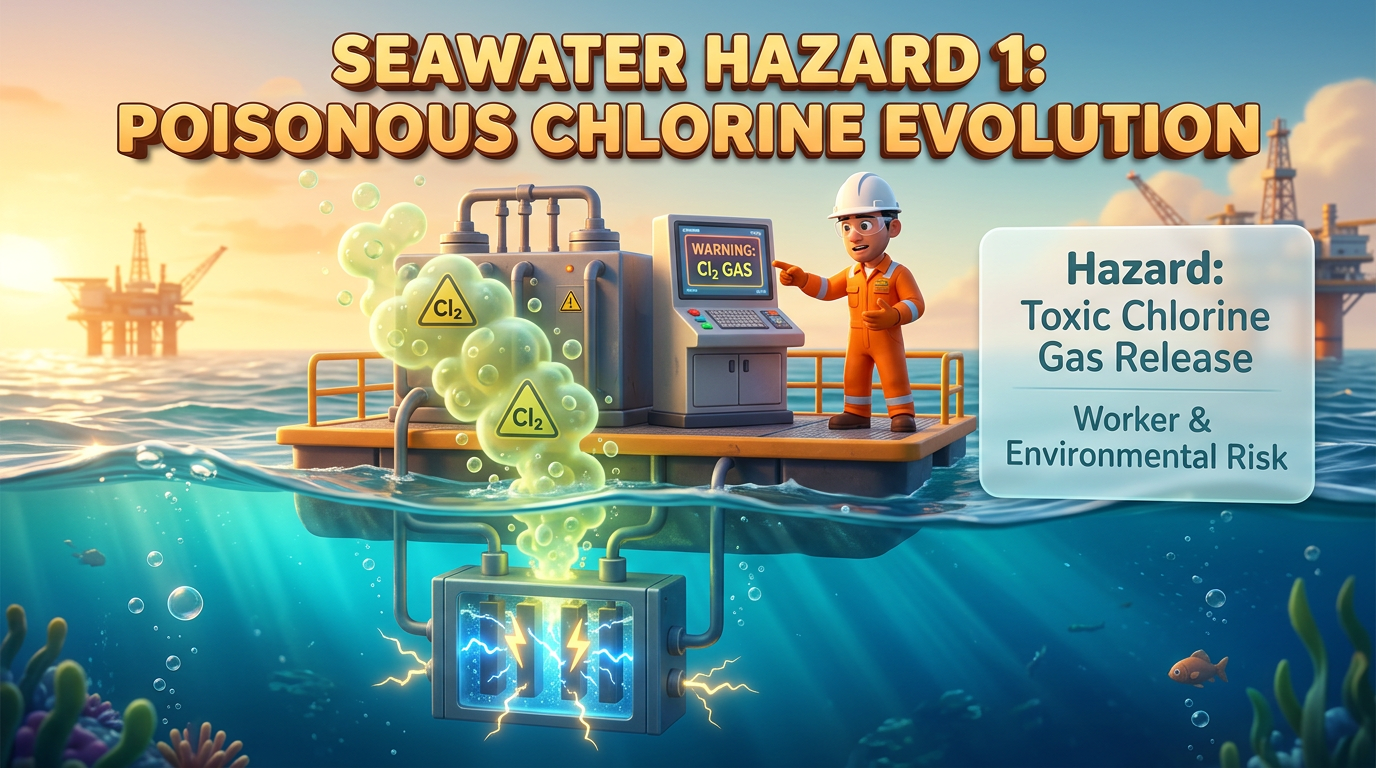
Poisonous chlorine evolution / AI image by Magnific.
Poisonous Chlorine Evolution:
Applying electrical current to seawater naturally triggers the release of toxic chlorine gas, which is hazardous to both workers and the surrounding environment.
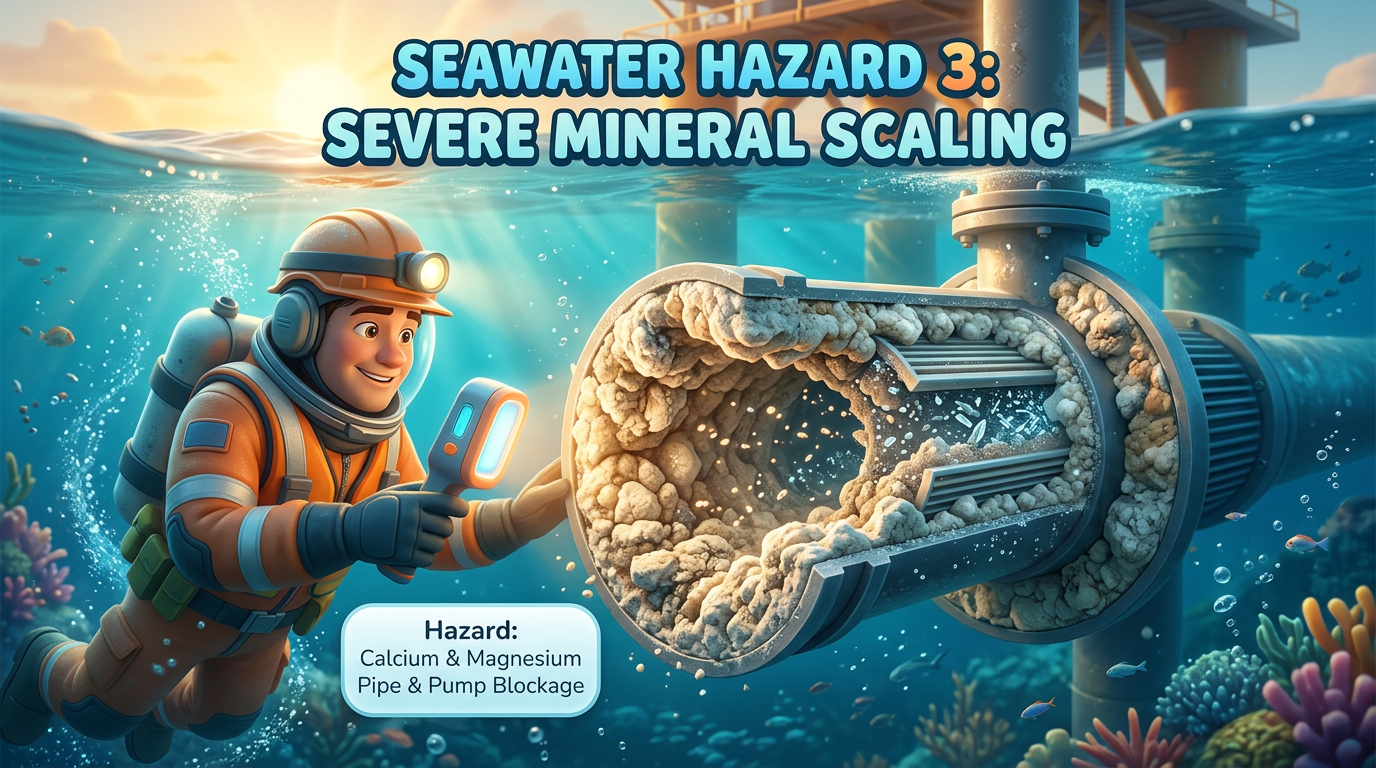
Severe mineral scaling / AI image by Magnific.
The Breakthrough:
PTFE Membranes, Non-Precious Catalysts, and AI Integration
To overcome these hazards, researchers from the Chinese Academy of Engineering and leading universities developed a revolutionary phase-change architecture that achieves thermodynamic equilibrium without desalination.
Molecular sieving physics / AI image by Magnific.
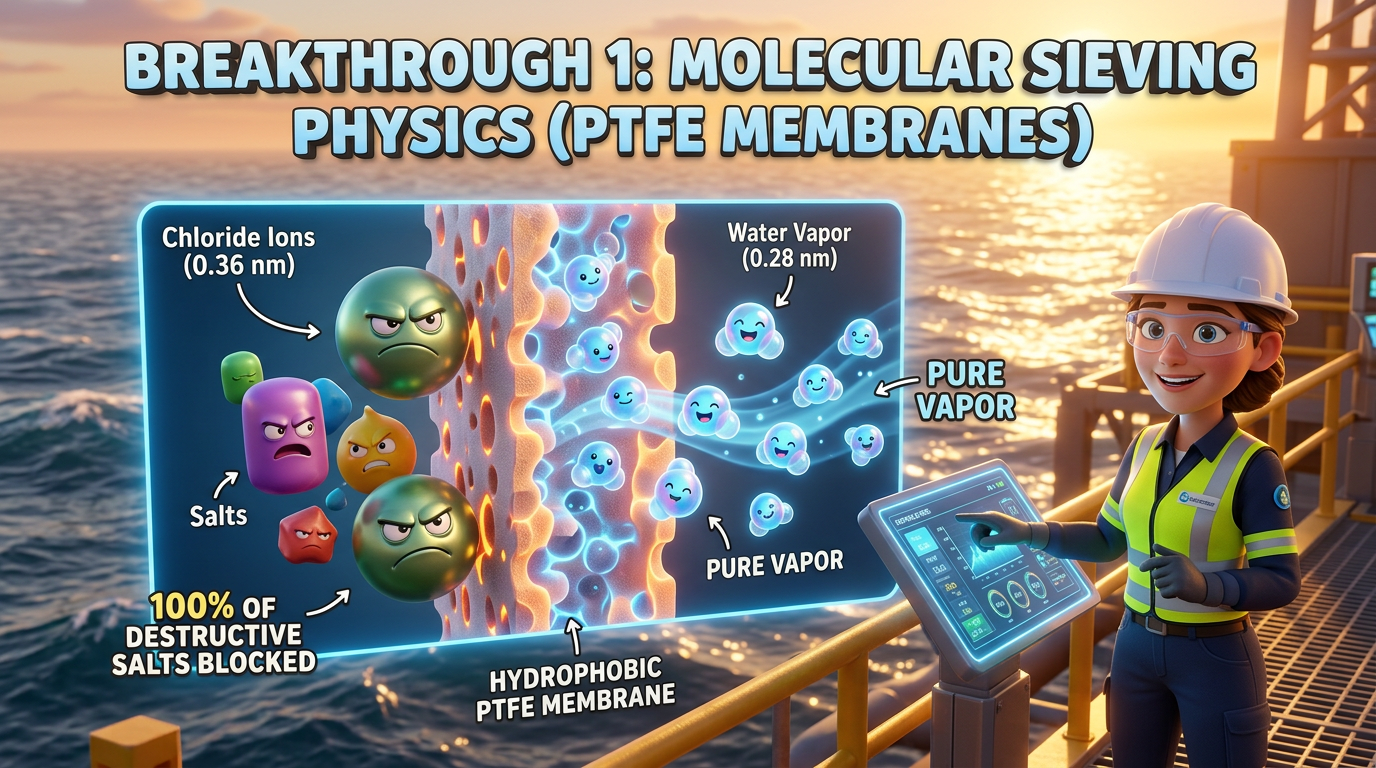
Molecular Sieving Physics:
The system utilizes a hydrophobic PTFE membrane with microscopic pores sized perfectly between water molecules (0.28 nm) and massive chloride ions (0.36 nm). Natural vapor pressure drives pure water vapor through the membrane into a concentrated potassium hydroxide electrolyte, leaving 100% of the destructive salts behind.
Energy Efficiency:
Traditional commercial systems consume 50 to 55 kWh per kilogram of hydrogen. The advanced seawater membrane system requires only 42 to 47 kWh/kg (including pumping and controls), approaching the theoretical thermodynamic limit of 39.4 kWh/kg.
Depth-Specific Foundations:
Engineers deploy gravity-based structures, jack-up platforms, or floating semi-submersible hulls tailored precisely to local water depths and extreme ocean dynamics.
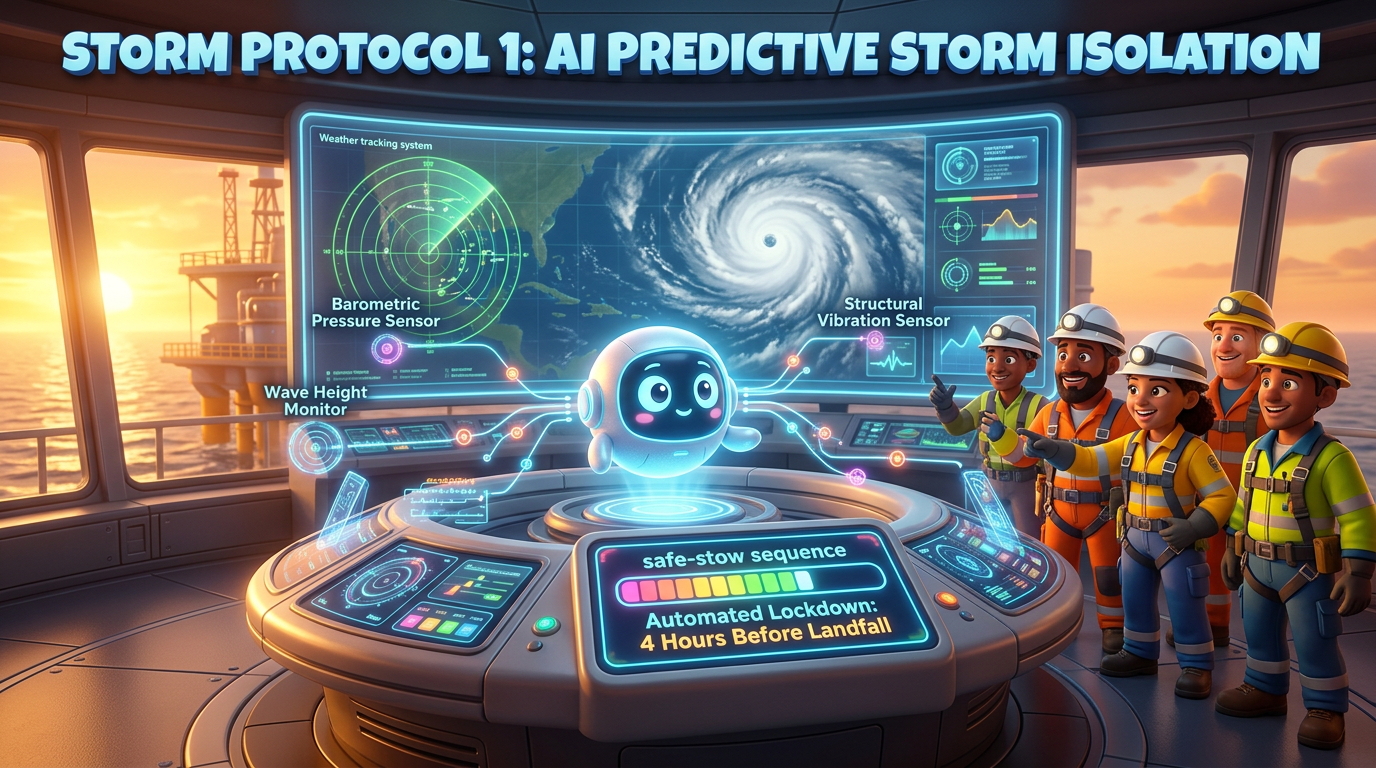
AI-predictive storm isolation / AI image by Magnific.
AI Predictive Storm Isolation:
Artificial intelligence monitoring systems continuously analyze barometric pressure drops, wave heights, and structural vibrations, triggering automated safe-stow sequences hours before a typhoon eyewall makes landfall.
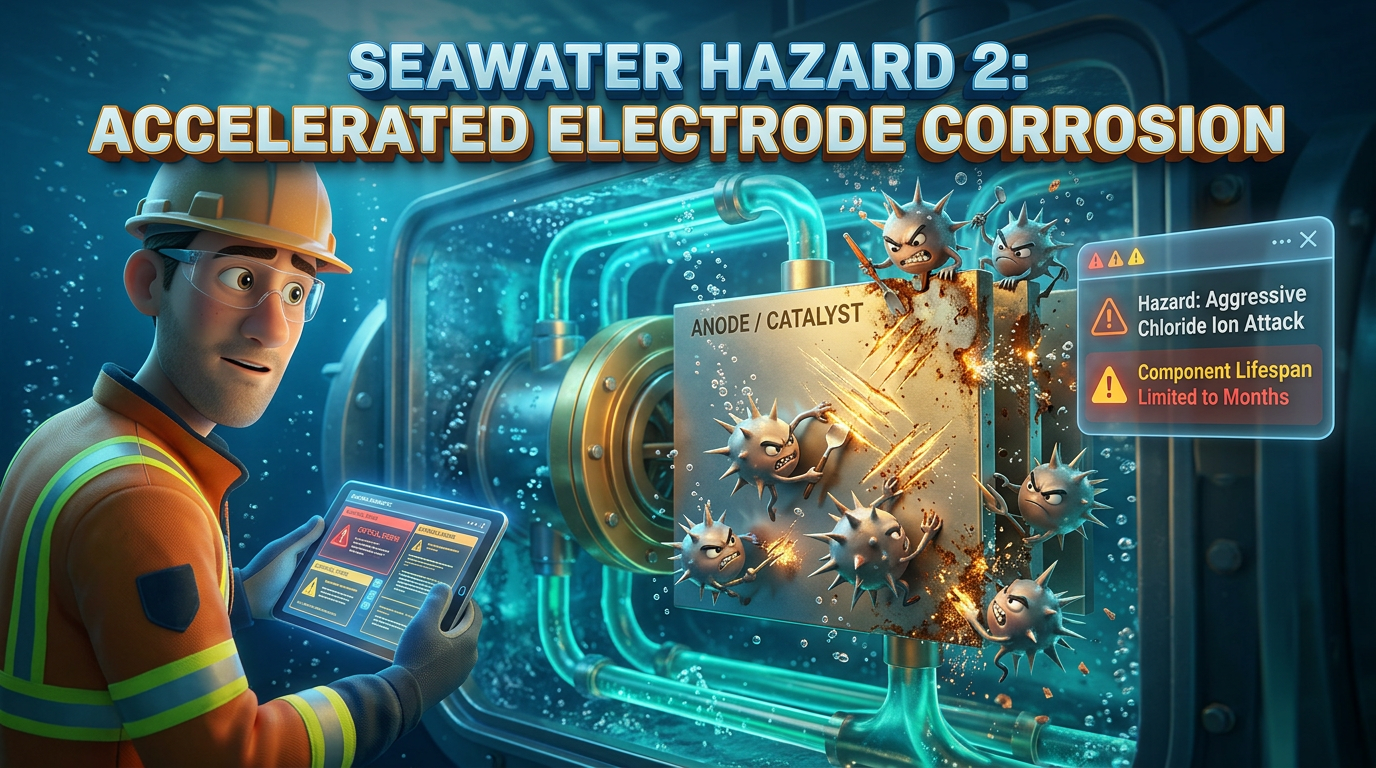
Accelerated electrode corrosion / AI image by Magnific.
Accelerated Electrode Corrosion:
Aggressive chloride ions rapidly attack and destroy expensive electrolyzer components and metal catalysts, severely limiting system lifespans to a matter of months.
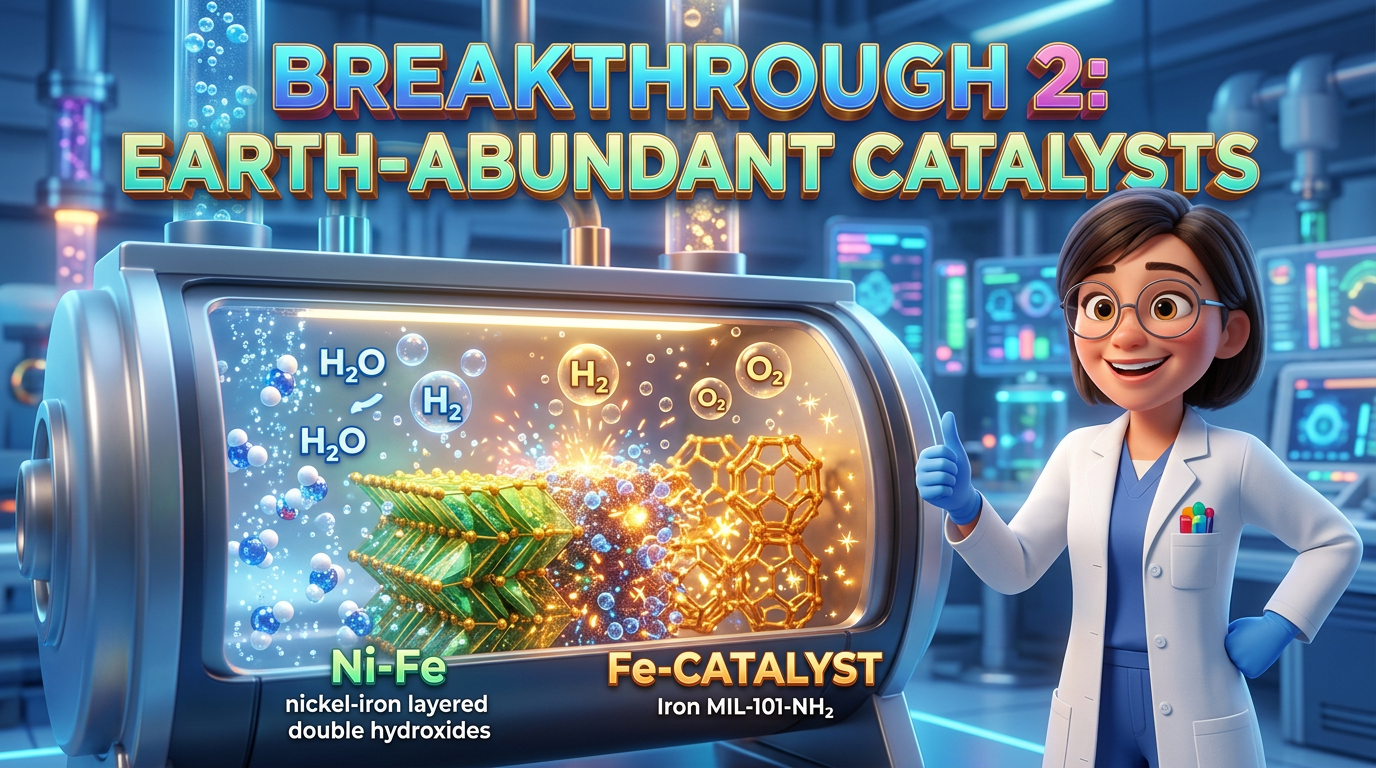
Earth-abundant catalysts / AI image by Magnific.
Earth-Abundant Catalysts:
Replacing scarce platinum and iridium, the system leverages highly active nickel-iron layered double hydroxides and iron-based catalysts (like Iron MIL-101-NH2) to accelerate water dissociation.
Internal Wave-Buffering Cabins:
Drawing from successful pilot demonstrations in regions like Xinghua Bay, facilities house vulnerable PTFE membrane electrolyzers inside buffered internal seawater chambers that neutralize violent wave surges before water reaches the vapor-phase separation barrier.

Active yaw and blade feathering / AI image by Magnific.
Active Yaw & Blade Feathering:
Offshore wind turbines are engineered to withstand extreme cyclonic loads exceeding 60 m/s, utilizing real-time sensors to pitch blades parallel to incoming winds and actively yaw nacelles to eliminate sail drag and structural resonance.
UNCLOS (United Nations Convention on the Law of the Sea):
Governs the rights and responsibilities of nations regarding the use of the world's oceans, establishing clear jurisdictional boundaries for EEZs (Exclusive Economic Zones) and continental shelves. For offshore hydrogen platforms, UNCLOS mandates comprehensive protection and preservation of the marine environment, obligating states to prevent, reduce, and control pollution from seabed activities and artificial offshore installations.
Severe Mineral Scaling:
Calcium and magnesium salts inherently present in seawater build up and calcify, acting like concrete to block pipes, pumps, and membrane channels.

AI-monitored anti-fouling / AI image by Magnific.
AI-Monitored Anti-Fouling:
Deployed on offshore floating platforms (proven in Xinghua Bay), the system combats harsh marine bio-fouling (barnacles and algae) using copper-aluminum electrolytic anodes that release protective ions. Artificial Intelligence (AI) handles predictive maintenance, monitoring weather changes, wave turbulence, and system health to ensure uninterrupted reliability.
Output and Efficiency Comparison: Seawater vs. Traditional Inland
Direct seawater electrolysis does not just match traditional pure-water systems—it optimizes them:
Durability & Purity:
The seawater system sustains a massive current density of 400 mA/cm² for over 3,200 continuous hours, yielding laboratory-grade 99.9% pure hydrogen directly from raw ocean water.
Water Conservation:
This architecture reduces freshwater dependency by 90% compared to inland facilities.
| Performance Metric | Traditional Inland System | Direct Seawater Membrane |
|---|---|---|
|
Energy Consumption (Lower kWh/kg is better) |
50 – 55 kWh/kg
|
42 – 47 kWh/kg (Near 39.4 Limit)
|
|
Freshwater Use (~9 Liters / kg baseline) |
100% Freshwater Demand
|
90% Reduction (Uses Raw Seawater)
|
|
Durability & Purity (Industrial stability & grade) |
Standard Purity (~99.0%)
|
99.9% Purity over 3,200+ Continuous Hours
|
Securing Offshore Infrastructure Against Seasonal Typhoon Corridors
Operating gigawatt-scale direct seawater hydrogen facilities in vulnerable coastal zones like the Taiwan Strait, the East China Sea, and the South China Sea requires more than high-efficiency electrolysis—it demands an uncompromising, multi-layered marine defense. Because these regions are subject to seasonal typhoon storms and Category 5 gusts, structural survival depends on combining wave-damping hull physics, single-point weathervaning mooring, active turbine feathering, and autonomous gas isolation systems.
Structural & Hydrodynamic Platform Engineering
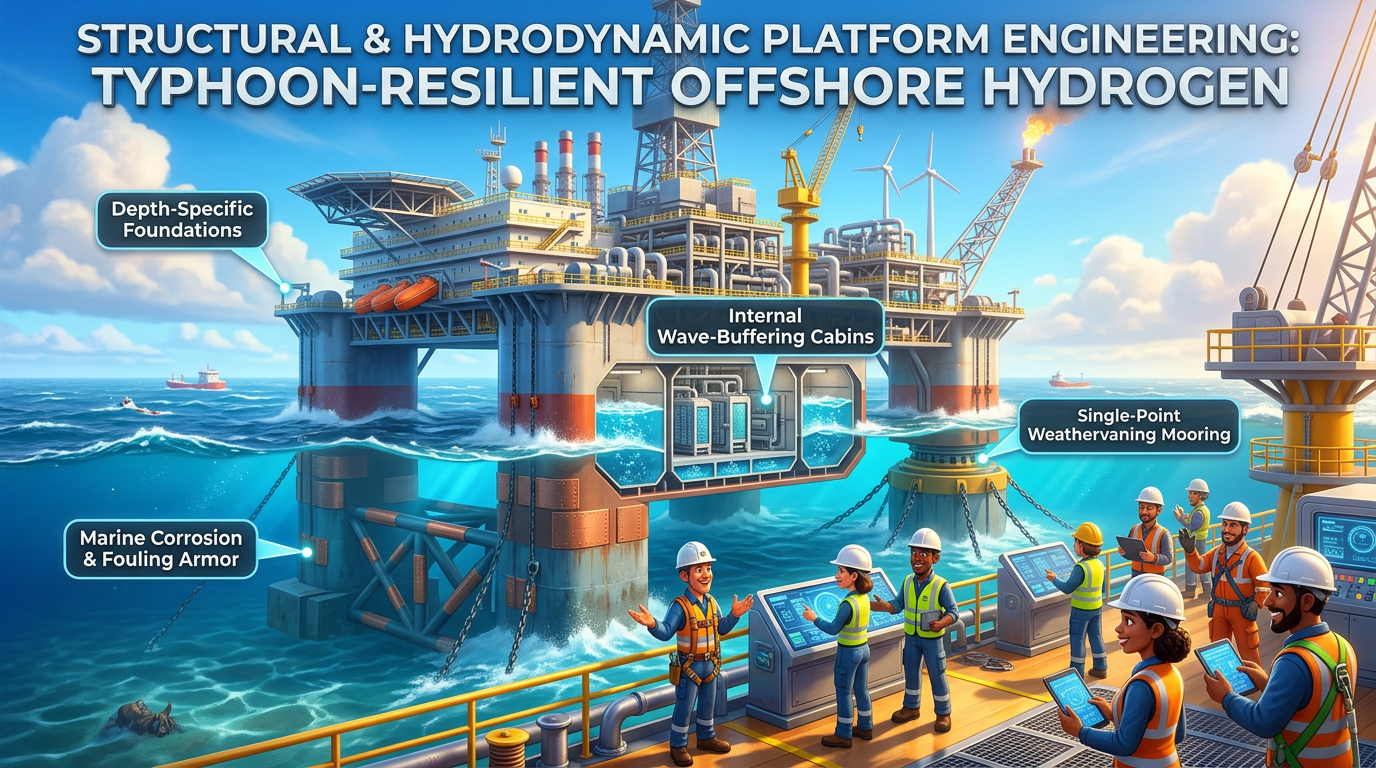
Platform hydrodynamic engineering / AI image by Magnific.
Single-Point Weathervaning Mooring:
Deep-water platforms utilize 4,000-ton ballast systems and single-point turret moorings that allow the entire structure to rotate 360 degrees, passively aligning with shifting typhoon winds and minimizing lateral wave impact.
Marine Corrosion & Fouling Armor:
Submerged hardware is shielded by copper-aluminum electrolytic anodes and protective sacrificial coatings, preventing salt-spray degradation and marine bio-fouling during severe storms.
Typhoon-Resistant Wind & Power Controls
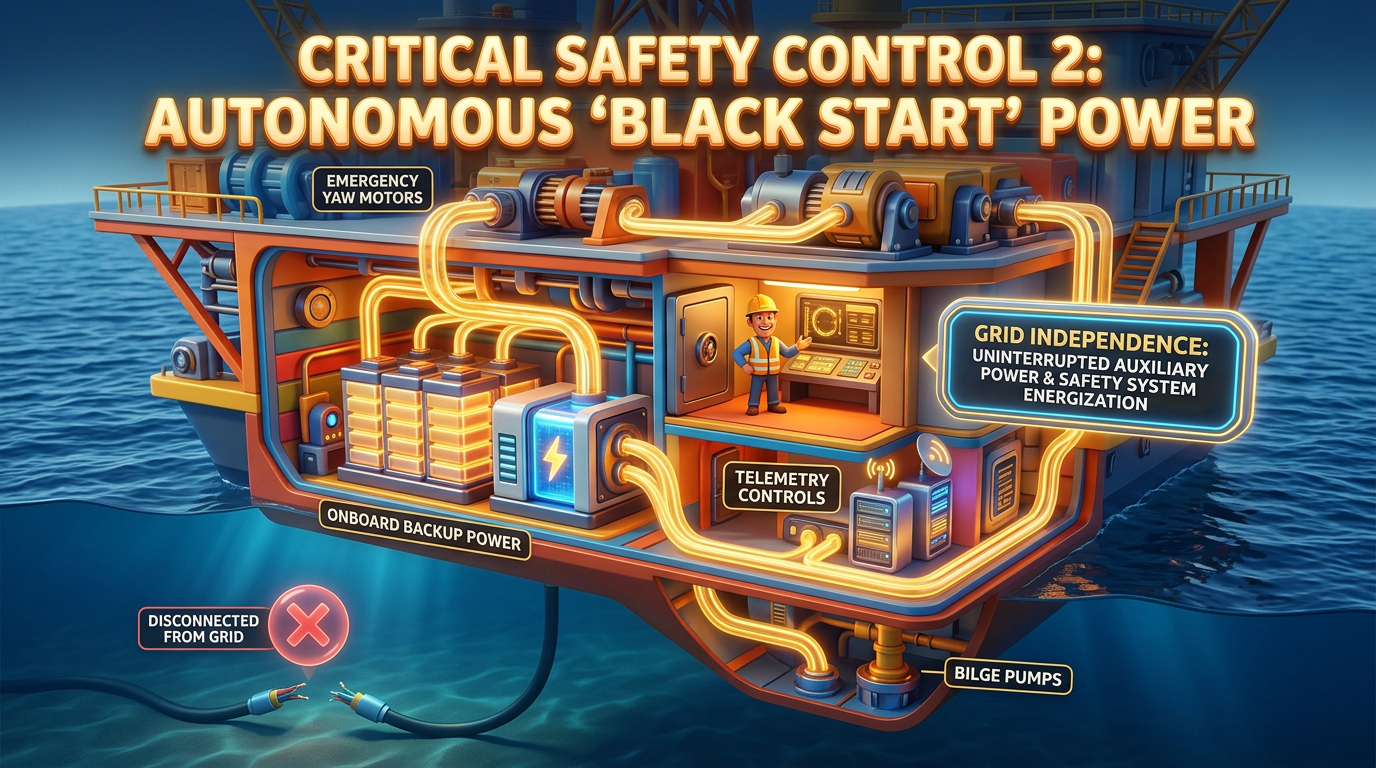
Autonomous black-start power / AI image by Magnific.
Autonomous "Black Start" Power:
Onboard backup battery arrays and hydrogen fuel cells ensure that critical auxiliary systems—such as emergency yaw motors, bilge pumps, and telemetry controls—remain fully energized even if subsea grid interconnects trip during a storm.
Electrolyzer & Gas-Safety Storm Protocols
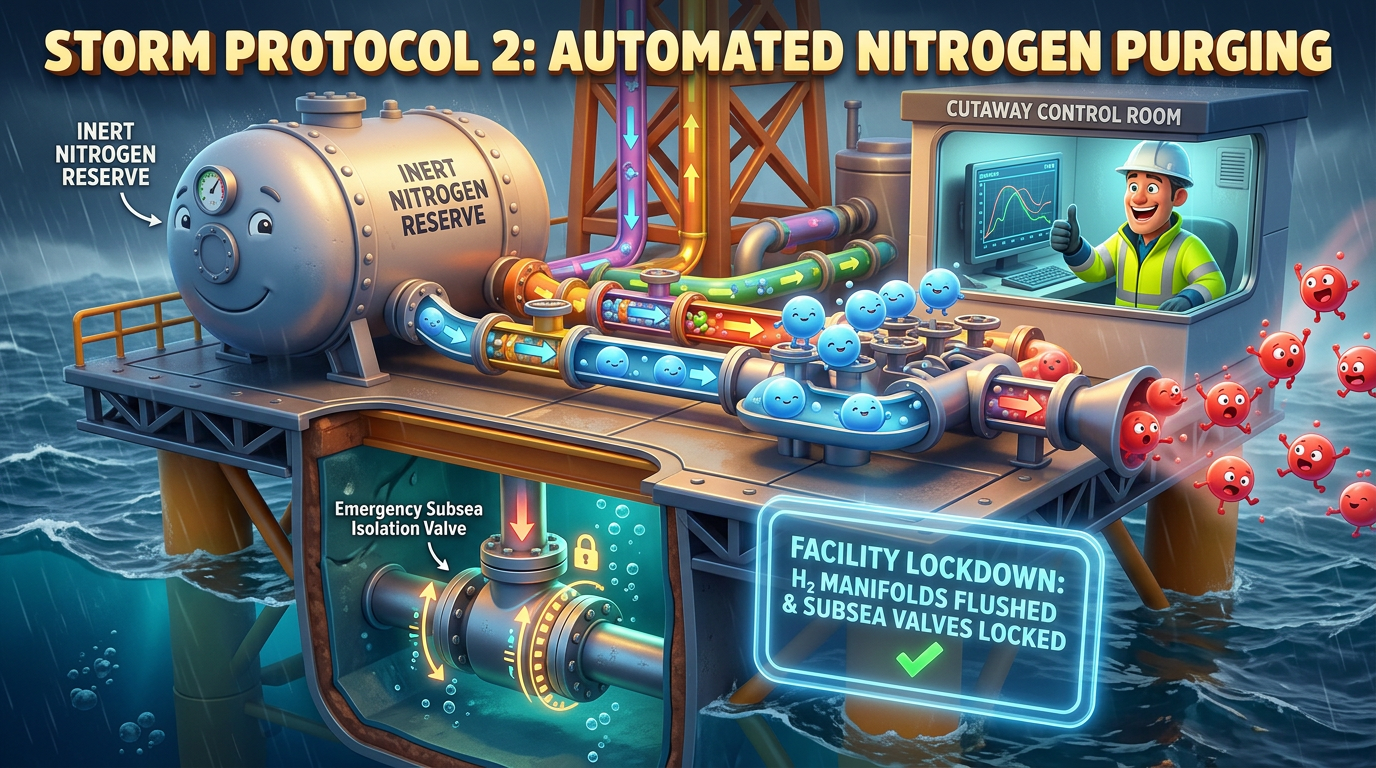
Automated nitrogen purging / AI image by Magnific.
Automated Nitrogen Purging:
Prior to peak winds, the facility halts electrolysis, flushes surface hydrogen manifolds with inert nitrogen gas, and locks down emergency subsea isolation valves.
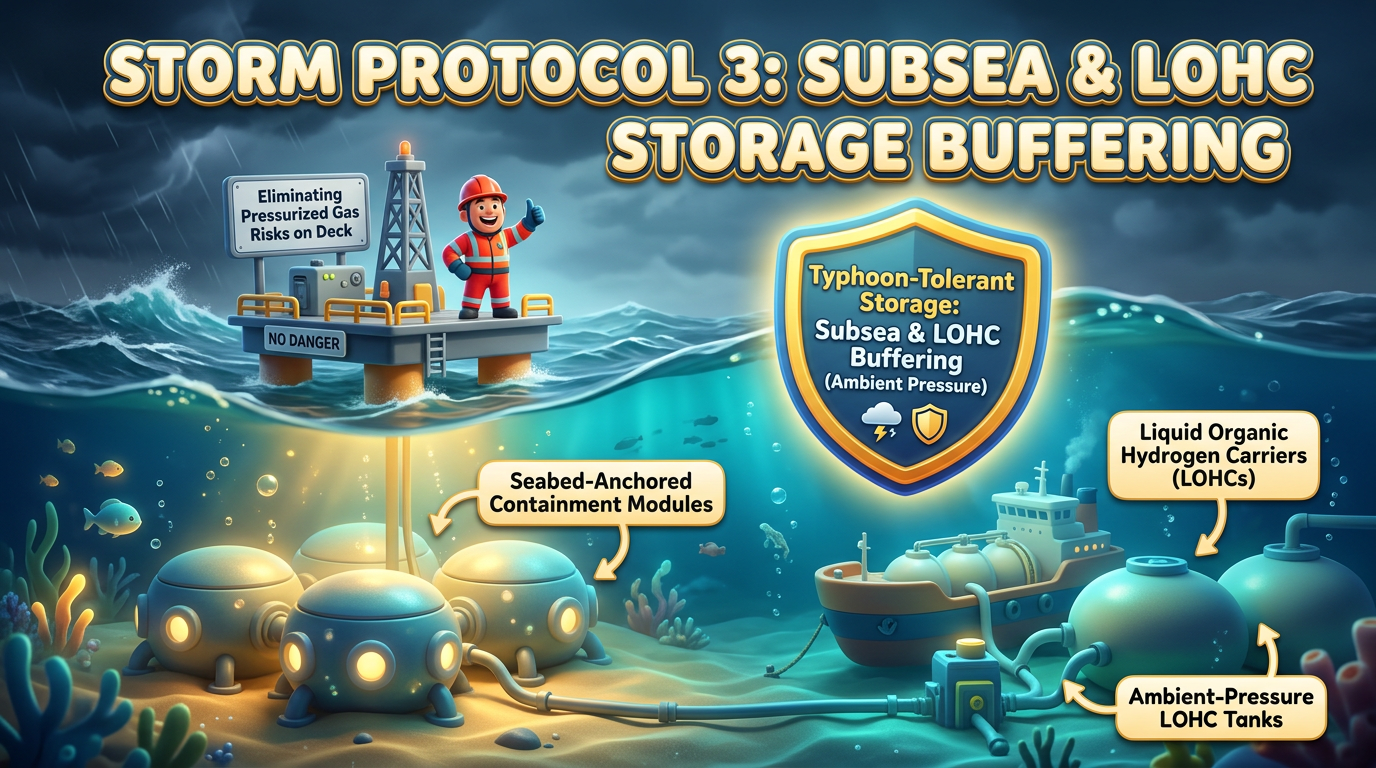
Subsea and long-term storage buffering / AI image by Magnific.
Subsea & LOHC Storage Buffering:
Storing hydrogen output safely in ambient-pressure Liquid Organic Hydrogen Carriers (LOHCs) or seabed-anchored containment modules eliminates high-pressure gas risks on storm-tossed platform decks.
| Engineering Protocol | Applicability in Typhoon Corridors | Operational Effectiveness & Storm-Securing Role |
|---|---|---|
| Depth-Specific Foundations & Weathervaning Mooring | Mandatory Structural Anchor | Very High: Gravity-based structures, jack-up platforms, or 4,000-ton ballasted semi-submersible hulls with 360° single-point turret mooring passively rotate to align with shifting typhoon winds and violent ocean swells. |
| Internal Wave-Buffering Seawater Cabin | Critical Membrane Protection | High: Encloses the hydrophobic PTFE membrane electrolyzers inside a damped internal seawater chamber (proven in Xinghua Bay), neutralizing wave turbulence and pressure spikes before water reaches the vapor-phase barrier. |
| Active Turbine Yaw & Blade Feathering | Essential (Category 5 Rated) | Very High: Real-time wind sensors pitch offshore turbine blades parallel to 60+ m/s typhoon gusts and actively yaw nacelles to track wind shifts, eliminating sail drag and structural resonance. |
| AI Predictive Isolation & Nitrogen Purging | Mandatory Gas-Safety Protocol | Critical: AI monitoring tracks barometric drops, wave heights, and structural vibration to trigger automated safe-stow sequences hours before landfall—halting electrolysis, purging hydrogen manifolds with inert nitrogen, and sealing isolation valves. |
| Subsea & LOHC Unpressurized Storage | High-Priority Deck Safety | High: Stores output in ambient-pressure Liquid Organic Hydrogen Carriers (LOHCs) or seabed-anchored tanks, eliminating high-pressure gas cylinder hazards on storm-tossed platform decks. |
| Electrolytic Anti-Fouling & Black-Start Power | Continuous Post-Storm Recovery | High: Copper-aluminum electrolytic anodes and sacrificial coatings prevent salt-spray corrosion and biofouling, while onboard backup batteries and fuel cells keep yaw motors and safety controls running if subsea grid cables trip. |
Executive Financial Review: 10 GW Seawater Green Hydrogen Facility
| Line Item | Component / Engineering Scope | Unit Pricing Metric | Quantity / Basis | Cost Range: Low ($'000) |
Cost Range: High ($'000) |
Midpoint Target ($'000) |
|---|---|---|---|---|---|---|
| 1.0 Plant Components & Equipment | 10 GW Seawater Electrolyzer Stacks (PTFE Membranes, Ni-Fe Catalysts), Power Conversion, Marine Gas Compression, LOHC Storage, Balance-of-Plant | $800 – $950 / kW installed | 10,000 MW (10,000,000 kW) | $8,000,000 | $9,500,000 | $8,750,000 |
| 2.0 Coastal Land & Marine Platforms | Coastal industrial zoning, shallow-water jackup platforms, or gravity-based structures for offshore generation platforms | Lump Sum / Marine Leases | Coastal footprint + Offshore integration | $250,000 | $350,000 | $300,000 |
| 3.0 Subsea Interconnect & Offshore Grid | HVDC subsea cabling interconnect to coastal substations and offshore wind farm tie-ins (no municipal water intake required) | Lump Sum / HVDC POI | 10 GW Offshore Grid Interconnect | $220,000 | $310,000 | $265,000 |
| 4.0 Marine Safety & AI Anti-Fouling | Cu-Al electrolytic anti-fouling anodes, AI predictive maintenance sensors, Marine EIAs, maritime zoning permits, and gas leak detection | Lump Sum Turnkey | Maritime Site Safety & Approvals | $120,000 | $180,000 | $150,000 |
| 5.0 SUBTOTAL A | Gross Turnkey Direct Seawater CapEx Requirement | $8,590,000 | $10,340,000 | $9,465,000 | ||
| 6.0 Byproduct Value: Freshwater (H2O) | Pure freshwater recovered from downstream fuel cells, supplying drought-stricken coastal agriculture and local municipal grids | $1.20 – $1.80 / m3 (potable value) | ~14.1M L/day (~5.14M m3/yr) | ($340,000) | ($420,000) | ($380,000 / yr) |
| 7.0 Byproduct Revenue: Oxygen (O2) | Clean oxygen released back into the atmosphere or captured for maritime aquaculture aeration and coastal hospital supply | $35 – $45 / metric ton | ~12,530 t/day (~4.57M t/yr) | ($160,070) | ($205,800) | ($182,000 / yr) |
| 8.0 Primary Revenue: Hydrogen (H2) | Zero-carbon fuel for clean synthetic maritime shipping fuels, coastal steel mills, and regional energy exports | $2.20 – $2.80 / kg net | ~1,566 t/day (~571.6M kg/yr) | ($1,257,520) | ($1,600,480) | ($1,368,000 / yr) |
| 9.0 SUBTOTAL B | Gross Annual Value Stream from Products & Co-Products | ($1,757,590) | ($2,226,280) | ($1,930,000 / yr) | ||
| 10.0 Government & Maritime Subsidies | Global coastal development grants, offshore wind integration subsidies (e.g., IRA/EU Hydrogen Bank equivalents), and maritime carbon-offset credits | 25%–30% Effective Stack | Monetized Year-1 Tax Credits & Abatements | ($2,147,500) | ($3,102,000) | ($2,600,000) |
| 11.0 Final Net Investment | Net Capital Exposure Post-Incentives & Year-1 Subsidies | $6,442,500 | $7,238,000 | $6,865,000 | ||
Ecosystem Impact and Maritime Regulations
Critics often point to traditional desalination plants, which discharge hyper-saline toxic brine back into the ocean, devastating local marine ecosystems. Direct seawater electrolysis completely eliminates this threat. Because the PTFE membrane acts as a vapor-phase barrier rather than a liquid filter, there is zero harmful saltwater or brine discharge returned to the ocean.
The only outputs returned to the atmosphere are pure water vapor and clean oxygen, leaving the marine ecosystem entirely undisturbed. Furthermore, this operational profile strictly adheres to international maritime environmental standards (such as UNCLOS and MARPOL), ensuring that offshore gigawatt-level hydrogen farms operate with a true zero-impact footprint.
International Regulatory Frameworks: UNCLOS and MARPOL
MARPOL (International Convention for the Prevention of Pollution from Ships):
Regulates operational and accidental pollution from maritime structures and vessels. Under MARPOL standards (specifically focusing on air pollution prevention and waste management regulations), offshore energy installations are bound to strict emission controls, zero-harm discharge limits, and rigorous safety management systems to prevent toxic spills or atmospheric contamination.
A Call to Action: Harvesting the Waters
Whether deploying next-generation capillary-fed electrolyzers at inland commercial hubs or floating PTFE-membrane platforms along our vulnerable coastlines, the technology to secure a zero-emission future has arrived. Nature has provided the ultimate, inexhaustible battery: water.
We must act now to accelerate government incentives, secure institutional funding, and scale these breakthroughs to meet our 2050 climate mandates. By transitioning to green hydrogen—our modern "Water Blessing"—we can power the exponential rise of AI, decarbonize global shipping, and heal the Earth for generations to come. The hydrogen-powered future starts right now with the boundless energy of the ocean.
The Global Hydrogen Map:
Breaking Fossil Dependencies, Powering the AI Frontier, and Healing Our Planet by 2050
By the Sustainable Energy Mission Team
The transition to a zero-emission global economy is both an environmental mandate and a massive industrial challenge. As energy networks struggle under the dual pressures of climate volatility and the massive power demands of next-generation technologies like Artificial Intelligence (AI), the global energy landscape must evolve. Among the most promising pillars of this transition is green hydrogen. Yet, realizing its potential requires a clear-eyed look at where hydrogen production stands today, the structural barriers holding it back, and the strategic pathways to a sustainable 2050.
The Present Reality: The Current Global Hydrogen Landscape
Today, global hydrogen production remains deeply dependent on fossil fuels. Annual production is dominated by Grey Hydrogen (natural gas-based), with Blue Hydrogen (fossil-based with carbon capture) and Green Hydrogen (renewable-based) accounting for only a fraction of the market.
The High Capital Cost of Electrolysis:
Traditional systems are expensive and require rare, costly metals like iridium and platinum.
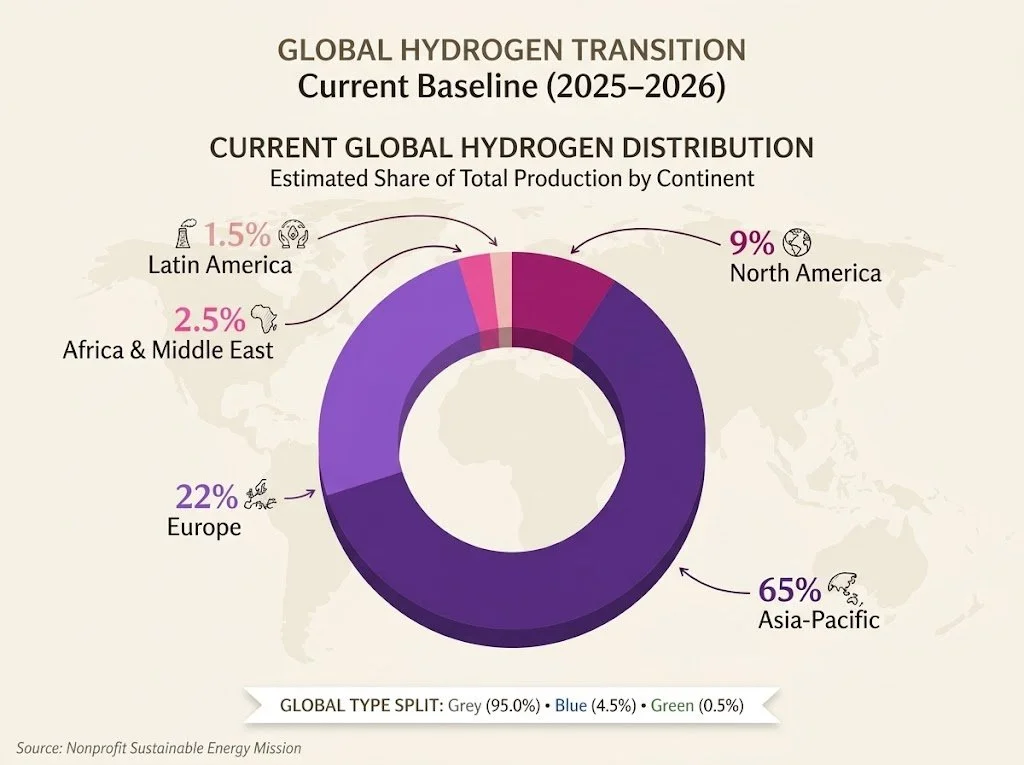
Current global hydrogen distribution baseline / AI image by Gemini.
Asia-Pacific (65%): Leads global production, driven primarily by China’s massive industrial base, steel manufacturing, and rapid chemical processing expansion.
Europe (22%): A major hub powered by dense industrial networks, although heavily reliant on imported natural gas and coal-derived processes.
North America (9%): Dominated by the United States and Canada, utilizing extensive natural gas networks for refining and ammonia production.
Africa & Middle East (2.5%): Heavily focused on oil and gas-based reforming, with low-carbon alternatives still in early-stage development.
Latin America & Oceania (1.5%): A small current footprint, primarily serving local agricultural and chemical demands.
Why This Distribution Occurs
The current regional imbalance is a direct consequence of historical industrialization. Large-scale hydrogen production has historically been located next to heavy energy demand—specifically chemical refining, steel production, and fertilizer manufacturing—where cheap natural gas or coal was readily available. Because grey hydrogen is inexpensive to produce in regions with vast fossil reserves, the infrastructure has remained concentrated in APAC, Europe, and North America. Green hydrogen has remained marginalized because of the historic cost premiums of renewable electricity and electrolysis hardware.
Overcoming the Barriers to General Market Feasibility
Transforming this carbon-heavy baseline into a zero-emission resource requires solving several critical structural bottlenecks:
The Principal Bottlenecks
Electrical and Mechanical Inefficiencies:
Insulating gas bubbles that form on submerged electrodes during standard electrolysis waste up to 30% of the incoming electricity.
Suggested Strategic Mitigations
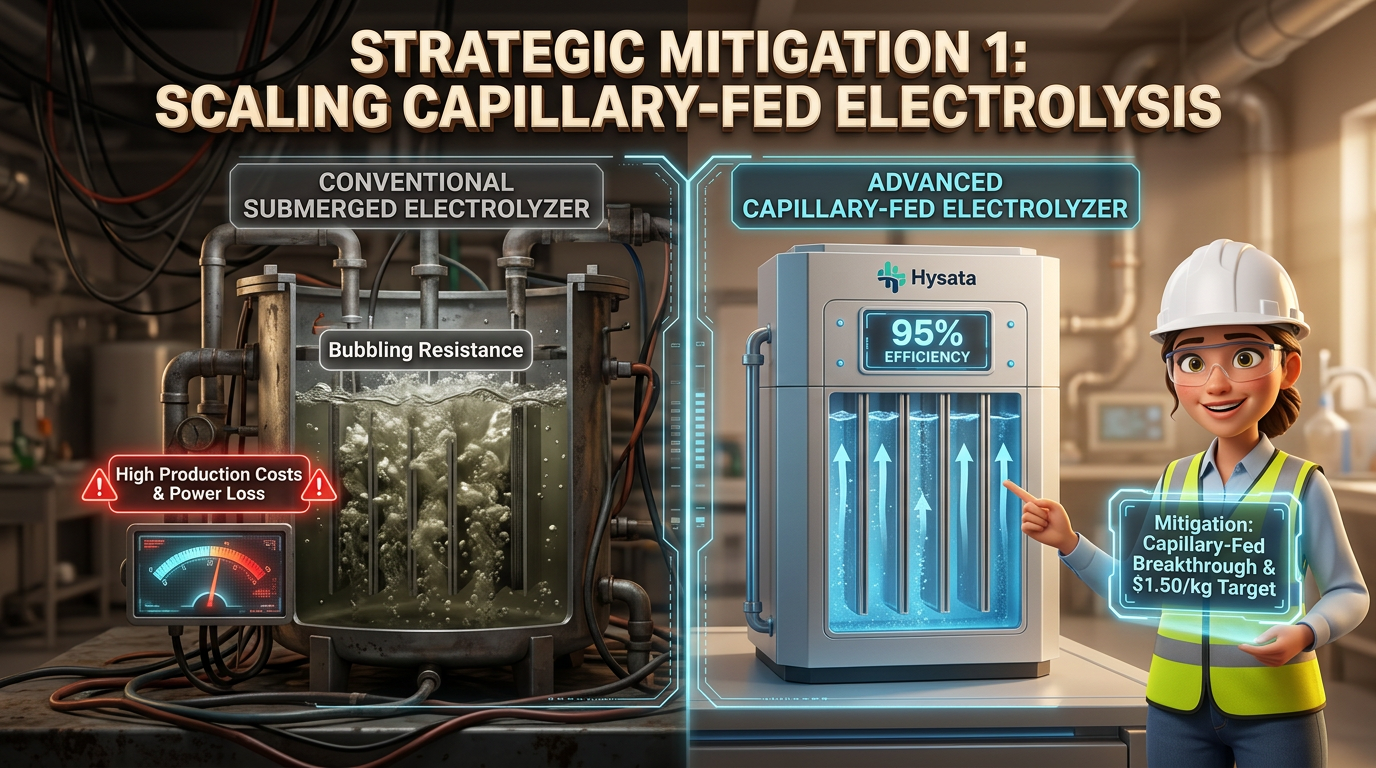
Scaling capillary-fed electrolysis / AI image by Magnific.
Scaling Capillary-Fed Electrolysis:
Standardizing breakthroughs like capillary-fed electrolysis (e.g., Hysata’s ~95% efficient cell architecture) eliminates bubble resistance, cuts balance-of-plant costs, and lowers production targets toward $1.50/kg.
Renewable Energy Grid Surcharges:
Green hydrogen requires massive amounts of dedicated renewable power, which often conflicts with the electrification needs of local communities and grids.
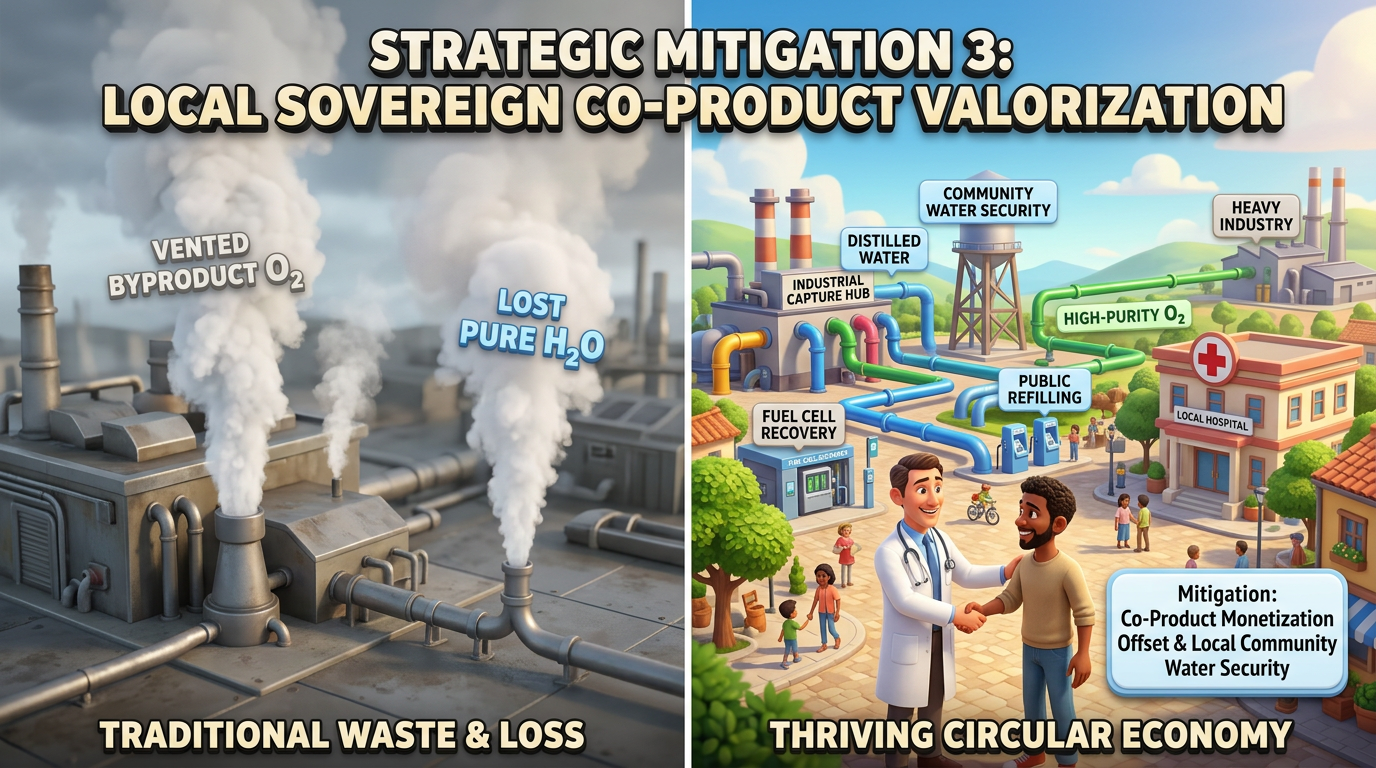
Local sovereign co-product valorization / AI image by Magnific.
Local "Sovereign" Co-Product Valorization:
Capturing and selling byproduct oxygen (to hospitals and heavy industry) and recovering distilled water from fuel cells can offset hydrogen production costs while supporting the local community.
Fueling the AI Revolution with Zero-Emission Power
This infrastructure overhaul is also a vital requirement for the next generation of our economy. The exponential rise of Artificial Intelligence (AI), machine learning, and advanced cloud computing has triggered an unprecedented surge in global electricity and cooling demands. Hyperscale data centers require 24/7 continuous baseload power that weather-dependent solar and wind alone cannot provide without massive storage.
Green hydrogen, when utilized in stationary fuel cells, offers a resilient, zero-emission off-grid power source that can support heavy computational workloads indefinitely without straining public grids.
Furthermore, as discussed in Part 4, because fuel cells generate massive volumes of pure, deionized water as a byproduct, they can provide a continuous supply of mineral-free liquid cooling for the data centers themselves—creating a circular, zero-water-withdrawal technology ecosystem. Integrating hydrogen into the AI frontier ensures our digital future does not come at the expense of our ecological survival.
The Horizon: Global Green Hydrogen potential by 2050
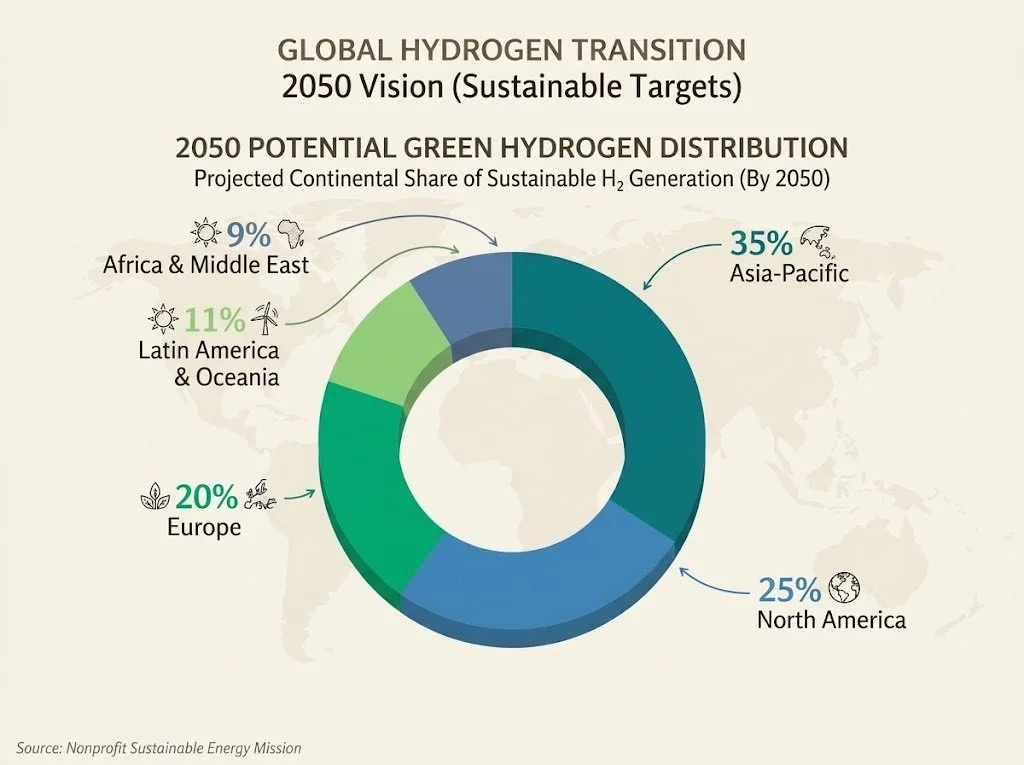
By 2050, the global hydrogen market is projected to shift from fossil-based dominance to a diversified, low-carbon network. A combination of falling renewable costs, supportive policy frameworks, and international trade will likely distribute production across the globe.
Asia-Pacific (35%): Remains the largest player, utilizing extensive solar, wind, and offshore networks to meet the demands of its massive industrial base.
North America (25%): Becomes a major producer and exporter, driven by vast land area, aggressive policy incentives (like the U.S. Inflation Reduction Act), and integrated pipeline transport.
Europe (20%): Though possessing less land, Europe’s strong regulatory frameworks and pipelines retrofitted for import and transport will support its role as a key consumer and technology hub.
Latin America & Oceania (11%): Australia, Brazil, and Chile will emerge as green hydrogen and ammonia export powerhouses, leveraging their high solar irradiance and wind resources.
Africa & Middle East (9%): Transforms into a low-cost export corridor, utilizing desert solar arrays to supply European and Asian market.

Global harmonization and trade agreements / AI image by Magnific.
Global Harmonization and Bilateral Trade Agreements:
Establish universal standards, certification schemes, and bilateral trade corridors to connect low-cost generation regions with high-demand industrial hubs.
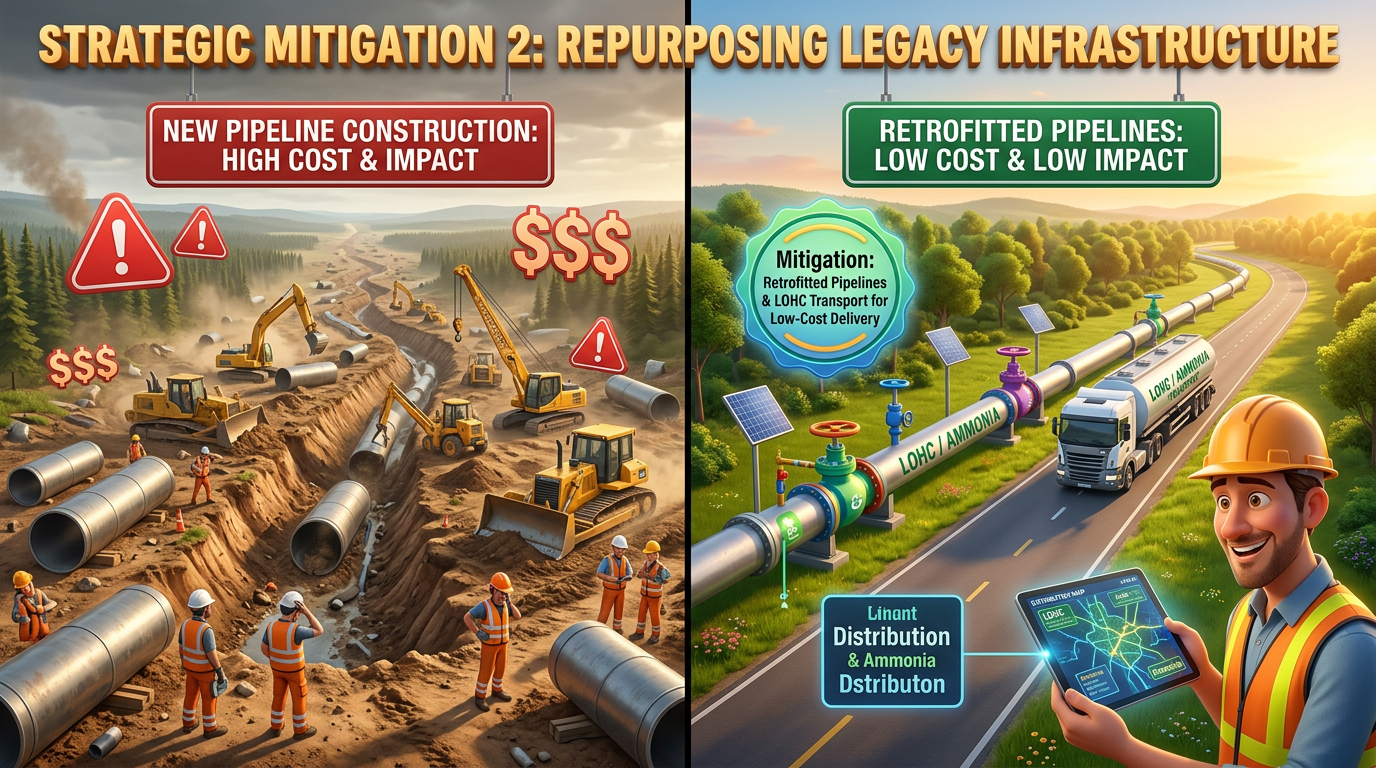
Repurposing legacy infrastructure / AI image by Magnific.
Repurposing Legacy Infrastructure:
Rather than building entirely new networks, blending hydrogen into retrofitted natural gas pipelines and utilizing Liquid Organic Hydrogen Carriers (LOHCs) or ammonia for transport can significantly lower distribution costs.
Global hydrogen transition 2050 vision / AI image by Magnific.

Public-private partnership investment models / AI image by Magnific.
Public-Private Partnership (PPP) Investment Models:
Mobilize targeted capital through sovereign green bonds and de-risked transition finance to build out the pipelines, port terminals, and offshore wind arrays needed to scale.
Logistics, Storage, and Transport:
Hydrogen’s tiny molecular size makes it prone to leakage and metal embrittlement, requiring expensive compression (350–700 bar) or cryogenic cooling (-253°C).
Suggested Strategies to Achieve the 2050 Target
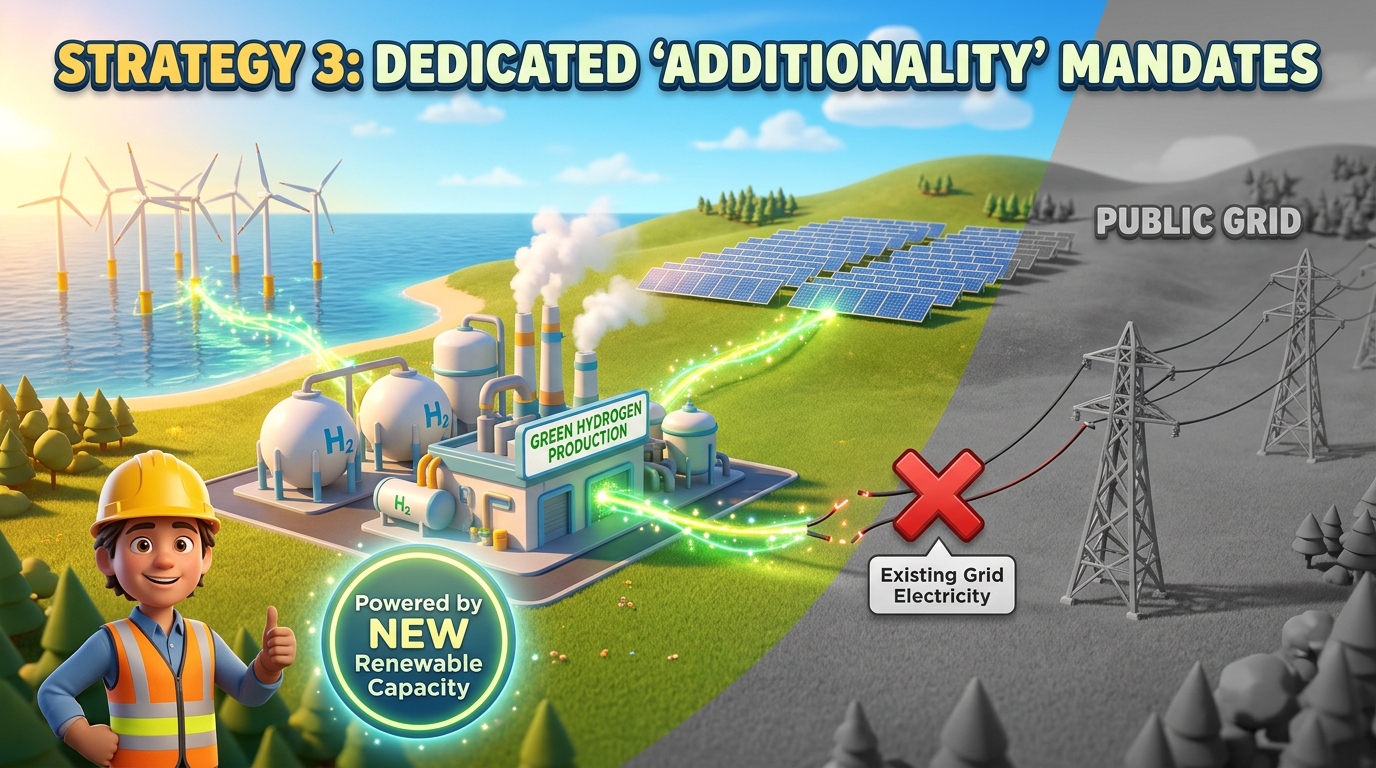
Dedicated additionality mandates / AI image by Magnific.
Dedicated "Additionality" Mandates:
Ensure new green hydrogen production is powered by new, dedicated renewable capacity rather than drawing from existing public grid supplies.
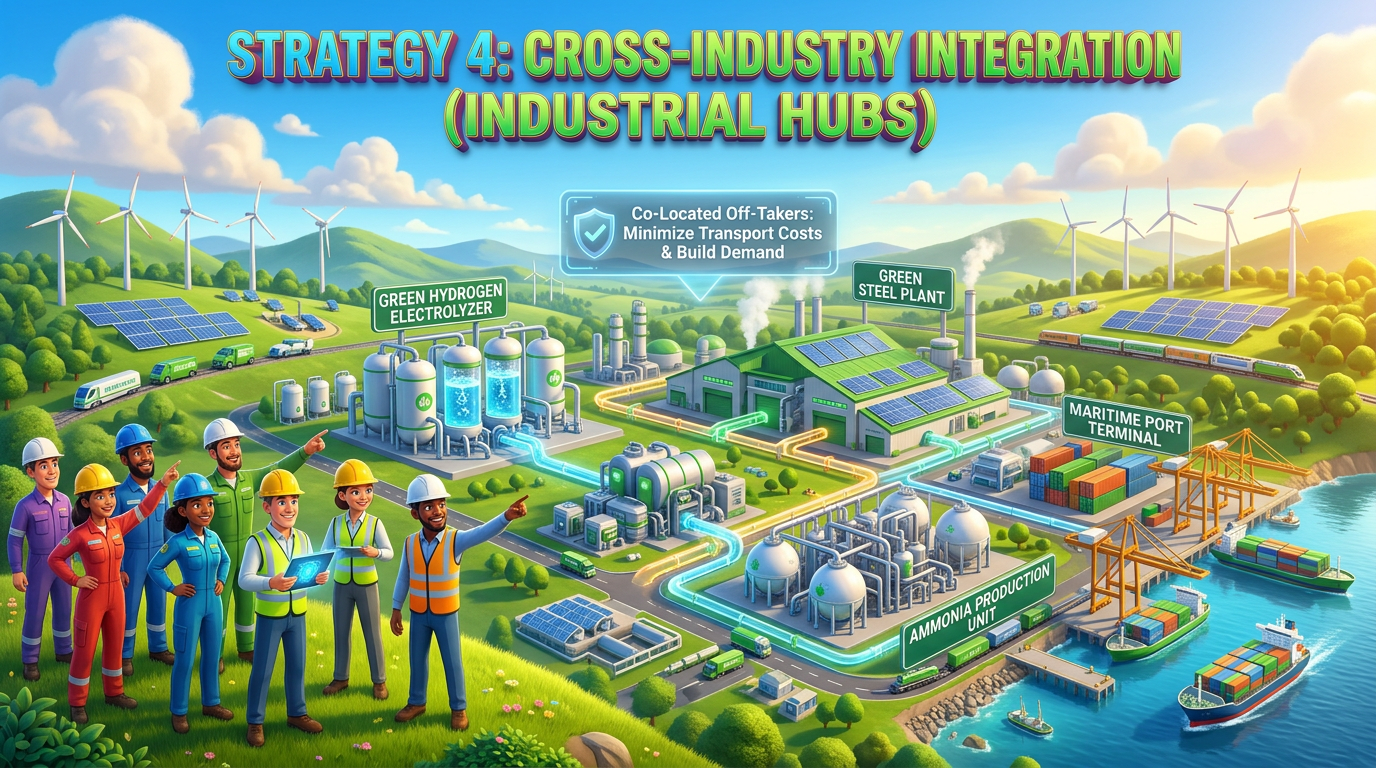
Cross-industry integration industrial hubs / AI image by Magnific.
Cross-Industry Integration (Industrial Hubs):
Co-locate electrolyzers directly with high-volume industrial off-takers—such as green steel, ammonia, and maritime ports—to minimize early transport costs and build immediate demand.
A Call to Action: Transforming Global Disaster into Our Greatest Blessing
Our planet is crying out for recovery. Around the globe, we are witnessing the severe impacts of a changing climate—floods, altering landscapes, and the rapid melting of glacial lakes, particularly across high-altitude regions like Tibet and Nepal. These visible changes serve as a stark reminder of our responsibility to find better ways of powering our lives.
Yet, even amid these challenges, there is an abundance of natural resources available to us. The vast waters becoming available from these natural shifts should not just be viewed as a hazard—they can be a source of renewal. By capturing and redirecting water that would otherwise cause harm, we can feed the very electrolyzers that produce green hydrogen, rescuing our communities while restoring balance to our environment. This abundant natural resource is a call to pay attention, to innovate, and to cultivate the blessings of our natural world in a way that safeguards our home.
Let us work together—nonprofits, governments, industry leaders, and communities—to turn these environmental challenges into a foundation for new invention and a better way of life. By reclaiming and using this water for noble, circular purposes, we can transform today's ecological challenges into tomorrow's sustainable economy, securing a healthier planet for generations to come.
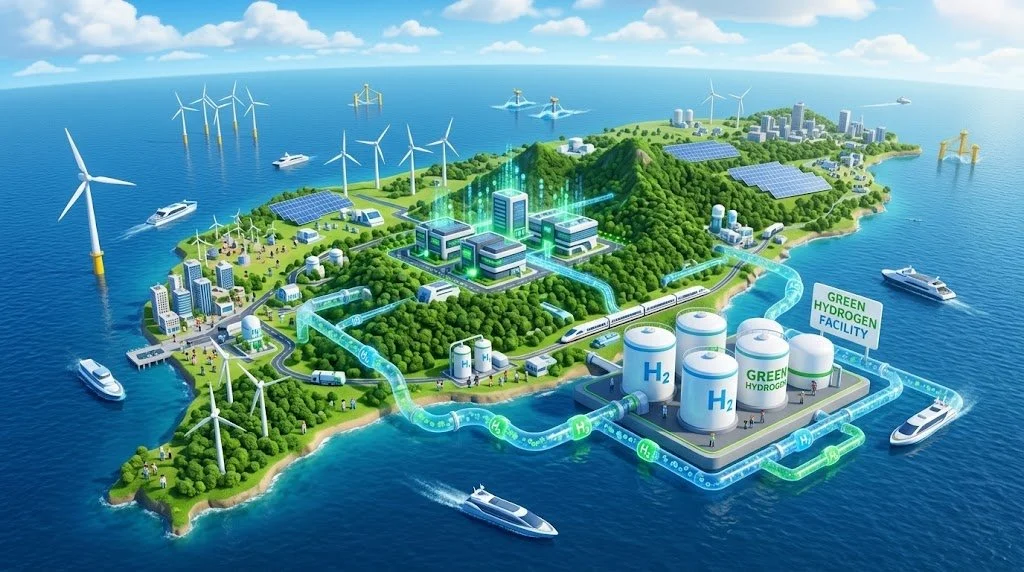
Comprehensive isometric overview of an island powered by green hydrogen facilities, wind turbines, and renewable microgrids.