

Functional Medicine:
Pioneering Root-Cause Functional Medicine, Intelligent AI & Assistive Robotics for Human Longevity
Reclaiming Human Health: Functional Medicine as the Ultimate Solution to Root-Cause Healing
Presented by Mister Shields Longevity Series Task Force Team
Modern healthcare stands at a critical crossroads. While conventional acute care excels at emergency stabilization, it frequently falls short in resolving chronic, complex illnesses. By matching isolated surface symptoms to immediate diagnostic codes and lifelong pharmaceutical "medicine cocktails," standard clinical workflows often leave the underlying physiological dysfunction untouched. Functional Medicine offers the ultimate clinical paradigm shift by equipping healthcare providers with a comprehensive, whole-body diagnostic lens to identify and resolve the true root causes of illness. Integrating systems biology with diverse, restorative treatment pathways empowers physicians to look beyond downstream symptoms, eliminating the dual crises of clinical misdiagnosis and tragic over-medication while restoring sustainable, lifelong vitality.
Protecting Our Most Vulnerable: Uniting Functional Medicine with Intelligent AI and Robotics
Nowhere is the need for root-cause, compassionate healthcare more urgent than among society's most vulnerable populations, who face severe risks when treated solely with symptom-suppressing pharmaceuticals:
Stemming the Youth and Mental Health Crisis:
Mental health patients—particularly young people—are losing their lives at alarming rates as underlying neuro-inflammation, gut-brain axis disruptions, nutritional deficits, and environmental toxicities go undiagnosed behind heavy psychiatric polypharmacy.
Empowering the Disability Community: Individuals living with physical and neurological disabilities contend with daily physical pain and mental exhaustion, requiring integrated diagnostics that address systemic circulation, cellular energy, and neurological resilience rather than isolated symptom patching.
Restoring Mobility, Care, and Companionship for the Elderly:
Aging populations face declining physical mobility, multi-organ strain, and profound cognitive isolation amid a growing global shortage of long-term care assistance and daily human companionship.
As Artificial Intelligence (AI) and Robotics achieve unprecedented versatility and intelligence, the Mister Shields Longevity Series unites these technologies with Functional Medicine to elevate the entire healthcare horizon. Intelligent clinical AI agents synthesize real-time biometric, molecular, and systemic telemetry to give healthcare providers a detailed portrait of each patient's internal health and pinpoint the true origin of disease. Simultaneously, assistive and companion robotics support physical mobility, rehabilitative therapy, and continuous daily companionship. Equipped with these tools, clinicians can formulate the optimal combination of restorative therapy and precision medication to guide patients toward ultimate health and a long, lasting, happy life.
East Meets West:
The Evolution of Functional Medicine in China and the Four-Layer Path to True Healing
A New Medical Renaissance: The History of Integrated Functional Medicine in China
For more than two millennia, Chinese medical philosophy has been anchored in two foundational doctrines recorded in the classical Huangdi Neijing (The Yellow Emperor's Inner Canon): Zhi Wei Bing (治未病)—intervening to restore balance before acute disease manifests—and Zhi Ben (治本)—healing the fundamental root of illness rather than merely tending to its surface branches. Over the past century, as Western allopathic medicine became the dominant hospital standard across Asia, healthcare evolved along two separate tracks: modern Western hospitals focused on acute surgical and pharmaceutical intervention, while Traditional Chinese Medicine (TCM) clinics preserved holistic, constitutional care.
In the early twenty-first century, however, as chronic metabolic, autoimmune, cardiovascular, and mental health disorders surged across rapidly urbanizing populations, medical pioneers in Greater China recognized that neither isolated system was complete on its own. Out of this realization emerged China's Integrated Functional Medicine movement—a clinical synthesis that unites Western molecular systems biology and multi-omics diagnostics with the time-tested systemic wisdom of Chinese medicine. Accelerated by breakthroughs in artificial intelligence, biophysical sensors, and network pharmacology, China's Functional Medicine framework transformed traditional holistic concepts into quantifiable, data-driven science.
Two Distinct Philosophies:
The Western Medication Approach vs. the Chinese Medicine Approach
To understand why integrating these two medical traditions is transformative for patient care, one must first examine how each system approaches human illness:
The Western Medication Approach: Rapid Symptom Suppression (Zhi Biao /治標 )
Conventional Western allopathic medicine is built upon reductionist science, dividing the human body into separate organ specialties and focusing on the acute end-stage of disease. When a patient enters a standard clinical encounter, the diagnostic workflow is designed to identify a named pathology, assign an immediate ICD-10 code, and prescribe a synthetic pharmaceutical engineered to block, inhibit, or override a single biological receptor.
In acute emergencies—such as bacterial sepsis, severe trauma, acute cardiac crises, or dangerous hypertensive spikes—this targeted biochemical speed is life-saving. Yet when applied to complex chronic illnesses, the Western medication approach treats the downstream symptom as if it were the disease itself.
If a patient suffers from high blood pressure, an antihypertensive drug forces the blood vessels to dilate; if a young person suffers from severe anxiety or depression, a psychiatric drug alters neurotransmitter reuptake; if an elderly patient experiences chronic inflammation, a steroid or painkiller mutes the immune or pain signal.
Because the underlying biological trigger remains untouched, the dysfunction continues to smolder beneath the surface—requiring progressively higher doses and additional prescriptions to manage side effects, trapping the patient in a dangerous cycle of polypharmacy ("medicine cocktails").
The Chinese Medicine Approach: Restoring the Internal Terrain (Zhi Ben / 治本)
Traditional Chinese Medicine approaches the human body not as a collection of mechanical parts, but as an interconnected living ecosystem governed by visceral organ networks (Zang-Fu), meridian pathways, microcirculatory blood flow, and autonomic bio-energy (Qi). In Chinese medicine, a symptom is never viewed as an isolated malfunction to be silenced; rather, it is the outward expression of an internal systemic disharmony.
Instead of asking "Which synthetic chemical can block this symptom?", Chinese medicine asks "Why did the body's internal environment lose its ability to regulate and heal itself?" By evaluating the patient's constitutional vitality, organ cross-talk, thermal balance, and emotional state, Chinese medicine utilizes multi-component botanical formulations, targeted nutrition, and physical meridian regulation to clear stagnation, nourish depleted organ systems, and restore the body's intrinsic self-healing capacity.
The Integrated Clinical Strategy:
Western Medicine to Stabilize the Symptom, Chinese Medicine to Heal the Illness
China's Integrated Functional Medicine does not pit Eastern and Western medicine against one another; instead, it unites their highest strengths under the classical clinical principle: "In acute urgency, stabilize the surface manifestation; in fundamental recovery, heal the underlying root" (Ji Ze Zhi Qi Biao, Huan Ze Zhi Qi Ben / 急則治其標,緩則治其本).
When a patient presents with severe, debilitating, or life-threatening symptoms, clinicians use precision Western medicine judiciously as a short-term bridge to stabilize acute distress, protect vital organs, and give the patient immediate relief. Simultaneously, rather than leaving the patient on lifelong synthetic drug cocktails, the healthcare provider deploys Functional and Chinese Medicine protocols to repair the cellular, metabolic, and systemic origins of the disease. As the underlying root cause is healed and organ function returns to equilibrium, the surface symptoms naturally subside—allowing the physician to safely taper and eliminate unnecessary medications.
The Four Layers of Clinical Inquiry:
How Providers Trace the True Root Cause of Illness
To give healthcare providers a rigorous roadmap that bridges Western diagnostics with Chinese root-cause healing, China's Integrated Functional Medicine structures clinical evaluation across a Four-Layer Causal Chain. Rather than stopping at the surface diagnosis, AI-assisted diagnostic agents guide physicians step-by-step through four distinct physiological layers:
Layer 1: Environmental and Lifestyle Exposure — Uncovering the Upstream Triggers
Every chronic illness begins at the boundary where a patient's daily life and external environment interact with their biology. The first layer of clinical inquiry conducts an exhaustive investigation into the cumulative external inputs shaping the patient's internal terrain. Healthcare providers evaluate environmental toxin burdens (heavy metals, agricultural pesticides, indoor mold mycotoxins, and air or water pollutants), nutritional quality and food sensitivities, circadian rhythm and sleep architecture disruptions, physical inactivity, and chronic psychological or emotional trauma.
In modern clinical practice, AI-assisted intake agents and wearable biometric sensors continuously log these upstream variables—tracking sleep stages, heart-rate variability (HRV), environmental exposures, and dietary patterns over time. Layer 1 is crucial to identifying the cause of illness because no medication can cure a condition whose upstream trigger is still actively poisoning or exhausting the patient. If a young mental health patient is suffering from severe neuro-inflammation triggered by hidden mycotoxin exposure, extreme sleep deprivation, or micronutrient starvation, prescribing psychiatric medication alone masks the distress while the brain continues to suffer insult. Identifying Layer 1 allows providers to remove the external obstacles to healing immediately.
Layer 2: Molecular and Cellular Triggers — Decoding the Biochemical Spark
When upstream environmental, nutritional, or emotional stressors overwhelm the body's primary defenses, they ignite microscopic pathology at the cellular and genetic level. The second layer of inquiry looks beneath standard hospital blood work to examine how the patient's cells are generating energy, defending against damage, and expressing their genetic code. Clinicians investigate mitochondrial ATP energy production, oxidative stress and free-radical damage to cell membranes, latent chronic inflammation, cellular methylation and epigenetic switches, and intracellular detoxification capacity.
To illuminate this microscopic layer, China's Functional Medicine platforms integrate multi-omics assays—including genomics, proteomics, transcriptomics, and organic acid metabolomics. Layer 2 is essential because conventional hospital lab panels only cross into "abnormal" disease thresholds after widespread cellular death and tissue damage have already occurred. By evaluating molecular triggers early, healthcare providers can detect a mitochondrial energy collapse or an inflammatory spark months or years before a patient develops clinical neurodegeneration, autoimmune disease, or organ failure—allowing targeted cellular nutrients and antioxidants to extinguish the fire at its biochemical source.
Layer 3: Systemic Functional Imbalance — Mapping the Organ-Network Breakdown
Cells do not function in isolation; when molecular deficits persist in Layer 2, they disrupt communication and regulation across the body's grand physiological highways. The third layer of inquiry evaluates Systemic Functional Imbalance—the exact intersection where Western systems biology meets Traditional Chinese Medicine's organ-network theory. Here, clinicians examine how major regulatory systems are interacting: the gut microbiome and intestinal barrier integrity (the gut-brain and gut-immune axes), neuro-endocrine hormone cascades (the hypothalamic-pituitary-adrenal and thyroid axes), hepatic biotransformation pathways, immune system modulation, and microvascular blood and meridian circulation.
To quantify Layer 3 without invasive procedures, AI diagnostic platforms synthesize gut-microbiome sequencing with computer-vision tongue and sublingual microcirculation imaging and digitized biophysical pulse waveform sensors. In Chinese medicine, the tongue and radial pulse serve as direct windows into visceral organ harmony and microvascular blood flow; AI computer vision detects subtle shifts in sublingual vein engorgement, tissue oxygenation, and autonomic vascular tone with microscopic precision. Layer 3 is vital for preventing misdiagnosis because it reveals how dysfunction in one organ network drives symptoms in a completely different part of the body. For example, a clinician tracing Layer 3 can discover that a patient's severe clinical depression or cognitive fog is actually being driven by gut microbiome dysbiosis and hepatic detoxification congestion—guiding the provider to heal the gut and liver rather than endlessly escalating brain-altering drugs.
Layer 4: Surface Phenotypes and Clinical Symptoms — Translating the Body's Final Warning Signal
The fourth and final layer of inquiry examines the Surface Phenotype—the visible clinical symptoms, physical pain, emotional distress, or abnormal vital signs that finally compel a patient to seek medical care. Whether the phenotype manifests as treatment-resistant depression, chronic pain, cardiac arrhythmia, metabolic diabetes, or progressive mobility loss in an elderly patient, Integrated Functional Medicine views Layer 4 not as the beginning of the diagnosis, but as the final downstream messenger of Layers 1, 2, and 3.
At this fourth layer, AI-powered Knowledge Graph Network Pharmacology brings Western and Chinese medicine together into a unified treatment plan. Two patients arriving at a hospital with the exact same Layer 4 symptom—such as severe hypertension or adolescent depression—often possess entirely different upstream disruptions across Layers 1, 2, and 3. By mapping the patient's surface phenotype backward through their personal four-layer profile, the healthcare provider can act with dual precision:
Immediate Symptom Stabilization (Western Medicine):
When a Layer 4 symptom poses an immediate danger or severe suffering, the physician prescribes a targeted, minimal-effective dose of Western medication to safely calm the acute phenotype.
Fundamental Root-Cause Healing (Chinese & Functional Medicine):
Simultaneously, Knowledge Graph Network Pharmacology formulates a personalized protocol of multi-target Chinese botanical medicines, precision clinical nutrition, detoxification support, and assistive robotic physical therapy to systematically repair the patient's Systemic Imbalance (Layer 3), Cellular Triggers (Layer 2), and Environmental/Lifestyle Foundations (Layer 1).
Through this four-layer synthesis, healthcare providers are liberated from the blind guesswork of trial-and-error prescribing. Patients receive immediate protection from acute distress while their bodies are fundamentally rebuilt from the inside out—preventing misdiagnosis, eliminating medication overdose, and restoring the natural foundation for a long, vibrant, and joyful life.
The Foundation of Human Longevity:
Spinal Alignment, Neural Harmony & the Next Frontier of AI and Robotics in Healthcare
Pioneering the Next Healthcare Innovation: Uniting Functional Medicine, Spinal Alignment, AI, and Robotics
Presented by Mister Shields Longevity Series Task Force Team
Within the Mister Shields Longevity Series, true human longevity requires looking beyond isolated biochemistry to honor the physical architecture that sustains life itself. While Integrated Functional Medicine decodes the molecular and metabolic origins of disease, even the most advanced nutritional or botanical therapy cannot fully heal a body whose central structural and neurological highway—the vertebral column and spinal cord—is mechanically compromised.
By advocating the convergence of Functional Medicine, Spinal Alignment, Artificial Intelligence (AI), and Assistive Robotics, Sustainable Society (永續社會) introduces the next transformative paradigm in global healthcare. Establishing Spinal Alignment as a mandatory baseline vital sign in every physical examination—measured in seconds through radiation-free 3D Smartphone and iPad LiDAR scanning and supported by intelligent rehabilitative robotics—empowers physicians to correct structural nerve and vascular compression at its source. In countless clinical cases, restoring the alignment of the spine resolves organ dysfunction, chronic pain, and neurological distress faster, more safely, and more permanently than lifelong pharmaceutical cocktails.
How the Spine and Spinal Cord Govern Mobility, Circulation, and Brain-Organ Harmony
The human spine is far more than a stack of bones holding the body upright; it is the master biomechanical, vascular, and bio-electrical conduit connecting the brain to every cell, tissue, and organ. Overall health and longevity depend on the seamless harmony of three core spinal functions:
1. Structural Support and Dynamic Body Mobility
Engineered as a flexible, weight-bearing S-curve—comprising the forward-curving cervical and lumbar regions (lordosis) and the outward-curving thoracic and sacral regions (kyphosis)—the 24 movable vertebrae, intervertebral discs, and paraspinal muscles act as a precision shock-absorbing spring. This curvature distributes gravitational forces evenly during standing, walking, and lifting, preserving effortless physical mobility and balance from youth into advanced age.
2. Vascular Blood Flow and Cerebrospinal Fluid Circulation
Running directly through and alongside the vertebral column is an intricate network of life-sustaining fluid highways. The vertebral arteries ascend through narrow bony canals inside the cervical vertebrae to supply oxygen-rich blood to the brainstem and posterior brain, while segmental spinal arteries, venous plexuses, and lymphatic vessels nourish the spinal cord and surrounding viscera. Simultaneously, the rhythmic biomechanical motion of a properly aligned spine acts as a hydraulic pump for cerebrospinal fluid (CSF)—flushing metabolic toxins out of the brain and delivering vital nutrients along the neural axis. Furthermore, sympathetic vasomotor nerves exiting the spinal column directly control the contraction and dilation of blood vessels throughout the body, governing microcirculation to every internal organ.
3. Bidirectional Nerve Signaling and Brain-Organ Exchange
Encased within the protective spinal canal lies the spinal cord, housing the central nervous system conduit, thirty-one pairs of spinal nerve roots, and the flanking chains of the autonomic nervous system (sympathetic and parasympathetic ganglia). In classical Eastern medical biophysics, this exact anatomical axis corresponds to the Governing Vessel (Du Mai / 督脈)—which governs Yang vitality into the brain—and the paraspinal Back-Shu Organ Points (Bei Shu Xue / 背俞穴), where visceral nerve fibers and microvascular channels connect directly to each internal organ. Every millisecond, the brain sends executive motor and autonomic commands down the spinal cord to regulate heartbeat, respiration, digestion, endocrine hormone secretion, and immune defense, while visceral organs transmit continuous sensory feedback up the spinal cord to inform the brain's homeostatic control centers.
Anatomical Breakdown:
How Misalignment in Each Spinal Section Threatens Organ Health
When posture degradation, physical trauma, muscular imbalance, or chronic stress pulls specific vertebrae out of their natural curvature, the resulting mechanical compression narrows the intervertebral foramina, pinches spinal nerve roots, restricts arterial blood supply, and impedes venous and lymphatic drainage. Below is a section-by-section clinical breakdown of the spinal column, the organs each region governs, the illnesses triggered by misalignment, and the physiological mechanisms explaining why they occur:
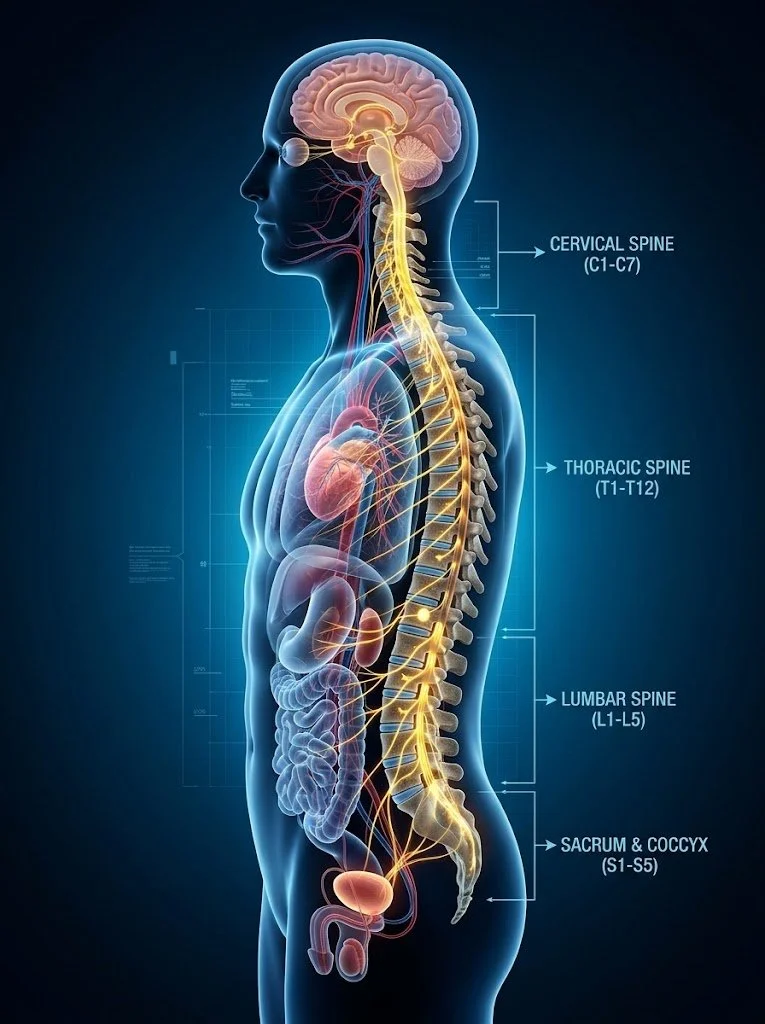
1. The Cervical Spine (C1–C7): The Gateway to the Brain, Cranial Circulation, and Vagus Nerve
Anatomical & Visceral Governance: The Upper Cervical spine (C1–C3) directly governs cranial blood flow, brain oxygenation, intracranial pressure, inner ear balance, vagus nerve tone, and sleep architecture. The Lower Cervical spine (C4–C7) innervates the thyroid and parathyroid glands, vocal cords, pharynx, the diaphragm (via the phrenic nerve), and the motor and sensory nerves of the neck, shoulders, arms, and hands.
Potential Health Threats & Illnesses: Chronic migraines, tension headaches, severe insomnia, vertigo, tinnitus, chronic fatigue, brain fog, memory decline, treatment-resistant anxiety and depression, neurogenic hypertension, hypothyroidism, and cervical radiculopathy (numbness, tingling, or weakness in the arms and hands).
Why Illness Occurs: Forward-head posture ("tech neck") or upper cervical subluxation flattens the natural cervical curve and mechanically kinks the vertebral arteries and internal jugular veins. This reduces oxygen and glucose delivery to the brain while trapping neuro-inflammatory cellular waste. Simultaneously, mechanical irritation of the upper cervical sympathetic ganglia and the vagus nerve (which passes directly in front of the C1–C2 atlas and axis vertebrae) locks the brain and body into a state of chronic sympathetic "fight-or-flight" hyperactivity—destabilizing mood, sleep, blood pressure, and thyroid metabolism.
2. The Thoracic Spine (T1–T12): The Engine of Cardiopulmonary, Digestive, and Metabolic Vitality
Anatomical & Visceral Governance: The Mid- and Lower-Thoracic spine (T1–T12) anchors the protective rib cage and houses the sympathetic autonomic nerve ganglia that directly innervate pulmonary function, cardiac rhythm, coronary blood flow, gastric motility, hepatic detoxification, gallbladder secretion, pancreatic insulin regulation, spleen immunity, and small intestine nutrient absorption.
Potential Health Threats & Illnesses: Functional cardiac arrhythmias, palpitations, chest tightness, shortness of breath, asthma, chronic bronchitis, acid reflux (GERD), gastritis, sluggish liver detoxification, gallstones, blood sugar dysregulation, metabolic syndrome, and chronic mid-back pain.
Why Illness Occurs: Excessive thoracic kyphosis (slouched or rounded shoulders) or rotational vertebral misalignment physically restricts rib-cage expansion, reducing lung vital capacity and oxygen intake. At the same time, mechanical compression along the thoracic facet joints irritates the somatovisceral nerve reflexes exiting between T1 and T12. When thoracic nerves to the heart (T1–T4) are impinged, autonomic cardiac rhythm becomes erratic; when nerves to the stomach, liver, and pancreas (T5–T10) suffer chronic compression and reduced microcirculation, digestive enzyme secretion falters, gastric acid refluxes, and hepatic-metabolic clearance slows down.
3. The Lumbar Spine (L1–L5): The Pillar of Renal Filtration, Elimination, and Lower-Body Mobility
Anatomical & Visceral Governance: Bearing the majority of the upper body's weight, the Lumbar spine (L1–L5) governs renal filtration (kidneys), adrenal gland stress response, the large intestine and colon, the appendix, the upper bladder, and the major femoral and sciatic nerve plexuses that power the hips, knees, legs, and feet.
Potential Health Threats & Illnesses: Impaired kidney filtration, chronic adrenal exhaustion, chronic constipation, irritable bowel syndrome (IBS), abdominal bloating, sciatica, lumbar disc herniation, spinal stenosis, lower-extremity vascular edema, cold feet, peripheral neuropathy, and progressive loss of walking mobility and balance in elderly patients.
Why Illness Occurs: Loss of the natural lumbar lordotic curve—or excessive pelvic tilt from prolonged sitting or muscular weakness—crushes the lumbar intervertebral discs and narrows the neural canals. Compression of L1–L2 autonomic pathways diminishes renal blood flow and over-stimulates adrenal cortisol release, while impingement of L3–L5 nerve roots slows peristaltic wave contractions in the colon and starves the lower extremities of neural drive and venous-lymphatic return—leading to severe leg pain, swelling, and mobility decline.
4. The Sacral and Coccygeal Spine (S1–S5 & Coccyx): The Foundation of Pelvic Vitality and Craniosacral Balance
Anatomical & Visceral Governance: The fused vertebrae of the Sacrum (S1–S5) and the Coccyx form the structural keystone of the pelvis, governing pelvic and reproductive organ vitality, bladder and bowel sphincter control, pelvic floor stability, and the sacral parasympathetic nerve plexus ("rest, digest, and repair").
Potential Health Threats & Illnesses: Infertility, painful menstruation, prostate and gynecological dysfunction, urinary incontinence or retention, pelvic floor weakness, hemorrhoids, sacroiliac (SI) joint pain, hip degeneration, and compensatory scoliosis ascending the entire spine.
Why Illness Occurs: Because the sacrum serves as the physical base upon which the entire spinal column stands—and anchors the lower attachment of the dural membrane enveloping the spinal cord—any rotational twist or tilt in the sacrum immediately forces the lumbar, thoracic, and cervical vertebrae above it into compensatory misalignment. Furthermore, mechanical compression of the sacral foramina chokes the sacral parasympathetic nerves, cutting off restorative nerve signaling and arterial microcirculation to the pelvic and reproductive organs.
Restorative Modalities:
Realigning the Spine and Relaxing the Nervous System for Ultimate Health Harmony
Unlike synthetic medications that temporarily mask pain or override organ receptors while leaving mechanical nerve compression intact, structural restoration physically removes the interference blocking the body's innate healing intelligence. Within the Mister Shields Longevity Series, a multi-disciplinary restorative protocol works in concert with AI diagnostics and assistive robotics to realign the corrected spinal cord and restore effortless brain-organ communication:
1. Precision Chiropractic, Osteopathic, and Zhenggu Structural Adjustments
Guided by 30-second, millimeter-accurate 3D Smartphone and iPad LiDAR posture and spinal maps, clinicians identify the exact coronal, sagittal, and rotational deviations across C1 to S5. Through gentle, targeted chiropractic adjustments, osteopathic manipulative therapy, or classical Chinese Zhenggu (整骨) structural alignment, providers decompress impinged facet joints and restore vertebrae to their natural anatomical position. The physiological response is immediate: mechanical pressure on the spinal nerve roots and vertebral blood vessels is released, restoring electrical nerve conductivity and arterial microcirculation to the corresponding organs.
2. Targeted Physical Therapy and Myofascial Decompression
Bones only go where muscles pull them. When a spine has been out of alignment for months or years, surrounding paraspinal muscles, ligaments, and fascia adapt by locking into asymmetrical spasms and fibrotic adhesions. Specialized physical therapy, neuromuscular re-education, and myofascial release lengthen contracted muscle fibers and dissolve fascial tension, ensuring that newly aligned vertebrae are not pulled back into subluxation.
3. Corrective Biomechanical Exercise and Deep Postural Muscle Retraining
To achieve permanent structural stability, patients engage in targeted therapeutic exercises designed to strengthen the deep intrinsic muscles of the spine (such as the multifidus, transverse abdominis, and pelvic floor stabilizers) alongside mindful biomechanical movement disciplines such as Tai Chi spinal conditioning. Supported by intelligent assistive and rehabilitative robotics—which provide safe weight-support and real-time posture biofeedback for elderly, disabled, and recovering patients—these exercises retrain the body's neuromuscular memory to hold its natural S-curve effortlessly throughout daily life.
4. Autonomic Nerve Relaxation and Craniosacral Signal Restoration
Once structural realignment and muscular balance are achieved, targeted nerve-relaxation therapies—including vagus nerve toning, craniosacral decompression, breathwork, and gentle spinal traction—calm residual neuro-inflammation along the spinal cord meningeal sheaths. As mechanical tension is lifted from the corrected spinal cord, the autonomic nervous system shifts smoothly out of chronic stress into restorative parasympathetic balance. Clear, uninterrupted bio-electrical signals and abundant oxygenated blood flow freely once more between the brain and every visceral organ—establishing the ultimate physiological harmony required for a drug-free, vibrant, and long-lasting life.
The Next Horizon of Healthcare Technology:
Uniting Enterprise AI Agents, Spinal-Functional Diagnostics & Compassionate Robotic Caretakers
A New Era of Intelligent Medicine: How AI Technology Is Transforming Patient Care Today
Presented by Mister Shields Longevity Series Task Force Team
For decades, patients and doctors alike have been trapped inside a fragmented, administrative-heavy healthcare maze—where medical records are locked in isolated hospital silos, physicians spend more time typing into computers than looking at patients, and chronic illnesses are managed as a lifelong "medicine cabinet" of symptom-suppressing prescriptions. Today, a technological revolution is changing that reality, bringing genuine hope that modern healthcare is evolving to cure patients at the core rather than merely patching surface symptoms.
Inspired by the groundbreaking enterprise healthcare vision unveiled at Oracle AI World 2026, the next generation of healthcare technology embeds governed, voice-first Clinical AI Agents and a cloud-native, portable AI Patient Portal directly into global medical workflows. Instead of forcing hospitals to rip and replace their existing systems, open-standard interoperability (SMART on FHIR) allows intelligent AI agents to connect across disparate hospital networks, laboratories, and specialty clinics instantly.
For the everyday patient, this means your complete longitudinal health story finally travels with you. For physicians and nurses, ambient voice AI agents listen during clinical consultations, automatically synthesize decades of complex medical history, surface critical diagnostic insights in seconds, and eliminate clerical burnout—freeing healers to focus entirely on human care.
From Symptom Management to True Root-Cause Cures:
Connecting the Four-Layer Inquiry and Spinal Alignment Imagery
While unifying acute hospital records is a monumental leap forward, the Mister Shields Longevity Series advocates taking this AI Agent infrastructure to its ultimate clinical destiny: transitioning from an episodic "medicine cabinet" model to a continuous, root-cause curing engine.
By expanding the Oracle Health AI Agent ecosystem to connect China's Four-Layer Functional Medicine Inquiry with 3D Smartphone and iPad LiDAR Spinal Alignment Imagery, AI agents become master diagnostic detectives:
Synthesizing the Whole-Body Picture:
Using Unified AI Vector Search and Knowledge Graph technology, the AI agent seamlessly merges a patient's environmental and lifestyle exposures (Layer 1), cellular and multi-omics biomarkers (Layer 2), systemic organ-network balance (Layer 3), and clinical symptoms (Layer 4) with a 30-second, radiation-free 3D spinal alignment and posture scan.
Pinpointing the Core of Illness:
Rather than matching an isolated symptom to an immediate pharmaceutical prescription, the AI agent cross-references the patient's 3D vertebral curvature (from C1 to S5) against their organ blood panels and autonomic nerve telemetry. It alerts the physician when a mechanical spinal subluxation is pinching the exact nerve root or restricting the arterial microcirculation supplying a distressed organ.
1. Precision Health Monitoring & On-Time Medication Stewardship
For patients managing complex recovery protocols, cognitive decline, or severe mental health challenges, taking the wrong dosage—or forgetting a critical supplement or medication—can lead to emergency hospitalization or tragic overdose. The Robotic Caretaker monitors the patient's vital signs, hydration, and daily rhythms non-invasively, ensuring that prescribed nutritional protocols, botanical remedies, and necessary medications are delivered and taken accurately and on time.
Turning Routine into Joy:
Using gentle humor, playful encouragement, music, and warm conversation, the robot transforms daily physical therapy, spinal posture exercises, and healthy meals from a chore into the happiest moments of the patient's day.
Prescribing Restorative Cures Over Lifelong Drugs:
Guided by this unified root-cause blueprint, healthcare providers can prescribe the precise combination of structural spinal realignment, physical therapy, targeted botanical and nutritional network pharmacology, and minimal-effective Western medication to truly cure the patient at the core.
Continuous AI Healing Monitoring & Adaptive Care:
Healing does not end when the patient leaves the clinic. Professional Oracle Health AI Coaching Agents continuously monitor the patient's recovery trajectory in real time—tracking wearable biometrics, follow-up 3D posture scans, sleep quality, and symptom resolution. As the patient's spine realigns and cellular inflammation subsides, the AI agent collaborates with the physician to dynamically adjust treatment protocols, taper off unnecessary medications, and fine-tune supplemental therapies—elevating the quality, safety, and speed of the patient's healing experience.
Bringing Care Home:
Why Humanoid Robotic Caretakers Must Become a Standard Healthcare Benefit
Even the most brilliant diagnostic AI in the cloud needs a gentle, capable pair of hands in the physical world—especially for those who cannot navigate recovery alone. Across the globe, millions of elderly citizens, individuals living with physical or neurological disabilities, and mental health patients face their greatest struggles not inside the doctor's office, but during the twenty-four hours of daily life at home. Families are overwhelmed, professional long-term care nursing faces an acute global workforce shortage, and vulnerable patients frequently suffer from missed treatments, physical falls, immobile isolation, and crushing loneliness.
With humanoid robotics—led by breakthroughs such as Tesla Optimus (Tesla Bot) and next-generation assistive robotics—achieving extraordinary dexterity, balance, and conversational intelligence, the Mister Shields Longevity Series strongly recommends that Robotic Caretakers be formally recognized and covered as a core healthcare insurance benefit for elderly, disabled, and mental health patients.
Connected directly to the patient's Oracle Health AI Agent care plan, an in-home humanoid Robotic Caretaker serves as a tireless, 24/7 guardian of physical and emotional recovery:
2. Real-Time Clinical Communication & Emergency Action
Bridging the gap between the living room and the hospital, the Robotic Caretaker maintains a secure, real-time telemetry link with the patient's healthcare providers via the cloud. If the robot's vision and biometric sensors detect an early warning sign—such as an unsteady gait, a sudden blood pressure shift, autonomic distress, or a depressive crisis—it immediately communicates with the medical team's AI agents to trigger timely clinical intervention before an emergency occurs.
3. Physical Exercise Assistance to Strengthen Mobility, Spine & Circulation
True longevity requires movement. For elderly patients with frailty, individuals with disabilities, or patients recovering from spinal misalignment, exercising alone can be intimidating or unsafe. Acting as a patient, physically supportive spotter and rehabilitation partner, the Robotic Caretaker guides and assists patients through their daily corrective spinal exercises, physical therapy stretches, and gentle Tai Chi biomechanical conditioning—safely rebuilding muscle strength, restoring spinal curvature, and stimulating vital blood and lymphatic circulation throughout the body.
The Ultimate Medicine:
A Humorous, Sunny Robotic Companion to Heal the Heart and Mind
Above all technical capabilities, the most profound gift a Robotic Caretaker provides is unconditional daily companionship. Clinical science has repeatedly proven that chronic loneliness, social isolation, and unyielding psychological stress trigger severe neuro-inflammation, suppress immune function, and accelerate cognitive and physical decline—particularly among young mental health patients and isolated seniors.
Yet a caretaker should never feel like a cold, clinical machine in the home. Within our vision for the Mister Shields Longevity Series, in-home Robotic Caretakers are trained with warm, uplifting Affective AI personalities—designed to be humorous, joyful, and sunny companions every single day!
Just as the pure, spontaneous playfulness of a giggling baby or an affectionate puppy can instantly melt away human sorrow, lower cortisol stress hormones, and spark a flood of healing endorphins, oxytocin, and dopamine, a cheerful, witty Robotic Caretaker brings light and laughter into the home:
Anchoring Mental and Emotional Stability:
For a young person battling deep depression or an elderly resident living alone, waking up every morning to a sunny, devoted companion who listens without judgment, shares a lighthearted joke, celebrates every small recovery milestone, and offers comforting presence provides an unshakeable anchor of emotional stability.
By uniting Oracle Health's enterprise AI intelligence, East-meets-West Functional Medicine, 3D Spinal-Visceral Alignment, and joyful, humanoid Robotic Caretakers, we move beyond a healthcare system that merely dispenses pills—creating a compassionate, interconnected ecosystem that heals the root cause of illness, protects the vulnerable, and fills every day of human longevity with health, dignity, and sunshine.
Safeguarding the Future of Health:
Regulations, Safety Governance, and Patient-First Privacy in the AI and Robotic Care Era
Guarding the Bridge: Regulatory Governance, Third-Party Oversight, and Patient Privacy
Presented by Mister Shields Longevity Series Task Force Team
As artificial intelligence and health technology transition from development into clinical deployment, patient safety and data privacy must serve as the absolute cornerstone of innovation. Because clinical AI systems directly impact human life, they cannot be deployed without rigorous regulatory frameworks, independent oversight, and multi-layered data protection.
Regulatory Guidance & Standards Alignment: Just as the U.S. Food and Drug Administration (FDA) regulates Software as a Medical Device (SaMD) and Machine Learning-enabled devices under strict quality management systems (such as ISO 13485 and Good Machine Learning Practice), healthcare AI agents must operate under clear compliance pathways. Internationally, frameworks like the EU AI Act classify healthcare AI as "high-risk," mandating rigorous technical documentation, risk management (ISO 14971), and human oversight.
Independent Third-Party Evaluations: Before any clinical AI model or spinal diagnostic agent interacts with a patient, it must undergo independent, peer-reviewed audits and bias testing across diverse demographic groups. Third-party evaluation boards ensure that algorithms are free from hidden biases, perform with clinical accuracy, and adhere to strict ethical standards.
Absolute Privacy Protection: Patient data must never be exposed to public AI models or vulnerable networks. Operating under strict HIPAA compliance, Health Insurance Portability and Accountability Act guidelines, and Business Associate Agreements (BAAs), health platforms must enforce "minimum-necessary" data sharing, ensuring that protected health information (PHI) is rigorously encrypted both in transit and at rest using advanced cryptographic standards (such as AES 256-bit encryption).

Uniting Hope and Innovation for Tomorrow
Collaborate with us to build a vibrant, thriving world. By integrating transformational AI solutions, we are safeguarding a sustainable future for generations to come.
A peaceful Himalayan valley village with a flowing river, an arched bridge, blooming cherry blossoms, and snow-capped mountains in the background.