
Turn the Tide:
From Glacial Threat to Thriving Communities
Join the Fountain Blue Initiative to safely drain the Himalayas' dangerous "barrel lakes" and transform that water into clean energy, reliable irrigation, and sustainable life for local villages.
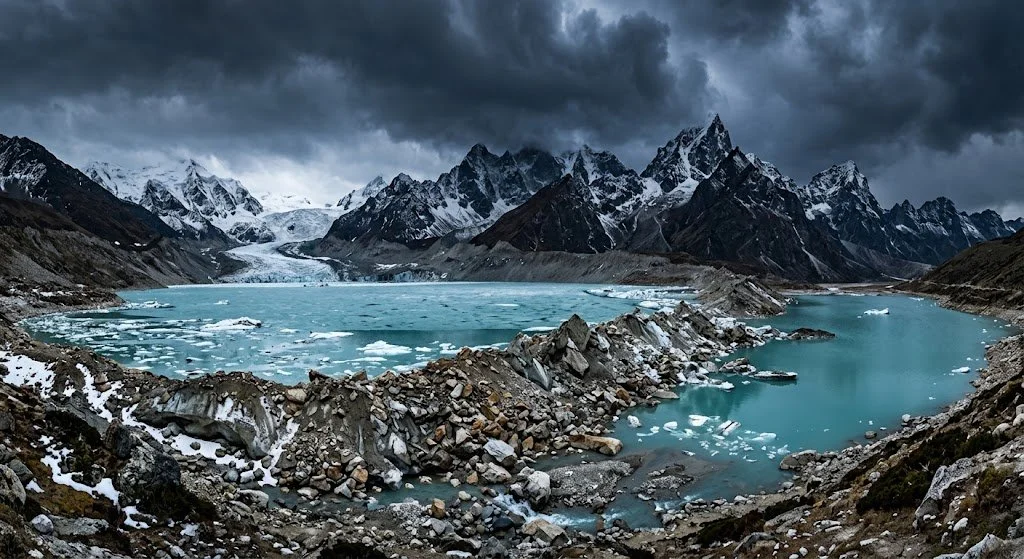
Panoramic view of a fragile glacial lake in the high Himalayan mountains with a natural moraine dam of loose rocks and ice under ominous stormy clouds.
Glacier Lake Drainage Project
Act Now:
Breaking the Cycle:
Engineering Solutions to Prevent Himalayan Glacial Floods
Climate change is rapidly altering the landscape of the Himalayas. Rising temperatures are accelerating the melting of deep ice, causing massive chunks of glaciers to detach from the high-altitude, steep slopes. This glacial retreat creates a dangerous phenomenon: the rapid formation of "barrel lakes" (glacial lakes) held back only by unstable natural dams of loose rock and ice.
As we recently witnessed with the devastating disaster at the border of Nepal and Tibet, China, when these natural dams fail, the resulting massive flooding is catastrophic. Right now, rescue missions to recover survivors and relocate villagers to permanent, safe settlements must be the absolute first priority.
However, the threat is ongoing. Continued climate change and heavy monsoon rains mean these lakes will continue to fill and eventually burst. To allow rescue missions and long-term reconstruction to proceed without the constant, immediate threat of another outburst, we must proactively manage the water levels in these high-altitude lakes.
If we utilize the following two methods to pump the water out to downstream rivers, the danger of barrel lakes bursting can be brought under control.
Proposal 1:
The Floating Pump Platform with Drone Management
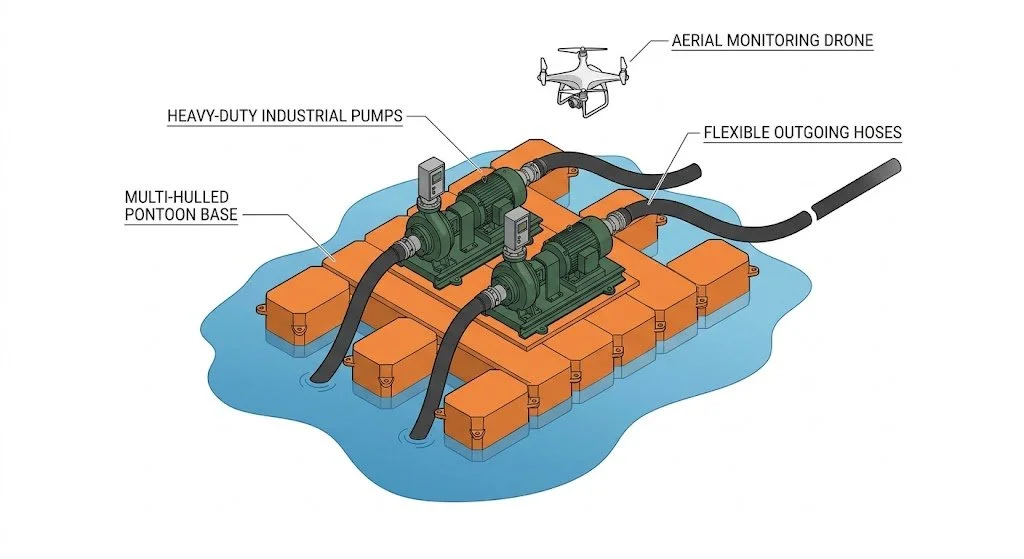
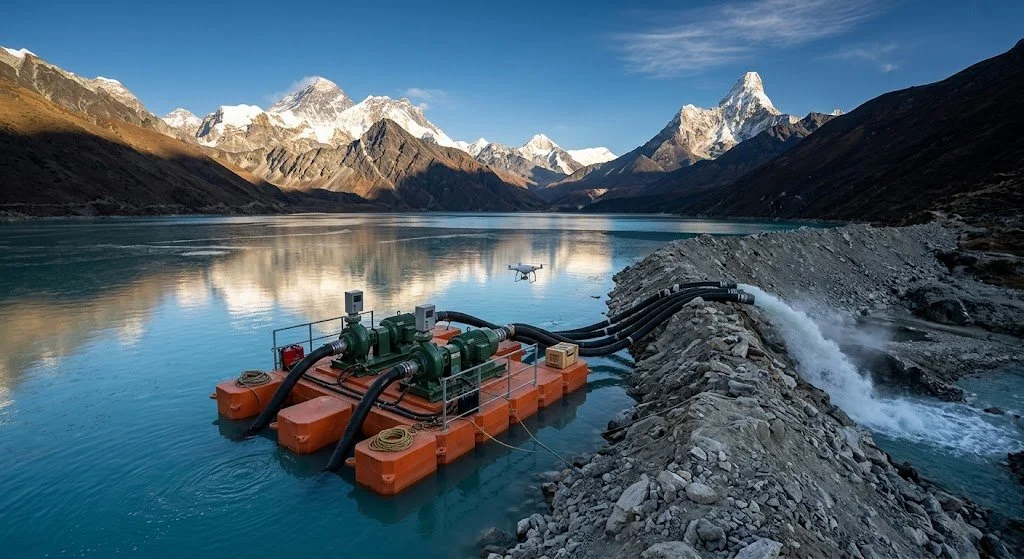
Instead of relying on a single, small floating drone—which lacks the physical power to move massive volumes of water—the most practical execution of this concept is a large, multi-hulled, buoyant pump platform.
Credit: Visualizations created using Google AI technology
How this design works:
This floating pontoon supports heavy, industrial-grade pumping equipment directly on the surface of the barrel lake. By floating on the water, the pumps don't have to fight as much vertical gravity to draw the water up from the depths. The heavy lifting is localized to the surface, and the water is pushed through large, flexible pipes over the natural dam to safely drain into the river below.
To solve the management and safety issues in these highly dangerous, remote areas, a dedicated aerial drone is paired with the platform. Instead of lifting water, the drone acts as the system's eyes and ears. It is deployed to inspect the integrity of the pipes, check the floating sensors, monitor the moraine wall for signs of collapse, and guide light maintenance—keeping human engineers safely out of the immediate danger zone.
Credit: Visualizations created using Google AI technology
Proposal 2:
Shore-Based Hybrid Siphon System
When moving water over the high, unstable rim of a glacial lake, fighting gravity requires an immense amount of power. Transporting fuel for massive generators up into the Himalayas during monsoon season is logistically nearly impossible.
This is where the Siphon Advantage becomes critical.
Credit: Visualizations created using Google AI technology
How this design works:
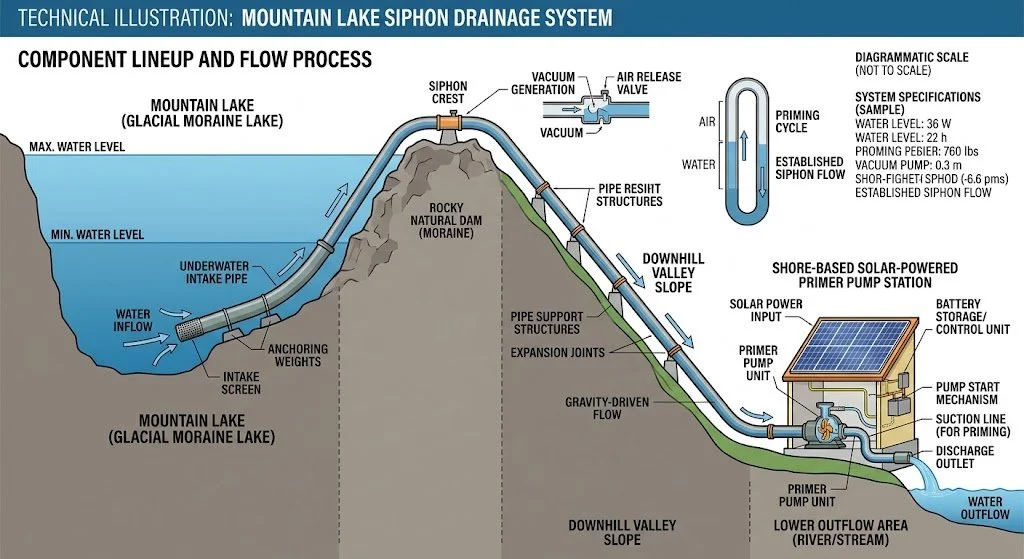
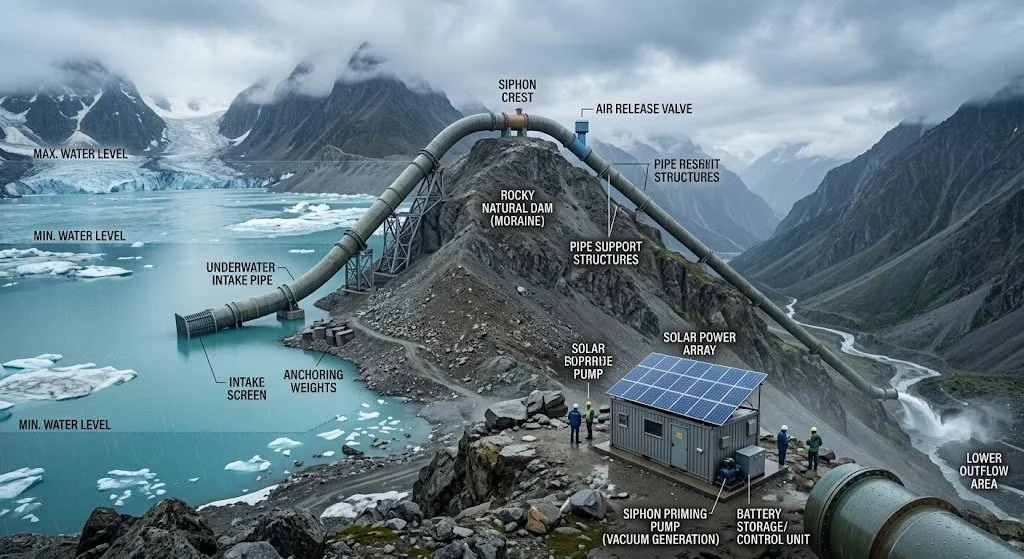
A siphon system uses the natural laws of physics to drain the lake with incredibly low energy requirements. The system involves laying a large, continuous pipe from inside the lake, up and over the moraine wall, and down into the lower river valley.
Credit: Visualizations created using Google AI technology
Why does it only need energy at the beginning?
Shore-based hybrid pumps (powered by a combination of solar panels and small backup generators) are only turned on to "prime" the system. They run just long enough to completely fill the pipe with water, removing all the air.
Once that full, continuous water column is established over the moraine and begins flowing downhill to the river, the pumps can be turned off. Gravity takes over. The weight of the water falling down the long side of the pipe creates a vacuum that continuously pulls more water up from the lake. The siphon will run passively, 24 hours a day, pulling millions of gallons of water out of the dangerous barrel lake using zero additional pumping power, effectively neutralizing the flood threat.
Transforming Glacial Threat into Sustainable Community Resources:
A Decentralized Infrastructure Plan
As climate change accelerates the melting of alpine glaciers, the rapid formation of high-altitude "barrel lakes" (glacial lakes) has become one of the most critical threats to mountainous regions worldwide. The sudden breaching of these natural dams causes catastrophic Glacial Lake Outburst Floods (GLOFs) and devastating landslides.
Our immediate priority must always be the preemptive, controlled drainage of these unstable lakes. However, simply removing the water is only half the solution.
In this long-term planning presentation, Sustainable Society outlines a strategic, decentralized infrastructure model. This plan captures the preemptively drained glacial water and transforms a lethal hazard into vital, life-sustaining resources for downstream communities:
agricultural irrigation, district cooling, and localized micro-hydroelectric power.
Phase 1:
The Decentralized Community Water Hub
Traditionally, large volumes of mountain runoff have been managed by massive, centralized dams. However, as extreme weather becomes more frequent, relying on single-point, large-scale infrastructure in geologically unstable regions is increasingly dangerous.
Our proposal shifts the paradigm to Decentralized Community Water Hubs.
Credit: Visualizations created using Google AI technology
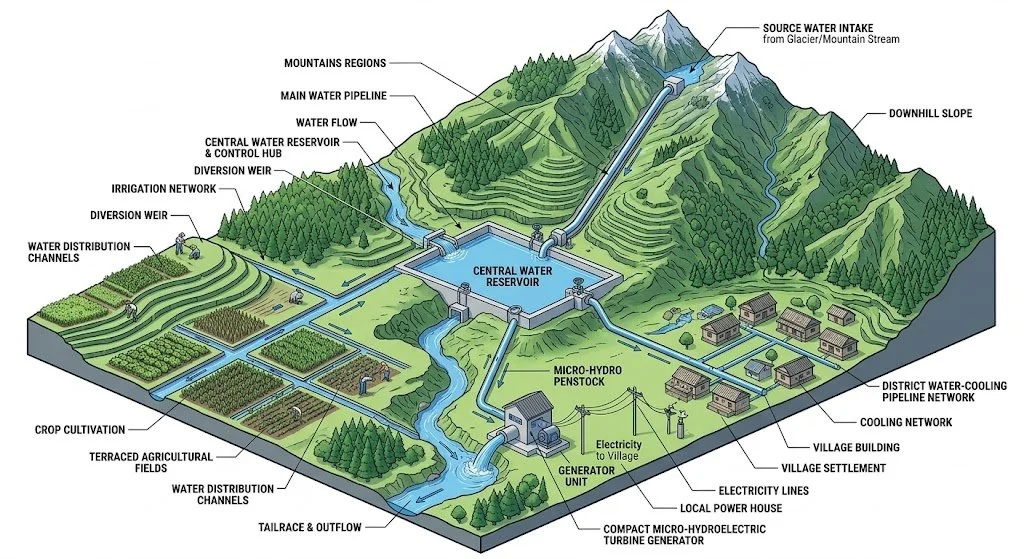
Through a secure main water pipeline, the water drained from high-altitude barrel lakes is safely channeled downhill into a central, reinforced community reservoir. Rather than hoarding the water for a single purpose, this hub acts as a distribution center that diverges the flow into three critical community resilience networks:
Sustainable Agricultural Irrigation
A network of diversion weirs and distribution channels feeds terraced agricultural fields, securing local food production against worsening seasonal droughts.
District Water-Cooling Infrastructure
A portion of the cold glacial water is routed through a localized pipeline network connected to village settlements, providing highly efficient, zero-emission summer cooling.
Micro-Hydroelectric Power Generation
The remaining pressurized flow is directed into a localized powerhouse to generate electricity for the immediate community.
Phase 2:
The Case for Resilient Micro-Hydro Power
When discussing power generation from mountain runoff, the default engineering solution has historically been the construction of large-scale dams.
We strongly argue against this approach in alpine environments affected by rapid glacial melt.
Large dams are highly vulnerable to the unpredictable surges and immense sediment loads caused by melting glaciers. A failure of a large dam due to a GLOF or extreme weather event amplifies the disaster exponentially. Furthermore, large dams cause massive ecological disruption and require billions of dollars and decades to build.
Instead, our infrastructure plan relies on Compact Micro-Hydroelectric Turbine Generators.
Gravity-Fed Efficiency
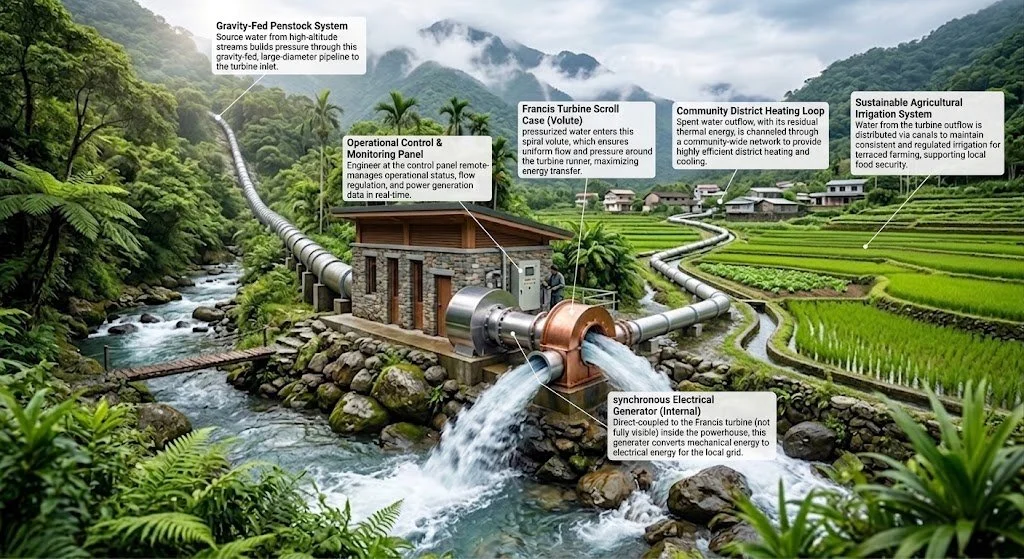
By utilizing the extreme elevation changes of mountainous regions, a gravity-fed penstock system allows source water to build immense pressure as it travels downhill to the turbine inlet.
Credit: Visualizations created using Google AI technology
Advanced Enclosed Turbines
Pressurized water enters a Francis Turbine Scroll Case (Volute). This enclosed design ensures uniform flow and pressure around the turbine runner, maximizing mechanical energy transfer to the synchronous electrical generator without the need to dam an entire river valley.
Cascading Utility
The genius of the micro-hydro approach is its integration. The spent water outflow from the turbine—having generated electricity—still retains residual thermal properties. It can be immediately channeled into the community district heating/cooling loop, and subsequently distributed via canals to maintain consistent irrigation for terraced farming.
Engineering for Resilience
We cannot stop the glaciers from melting, but we can engineer our environments to adapt safely. By shifting away from vulnerable, centralized mega-dams and embracing agile, decentralized water hubs and micro-hydro power, we can neutralize the threat of glacial flooding. In its place, we establish a localized infrastructure that guarantees food security, sustainable temperature control, and resilient power generation for generations to come.
This proposal is currently under review by leading structural geology and disaster mitigation engineering professors.
We invite global collaboration to standardize and deploy these systems in vulnerable regions worldwide.
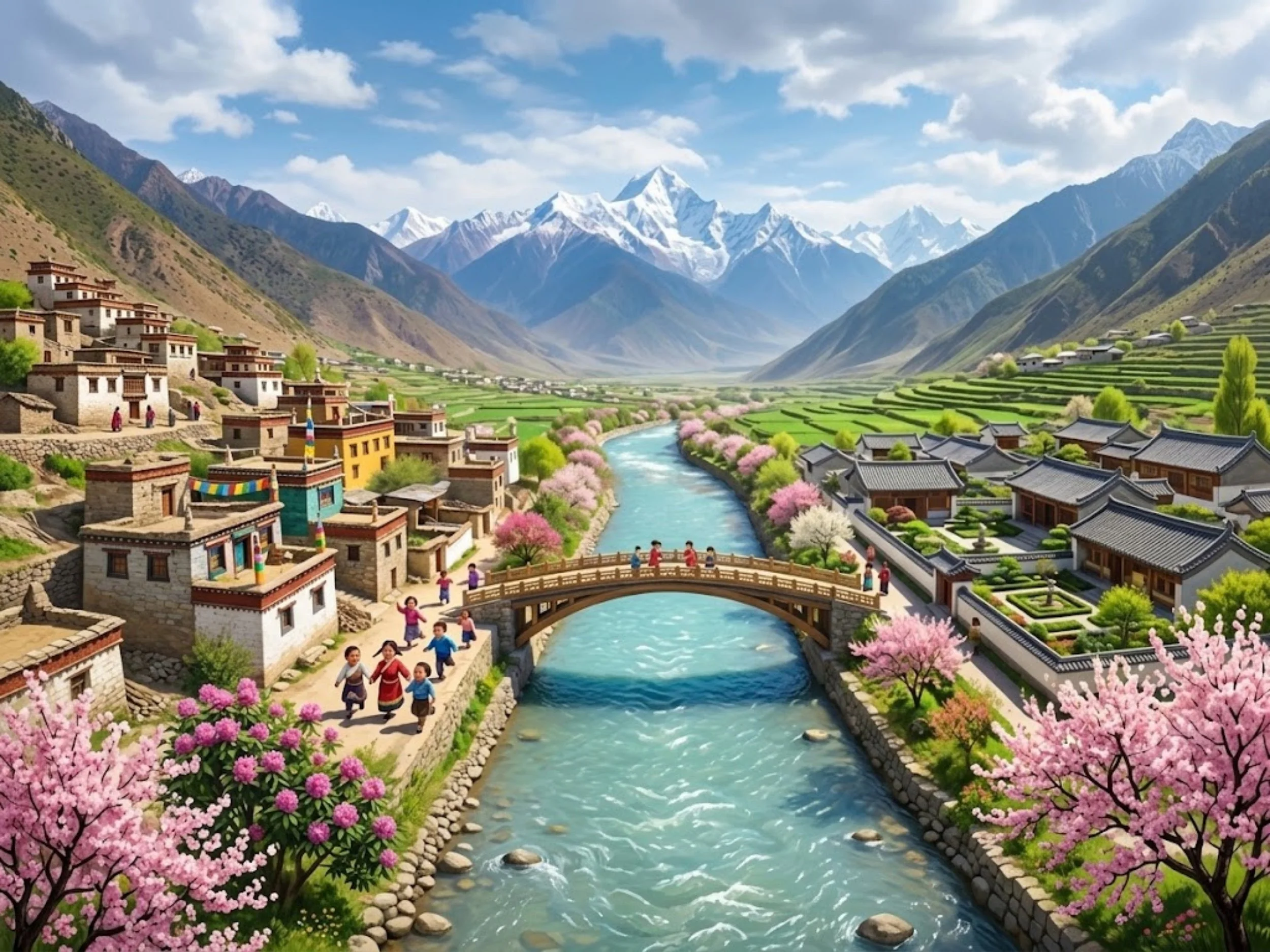
Uniting Hope and Innovation for Tomorrow
Collaborate with us to build a vibrant, thriving world. By integrating transformational AI solutions, we are safeguarding a sustainable future for generations to come.
A peaceful Himalayan valley village with a flowing river, an arched bridge, blooming cherry blossoms, and snow-capped mountains in the background.