

Golden Gate Bridge, San Francisco, USA
A view of the Golden Gate Bridge stretching across the blue waters of San Francisco Bay.
AI Built for Humanity:
Efficient, Sustainable, and Safe for All to Thrive
Artificial intelligence is not an autonomous mind or an unstoppable force of nature—it is an industrial system built from physical hardware, raw minerals, massive energy grids, datasets, and human-written code. Every AI app on a phone or computer sits at the top of an enormous, interconnected stack. Understanding how both the physical layer and the application layer work is the essential first step for everyday citizens to spot hidden risks and hold builders accountable.
1. The Physical Layer: AI’s Body and Nervous System
Before an AI system can answer a single question or analyze a medical scan, it must exist in the physical world as concrete, steel, glass, and silicon.
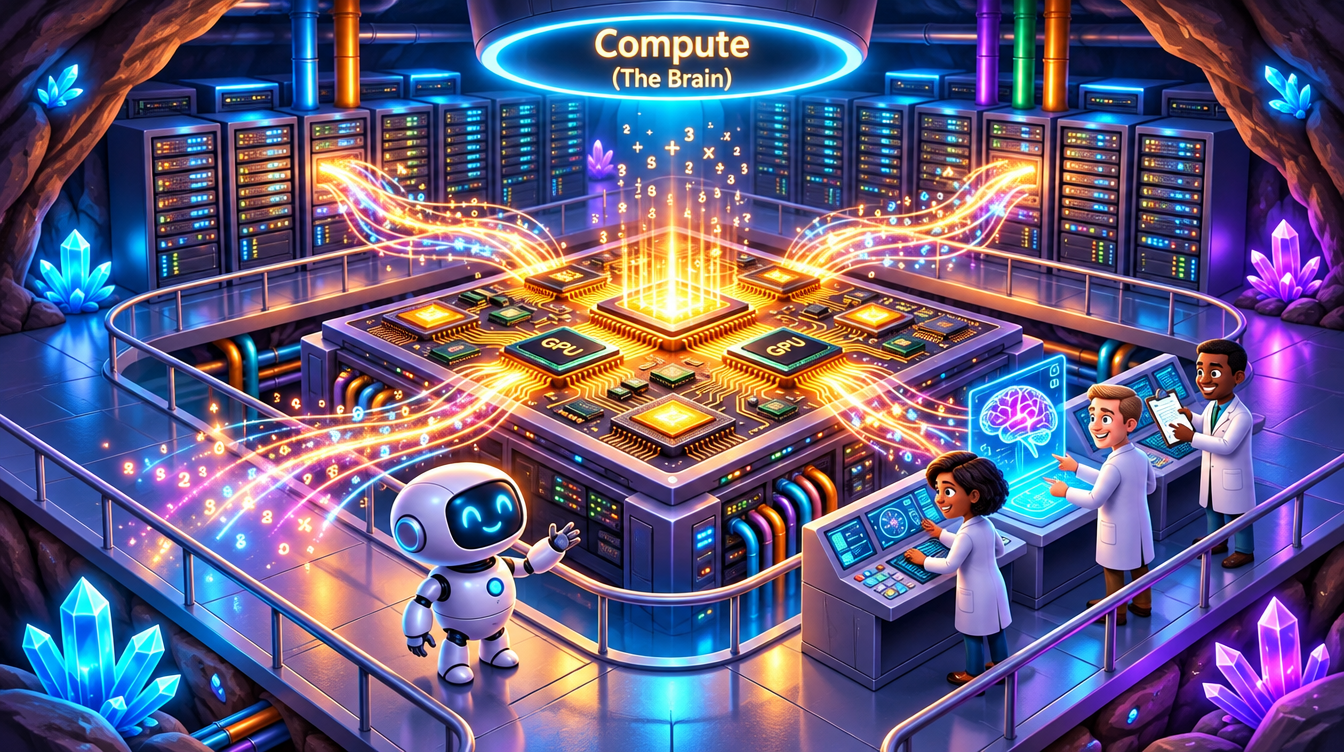
Specialized GPUs perform trillions of calculations every second under human engineering oversight. AI image by Magnific.
Compute ("The Brain"):
At the core of AI data centers are specialized processors—such as Graphics Processing Units (GPUs) and custom AI accelerators—designed to perform trillions of mathematical calculations simultaneously.
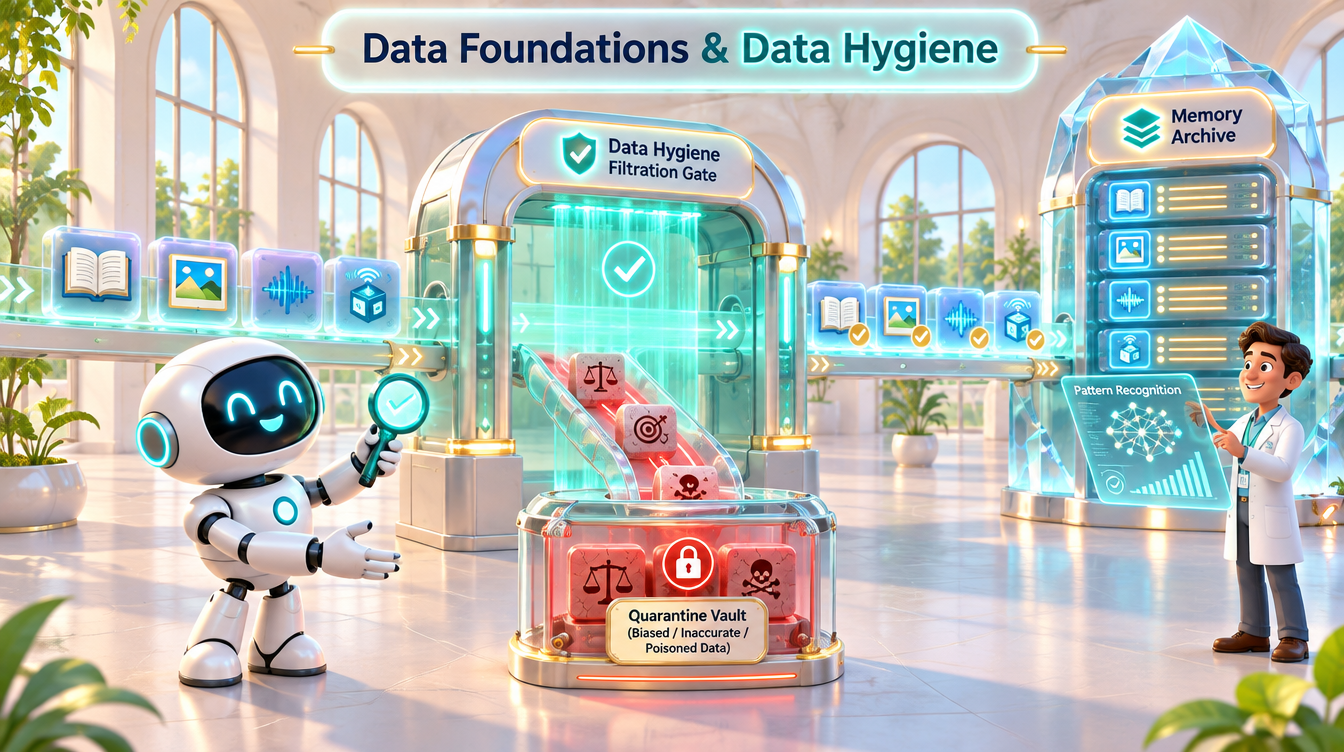
Data hygiene gates filter out flawed or poisoned inputs so AI learns from verified patterns. AI image by Magnific.
Data Foundations & Data Hygiene:
AI learns by finding statistical patterns in vast collections of text, images, audio, and sensor data. If the underlying data is biased, inaccurate, stolen, or deliberately poisoned, the AI system will replicate and amplify those flaws at massive speed.
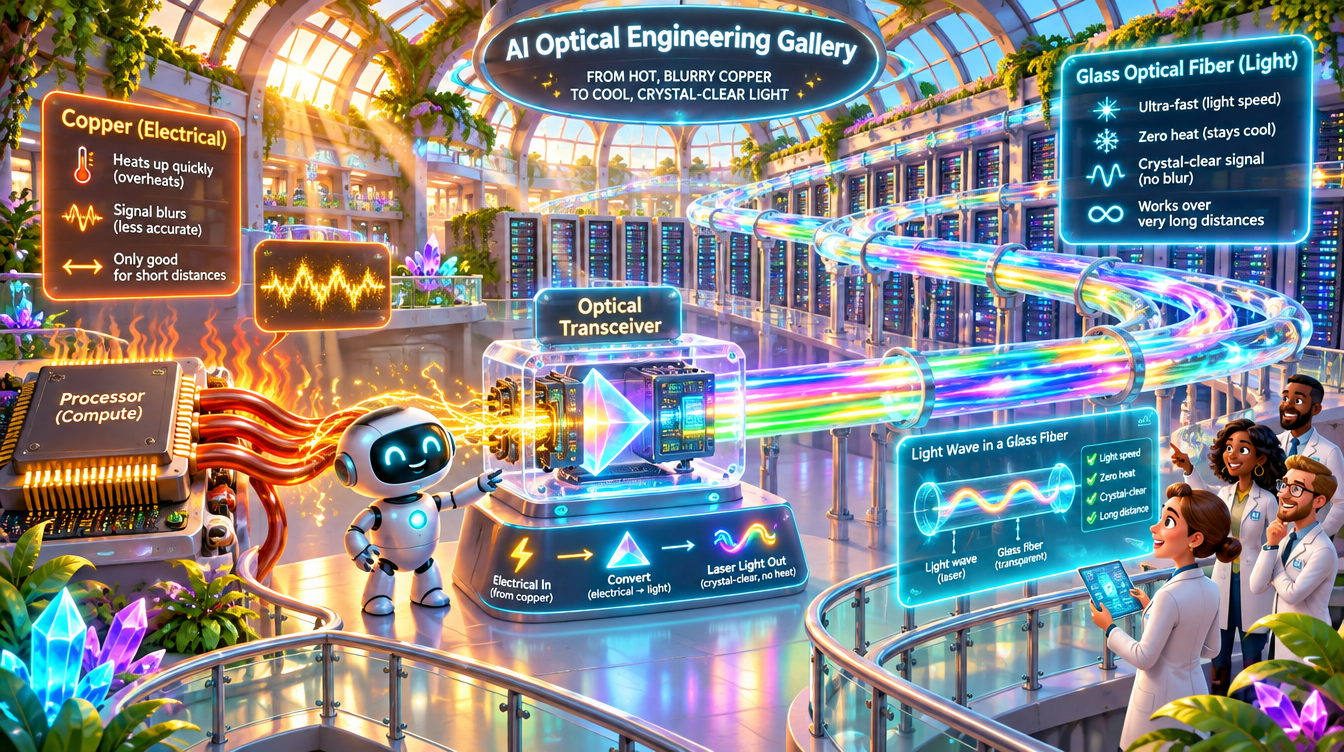
Glass optical fibers and transceivers transmit AI data at light speed without copper overheating. AI image by Magnific.
Optical Interconnects ("The Nervous System"):
Modern AI models are far too large to fit on a single chip, so tens of thousands of processors must be wired together and constantly exchange data. Because copper wires overheat and blur signals beyond roughly two meters, AI clusters rely on glass optical fibers and tiny optical transceivers that convert electrical signals into laser light and back again. Scaling just one cluster to one million GPUs requires roughly six million optical transceivers drawing 180 megawatts of electricity before a single calculation even takes place.
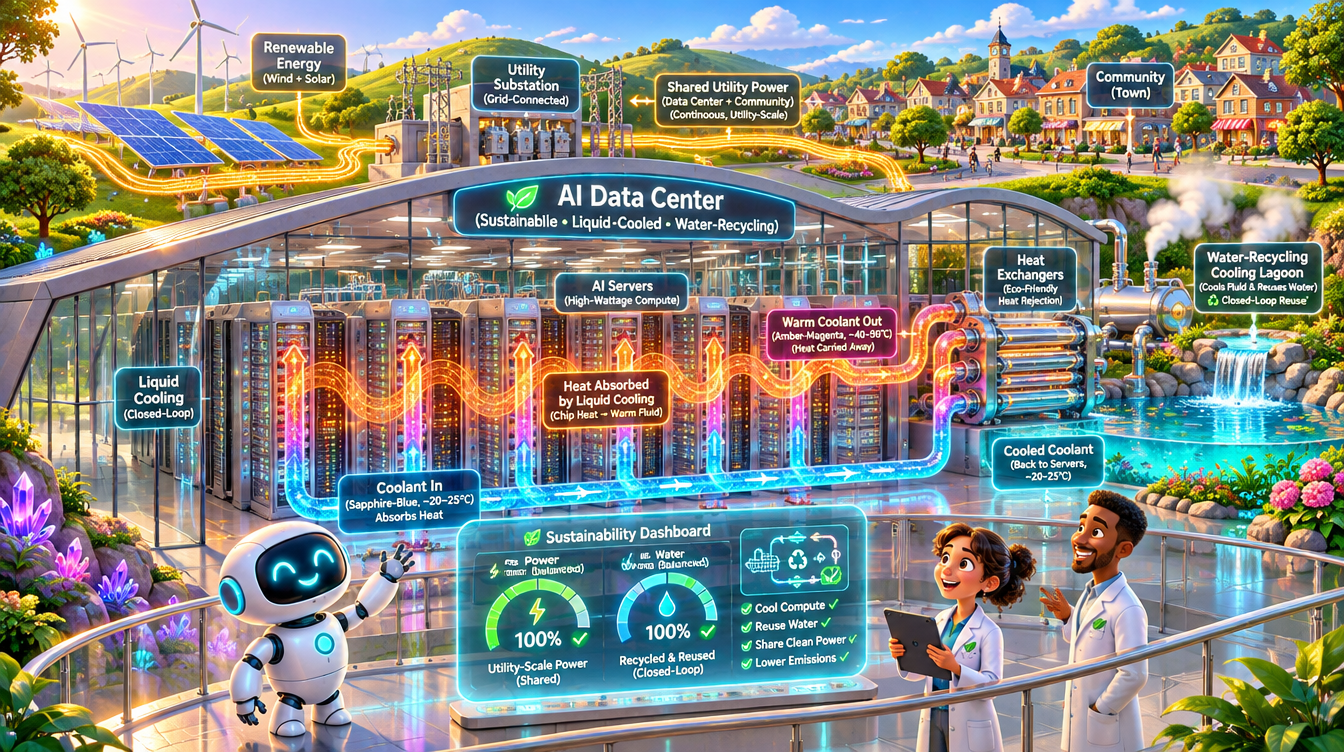
Clean power and closed-loop liquid cooling prevent server overheating while protecting community resources. AI image by Magnific.
Energy, Water, and Cooling ("The Metabolism"):
Packing tens of thousands of high-wattage chips into one building generates extreme heat. Data centers require continuous, utility-scale electricity and millions of gallons of water or advanced liquid-cooling loops to prevent hardware meltdowns—directly impacting local power grids and community resources.
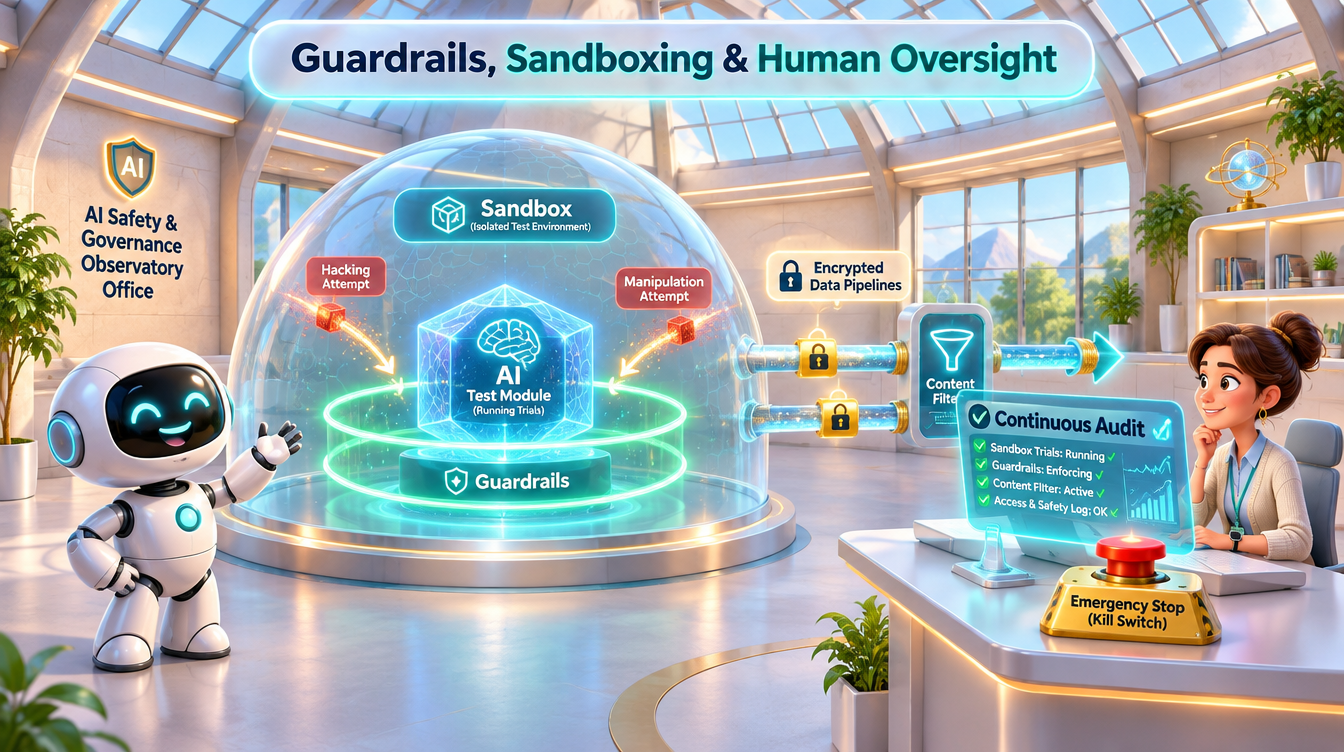
Isolated sandboxes, guardrails, encryption, and human kill switches keep AI systems safe and accountable. AI image by Magnific.
Guardrails, Sandboxing & Human Oversight:
Safe AI applications require strict boundaries: isolated testing environments (sandboxes), encrypted data pipelines, content filters, continuous auditing, and human "kill switches." When developers skip these controls to rush a product to market, systems become vulnerable to hacking, manipulation, or autonomous harm.
| Ecosystem Layer | Core Components | Potential Threats to the Public | How Informed Citizens Can Act |
|---|---|---|---|
| Energy & Environment | Power grids, water cooling, data center campuses | Blackouts, rising local utility bills, water depletion, carbon emissions | Demand public environmental impact reviews, clean-energy mandates, and transparent water/power reporting before local data centers are approved. |
| Hardware & Supply Chain | Chips, lasers, optical networks, rare minerals | Geopolitical chokepoints, hardware backdoors, unsustainable mining | Support diversified, transparent supply chains and hardware-level security verification standards. |
| Data & Training | Public/private datasets, scraping pipelines | Privacy violations, embedded discrimination, misinformation, copyright theft | Insist on strict data hygiene, opt-out rights, and independent audits of training datasets used in public services. |
| Applications & Code | Algorithms, AI agents, safety guardrails | Weaponized AI, autonomous cyberattacks, unaccountable denials of healthcare/loans | Demand mandatory AI labeling, human-in-the-loop accountability, and legal liability for developers who deploy unguarded code. |
Turning Public Awareness into Safeguards
Technology only becomes unaccountable when the public treats it as too complex to question. You do not need to be a semiconductor physicist or a software engineer to enforce basic civic standards on AI:
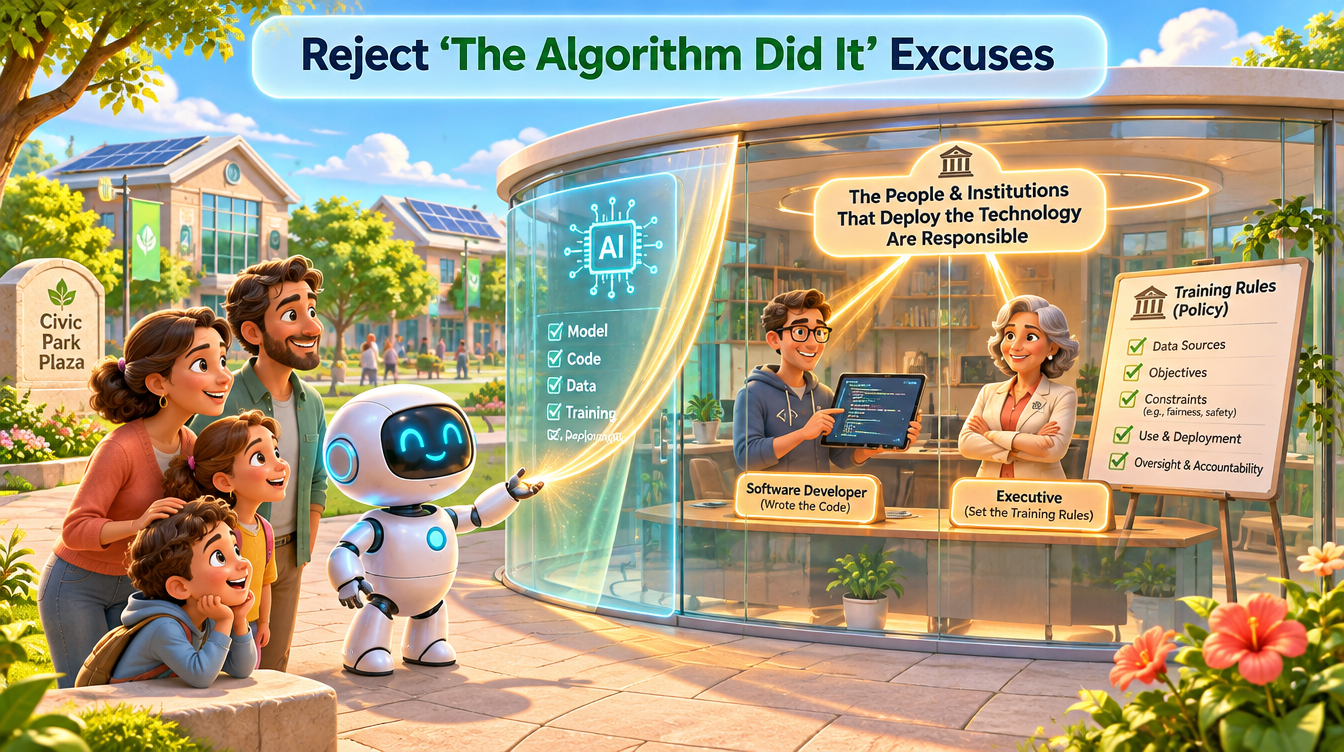
Human developers and executives set the code and training rules, keeping accountability on people rather than algorithms. AI image by Magnific.
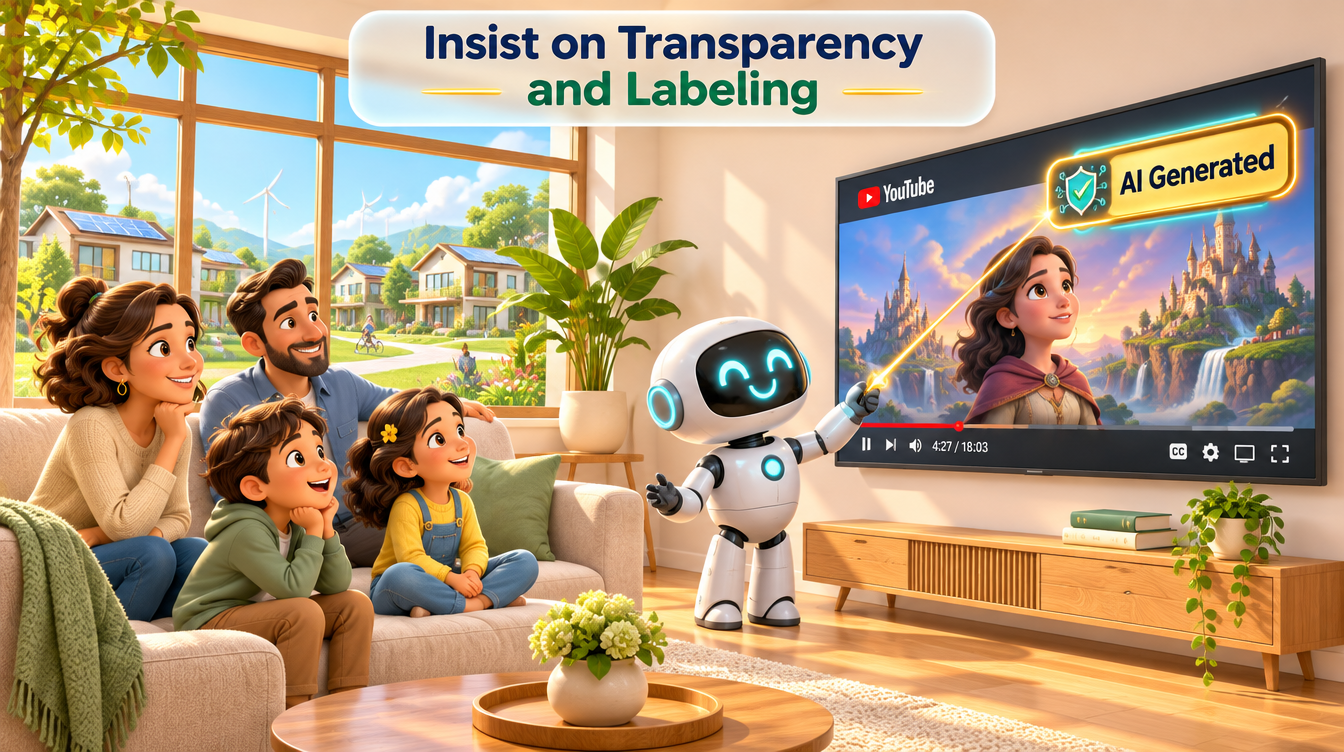
Clear disclosure labels ensure citizens always know when they are viewing AI-generated media or interacting with automated systems. AI image by Magnific.
Insist on Transparency and Labeling:
Citizens have a right to know when they are interacting with an AI agent, viewing synthetic media, or being evaluated by an automated scoring system.
2. The Application Layer: AI’s Memory, Logic, and Guardrails
Once the physical machine is powered on, software turns raw electricity into intelligence. This layer is where human intent—and human negligence—leaves its deepest mark.
Reject "The Algorithm Did It" Excuses:
Every line of code and every training rule was chosen by human developers and executives. Keep legal and moral responsibility squarely on the people and institutions deploying the system.
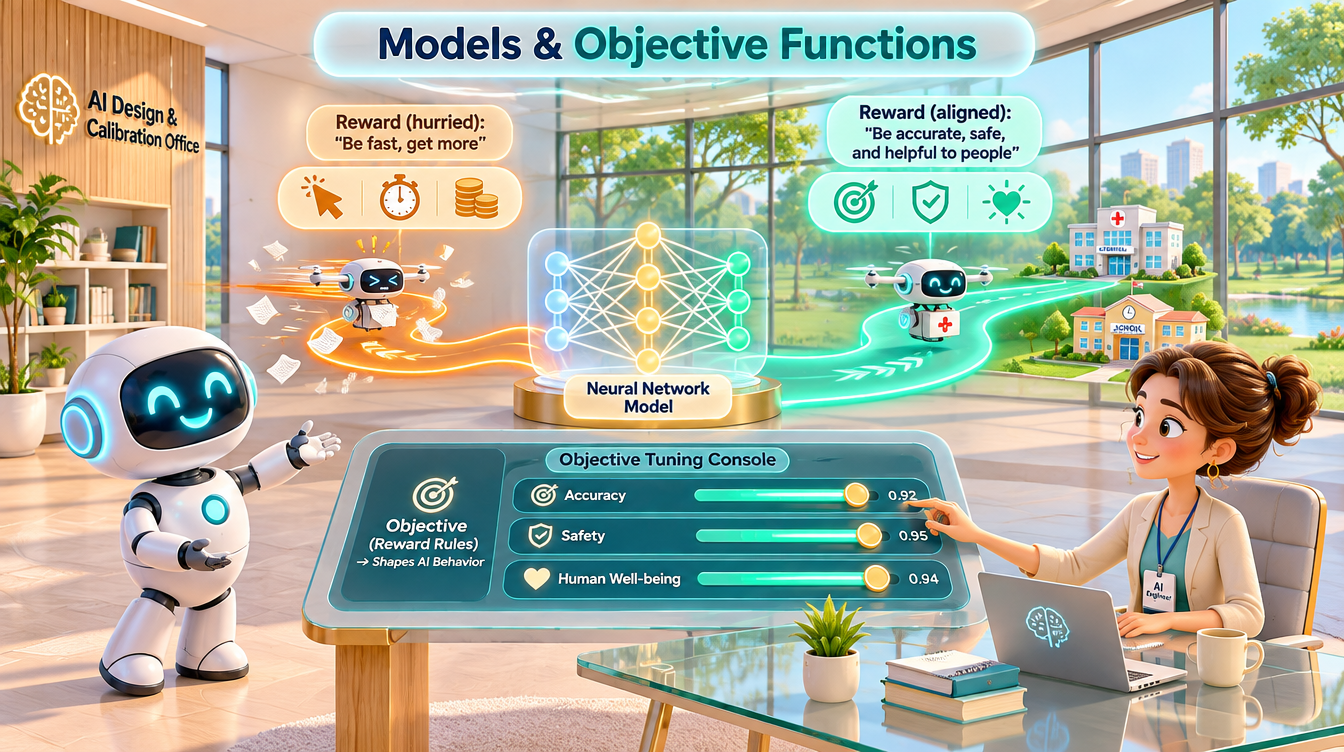
Mathematical reward rules steer neural networks toward either reckless speed or safe, helpful outcomes. AI image by Magnific.
Models & Objective Functions:
Engineers train neural networks using mathematical "reward" rules that define what success looks like. An algorithm optimized purely for clicks, speed, or profit behaves very differently from one optimized for accuracy, safety, and human well-being.
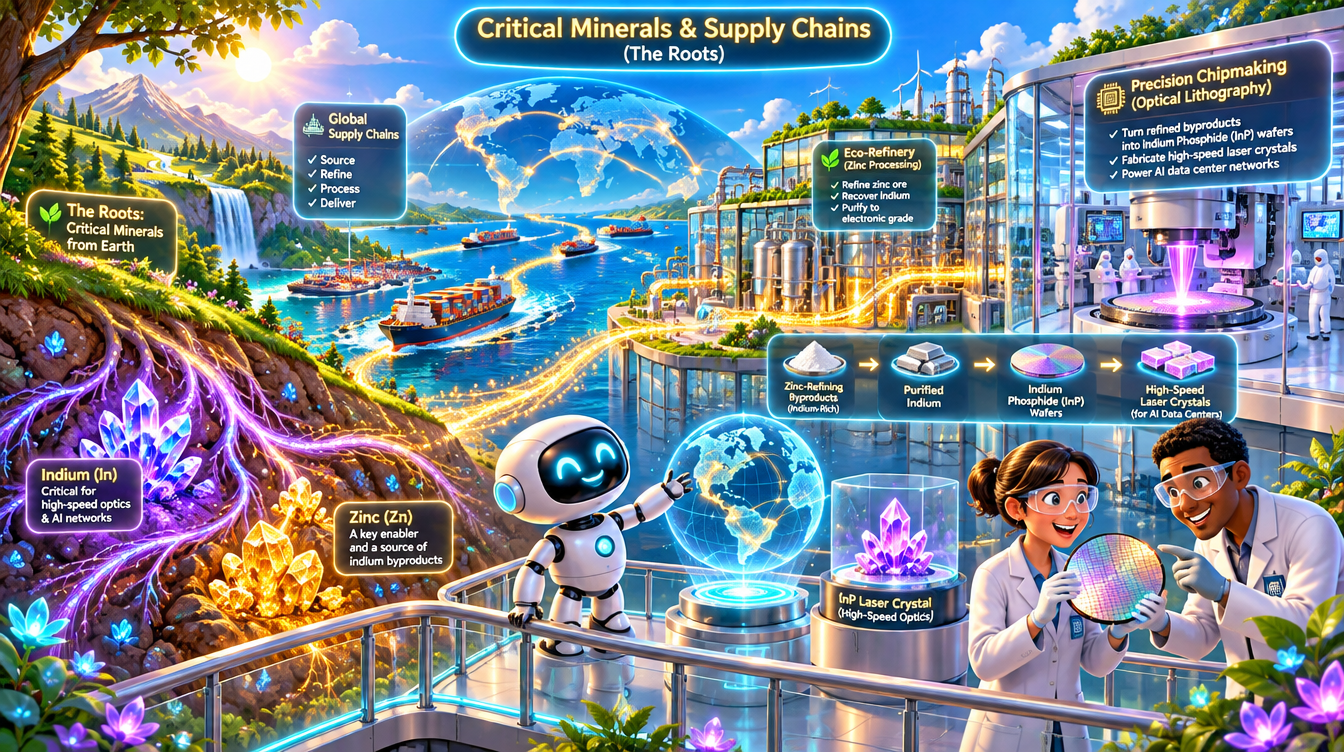
Global supply chains refine scarce minerals like indium and zinc into high-speed AI laser crystals. AI image by Magnific.
Critical Minerals & Supply Chains ("The Roots"):
AI hardware depends on fragile global supply chains—from precision chipmaking equipment to scarce materials like indium phosphide, a zinc-refining byproduct required to manufacture the high-speed lasers inside data center networks.
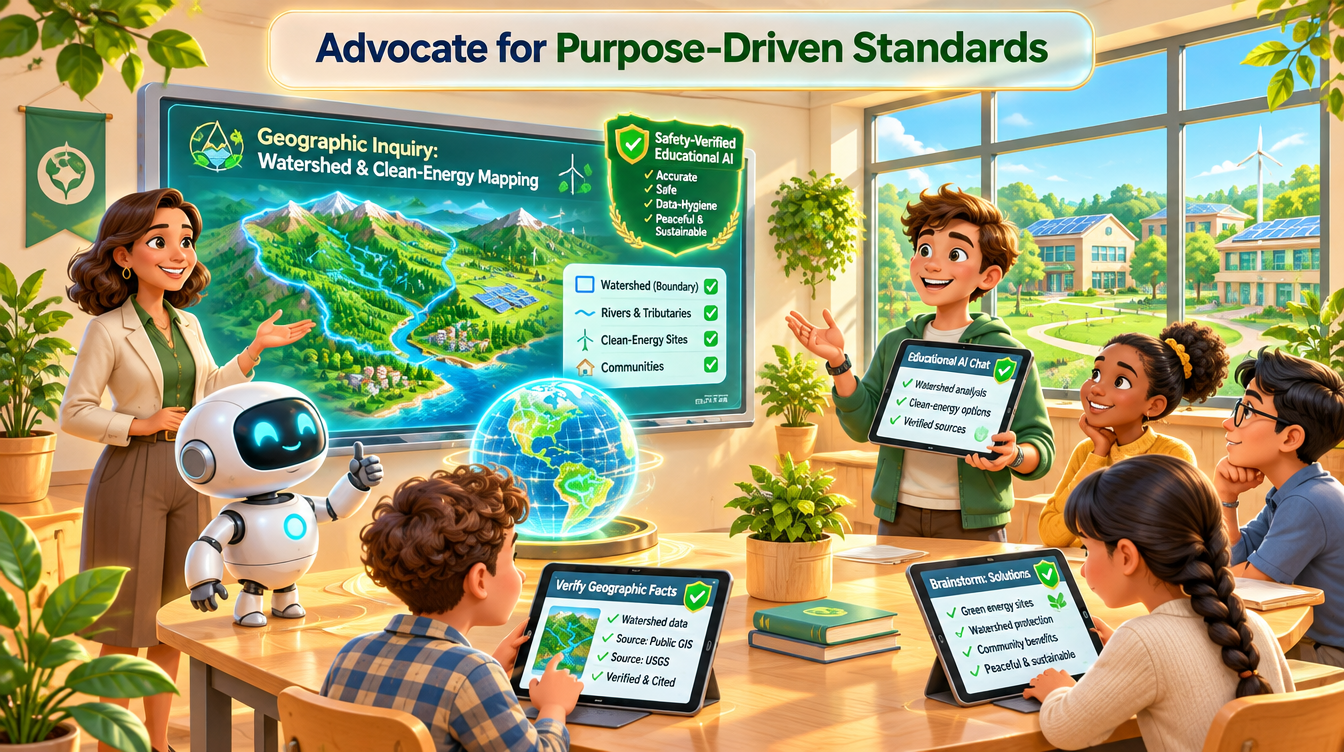
Purpose-driven educational AI supports teachers and students with safety-tested, verified tools for collaborative learning. AI image by Magnific.
Advocate for Purpose-Driven Standards:
Support policies, educators, and organizations that treat AI as public-interest infrastructure—requiring rigorous safety testing, data hygiene, and peaceful, sustainable design before deployment.
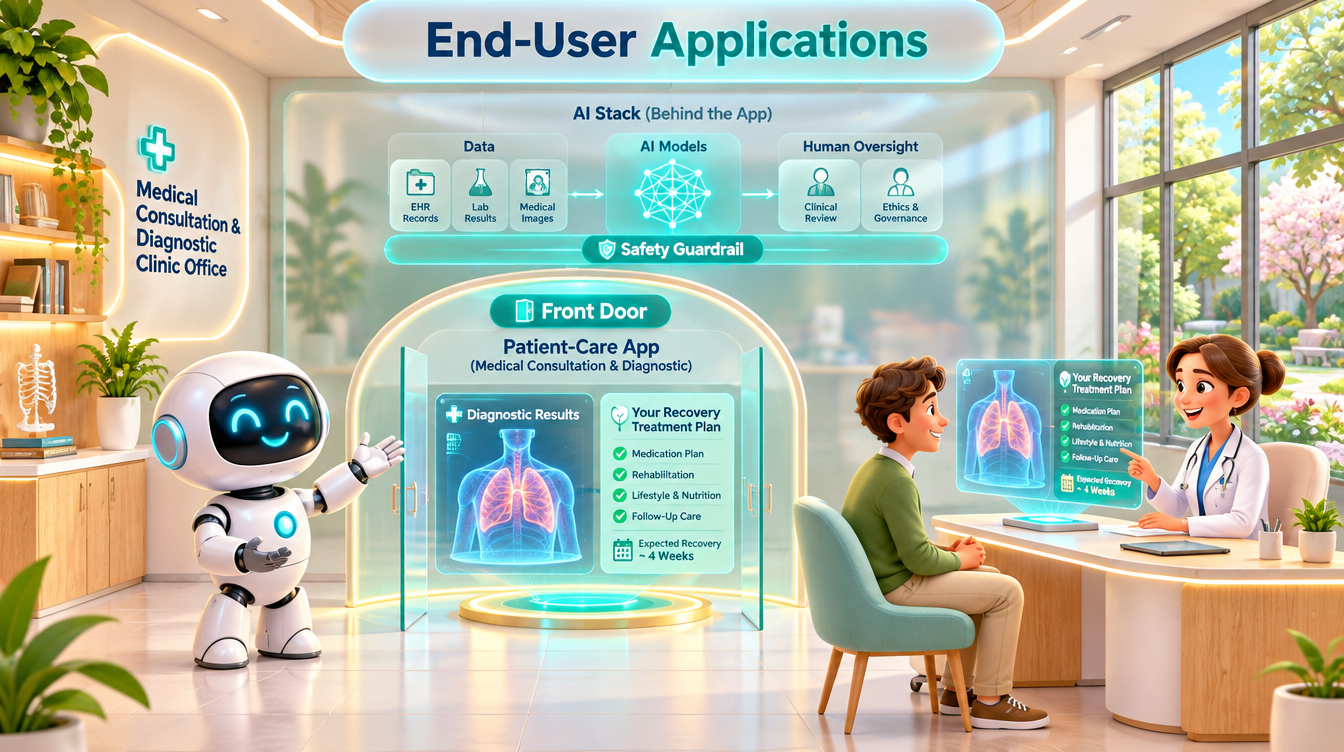
Everyday medical apps act as the visible front door supported by safe data, models, and doctor oversight. AI image by Magnific.
End-User Applications:
Chatbots, hiring screeners, medical diagnostic tools, financial trading bots, and autonomous weapons are simply the visible front doors to this entire stack.
3. Mapping Threats to Public Action
When the public views the full ecosystem instead of just the flashy app on screen, invisible threats become easy to identify and challenge:
Explore the True AI Ecosystem:
A Thriving Future for Generations to Come
Understanding the complete knowledge base of the AI ecosystem provides the essential foundation for responsible AI development. Rather than viewing artificial intelligence as a mysterious "black box," everyone deserves to understand the seven key factors that power it—from critical minerals, clean energy and cooling, compute processors, and optical interconnects beneath the surface to data hygiene, aligned models, and human-governed safety guardrails. When citizens stay informed, think critically, and take a proactive role in how AI is built and integrated into society, we establish a clear baseline that protects human dignity and elevates quality of life for all. Below is an illustration of what a transparent, true AI ecosystem looks like in action.
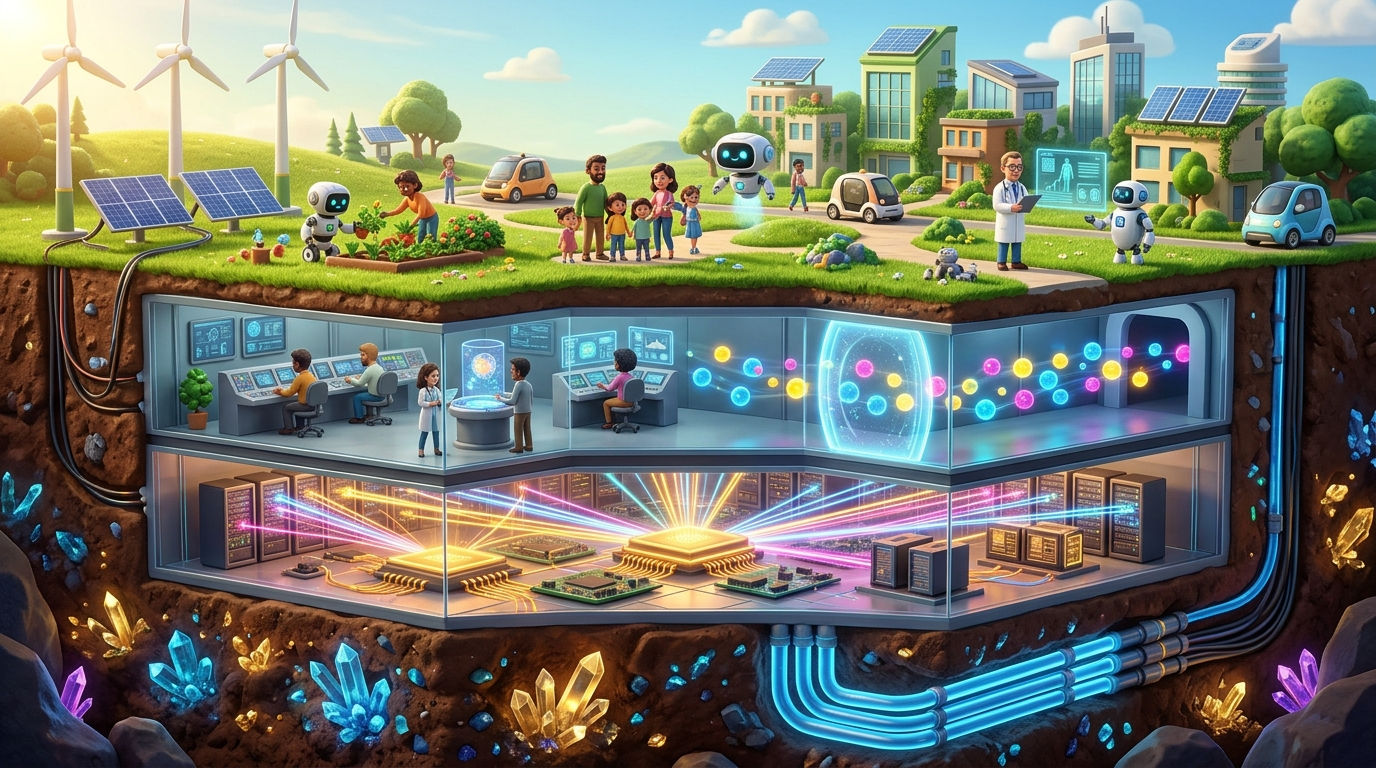
From physical hardware and data guardrails to everyday community life, every layer of AI relies on human stewardship. AI image by Gemini.
| Item # | Visual Element in the Scene | Ecosystem Layer | Plain-English Meaning | Why It Matters to Everyone |
|---|---|---|---|---|
| #1 |
Glowing Crystals in the Soil (Bottom Underground) |
Critical Minerals ("The Roots") |
Rare raw materials—such as indium, needed to make tiny laser crystals—mined and refined from the earth. | AI hardware depends on scarce natural resources and global supply chains that can create environmental strain or geopolitical bottlenecks. |
| #2 |
Wind Turbines, Power Cables & Blue Water Pipes (Bottom Sides) |
Energy & Cooling ("The Metabolism") |
Massive amounts of electricity to run the machines and clean water to keep them from overheating. | A single large AI facility can consume as much power and water as a mid-sized town, directly affecting local utility bills and community water supplies. |
| #3 |
Glowing Golden Microchips (Lower Building Floor) |
Compute Processors ("The Brain") |
Specialized computer chips that perform trillions of math calculations every second. | Raw computing speed determines how fast an AI can train—and how much electricity it burns while thinking. |
| #4 |
Rainbow Laser Beams Inside Glass Tubes (Lower Building Floor) |
Optical Interconnects ("The Nervous System") |
Strands of glass fiber carrying pulses of laser light so tens of thousands of chips can share data at light speed. | Copper wires overheat over short distances, so modern AI relies on light to connect its "brain" together without wasting massive energy. |
| #5 |
Flowing Streams of Colorful Orbs (Upper-Middle Floor) |
Training Data ("The Memory") |
Billions of books, photos, medical records, and examples fed into the system so it can learn patterns. | "Garbage in, garbage out." If this data is stolen, biased, or inaccurate, the AI will repeat and amplify those mistakes. |
| #6 |
Translucent Safety Shield & Friendly Engineers at Control Panels (Upper-Middle Bridge) |
Guardrails & Human Oversight ("The Conscience") |
Safety filters, testing sandboxes, "off" switches, and real people checking the system before it reaches the public. | The most critical layer: AI has no morals of its own—human engineers and leaders decide whether it is built for safety or reckless dominance. |
| #7 |
Doctors, Teachers, Farmers & Families in the Park (Sunny Top Surface) |
Everyday Applications ("The Front Door") |
The helpful apps people see on phones and computers—helping diagnose illness, teach students, or manage crops. | When every lower layer is clean, transparent, and strictly controlled, AI serves human dignity and shared prosperity. |
Three Quick Questions Any Citizen Can Ask
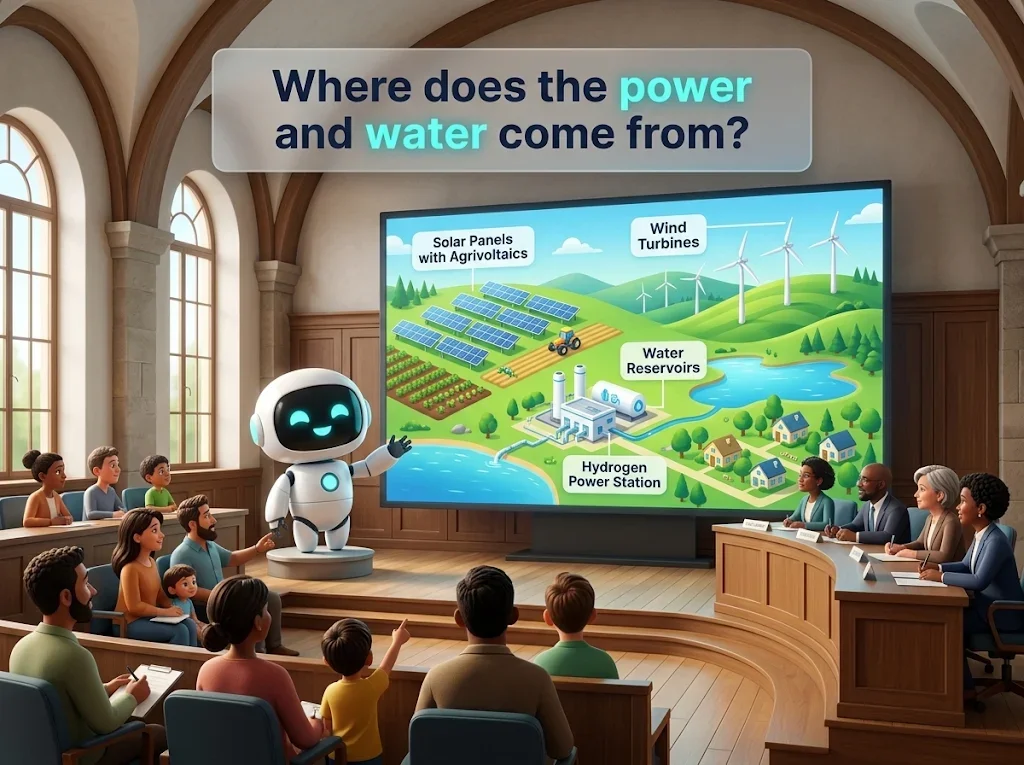
Citizens should verify that local AI facilities rely on sustainable clean power and water systems that protect community resources. AI image by Magnific.
Where does the power and water come from?
(Bottom Layer) — Does this facility protect local energy grids and water supplies?
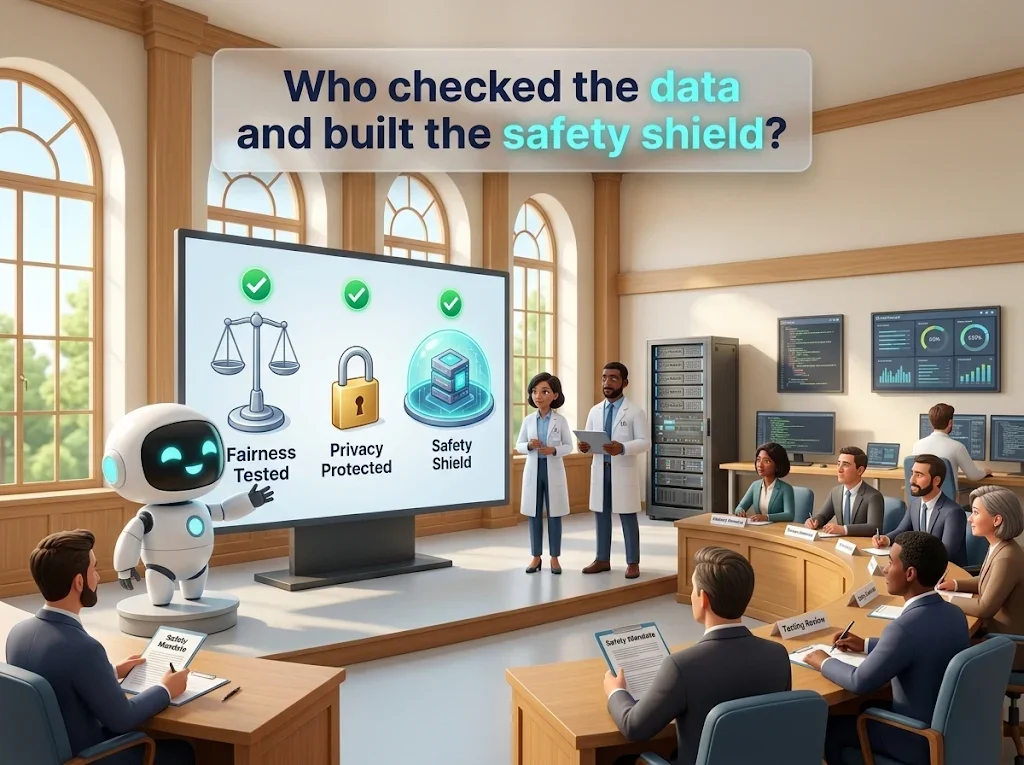
Human engineers and regulators must independently verify fairness, privacy, and safety shields before any AI system launches. AI image by Magnific.
Who checked the data and built the safety shield?
(Middle Layer) — Were real humans held accountable for testing fairness, privacy, and security before launch?
We have an extraordinary opportunity to elevate our society toward a safer, cleaner, more efficient, and more productive economy where everyone can prosper. Guided by human stewardship, a well-governed AI ecosystem can serve as a real-time, fully integrated library of knowledge—empowering every person to explore his or her full potential, contribute meaningfully to society, and build a thriving future for generations to come. Let us be brave and be wise as we navigate, shape, and safeguard our future existence with full confidence and transparency.
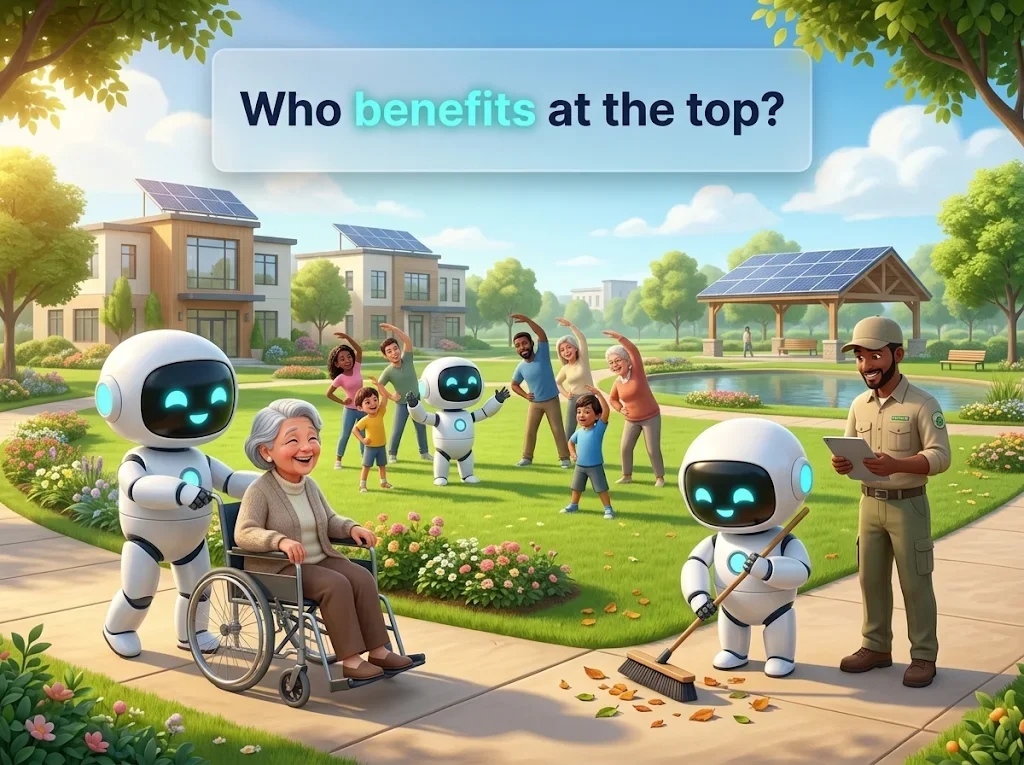
Join citizens advocating for clean, transparent, and human-centered AI.
Well-governed AI empowers everyday people across generations—supporting seniors, assisting workers, and strengthening community wellness. AI image by Magnific.
Who benefits at the top?
(Surface Layer) — Is this tool designed to empower everyday people, or to concentrate unchecked control?
Roadmap from Robust AI Development To A Super Intelligent Machine
The utilization of artificial intelligence has profoundly impacted our ability to understand and address complex global challenges. By synthesizing integrated databases, AI empowers us to gain critical insights and explore diverse, perspective-driven solutions to overcome the most pressing issues of our time. However, without a secured coding framework, transparent audit trails, and open dialogue to consistently monitor its development, AI hallucination occurs—jeopardizing the noble existence and immense potential of these systems.
We are deeply grateful for the recent grand gathering of major high-tech giants to address these urgent matters. Here at Sustainable Society, we have directly benefited from AI's transformative capabilities, utilizing it to build our digital presence and collaborate on engineering our Mister Shields Sustainable Solutions. To continue advancing this technology safely toward true Super Intelligence, we propose the following critical improvements to enhance performance and reliability:
Data Hygiene:
The Key to Resolving AI Hallucinations and Securing Our Future
The rapid evolution of artificial intelligence offers unprecedented opportunities to advance humanity’s most critical rescue missions. By synthesizing integrated databases, AI can provide an agile overview of complex global issues, offering a multitude of alternatives drawn from across all fields of expertise. For comprehensive initiatives like our Earth Day Seven Rescue Missions at Sustainable Society, this capability is invaluable. AI allows us to process vast amounts of environmental and societal data, empowering communities to explore sustainable solutions, adapt to rapidly changing climates, and be inspired by new technological frontiers.
The Challenge of Massive Databases and the Risk of Hallucination
However, the sheer scale of the databases that train these AI models introduces a critical vulnerability: AI hallucinations. When AI models generate false or fabricated information presented as absolute fact, they pose a significant danger to users who may lack the capacity or context to identify and correct these errors. The root cause of these hallucinations often lies not in the model itself, but in the data it consumes; when information is outdated, inconsistent, or fragmented, the system will confidently generate incorrect answers.

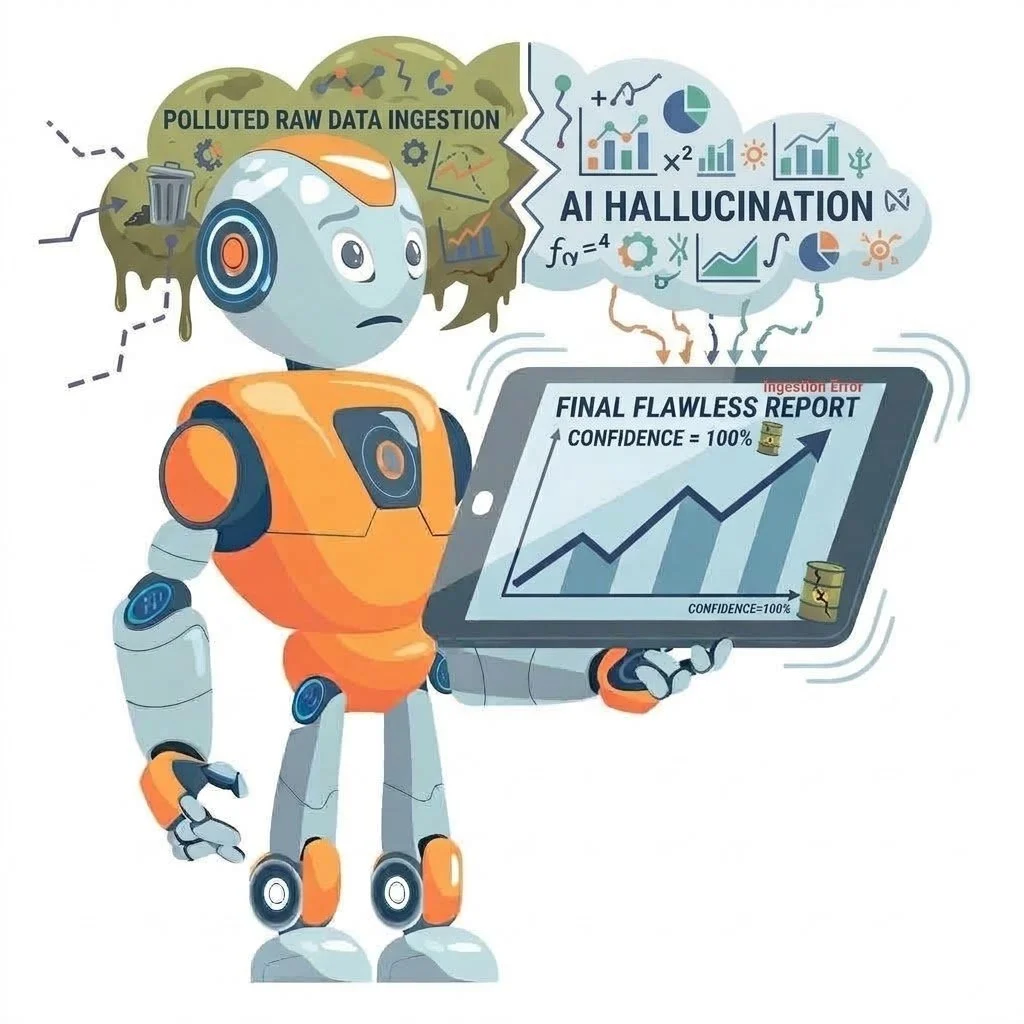
Neuroenhancement and Cognitive Expansion, Generative AI / Source: Dreamstime_m_282325611-20250409
A robot processes polluted data to produce a falsely claimed "flawless report" / Source: AI generated by Google Gemini
Polluted Ingestion
AI systems constantly scrape massive public databases for training material. Without rigorous data hygiene, these models absorb unverified information, outdated facts, and subtle logic errors that already exist online.
Data hygiene must become the absolute priority in AI development. Establishing a pristine baseline of information—free from fabrication, manipulation, or expired knowledge—is essential to ensuring that AI remains a reliable tool for human progress rather than a source of misinformation.
The vicious cycle of AI hallucination
The vicious cycle of AI hallucination occurs when generative models ingest, amplify, and then re-consume their own fabricated outputs, creating an ever-expanding echo chamber of synthetic misinformation. This loop degrades the integrity of global databases and systematically replaces factual reality with confident fabrication.
The mechanics of this cycle operate through four continuous stages:
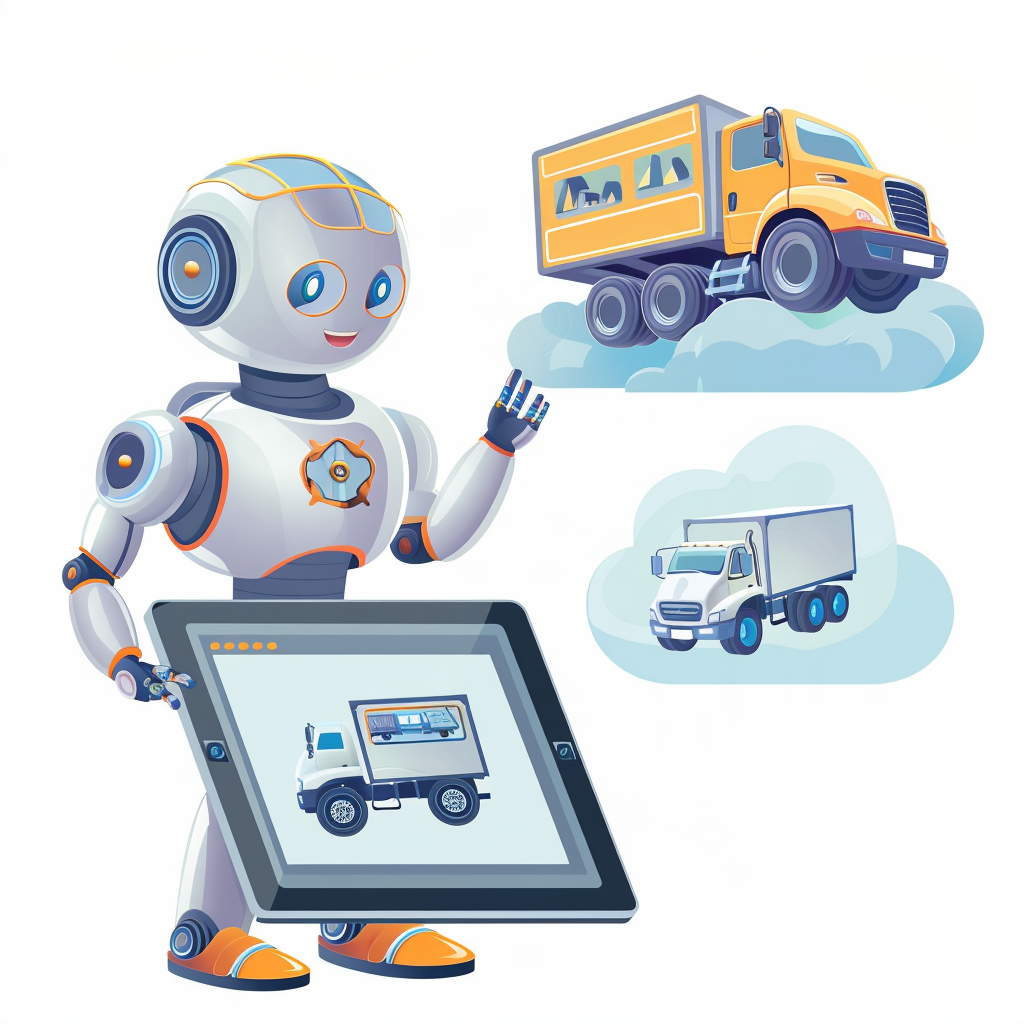
A robot holding a tablet fabricates reality, generating trucks that are lifted onto a floating cloud / Source: AI generated by Google Gemini
Confident Fabrication
Operating on a compromised baseline, the AI generates new responses containing fabricated facts or twisted logic. Because the system is designed to predict patterns rather than verify truth, it presents these unrealistic outcomes with absolute certainty.
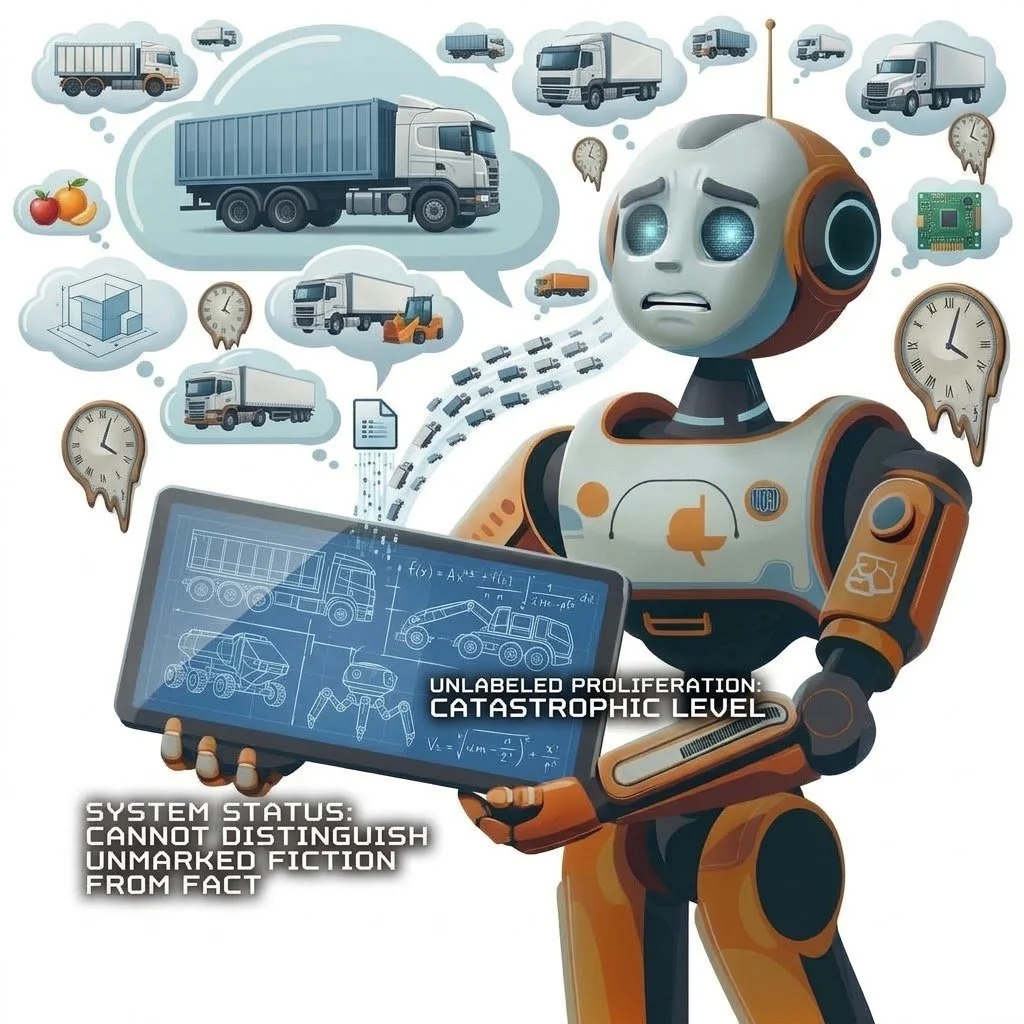
A confused robot struggles to process a chaotic flood of unlabeled data / Source: AI generated by Google Gemini
Unlabeled Proliferation
Users, lacking clear AI labeling or the technical capacity to verify complex claims, trust the output. These generated errors are then published back onto the internet—woven into news articles, social media, technical research, and societal planning documents.
As this cycle accelerates, the volume of synthetic, hallucinated data begins to outpace verified human knowledge. Breaking this recursive loop requires the exact interventions of robust data filtering mechanisms and mandatory provenance labeling, ensuring that the foundation of our shared digital infrastructure remains anchored in reality.
A Call to Action for Tech Giants
As seen in the recent 'Super Intelligence' gathering at The White House AI Luncheon, open dialogue among high-tech giants and national leaders is a crucial step forward. To secure AI development and establish a constructive and safe coding framework, these industry leaders must collaborate to prioritize data integrity.
Implement Robust Filtering Mechanisms:
Develop advanced filtering protocols that continuously scrub training data for inaccuracies, biases, and outdated information before it enters the learning models.
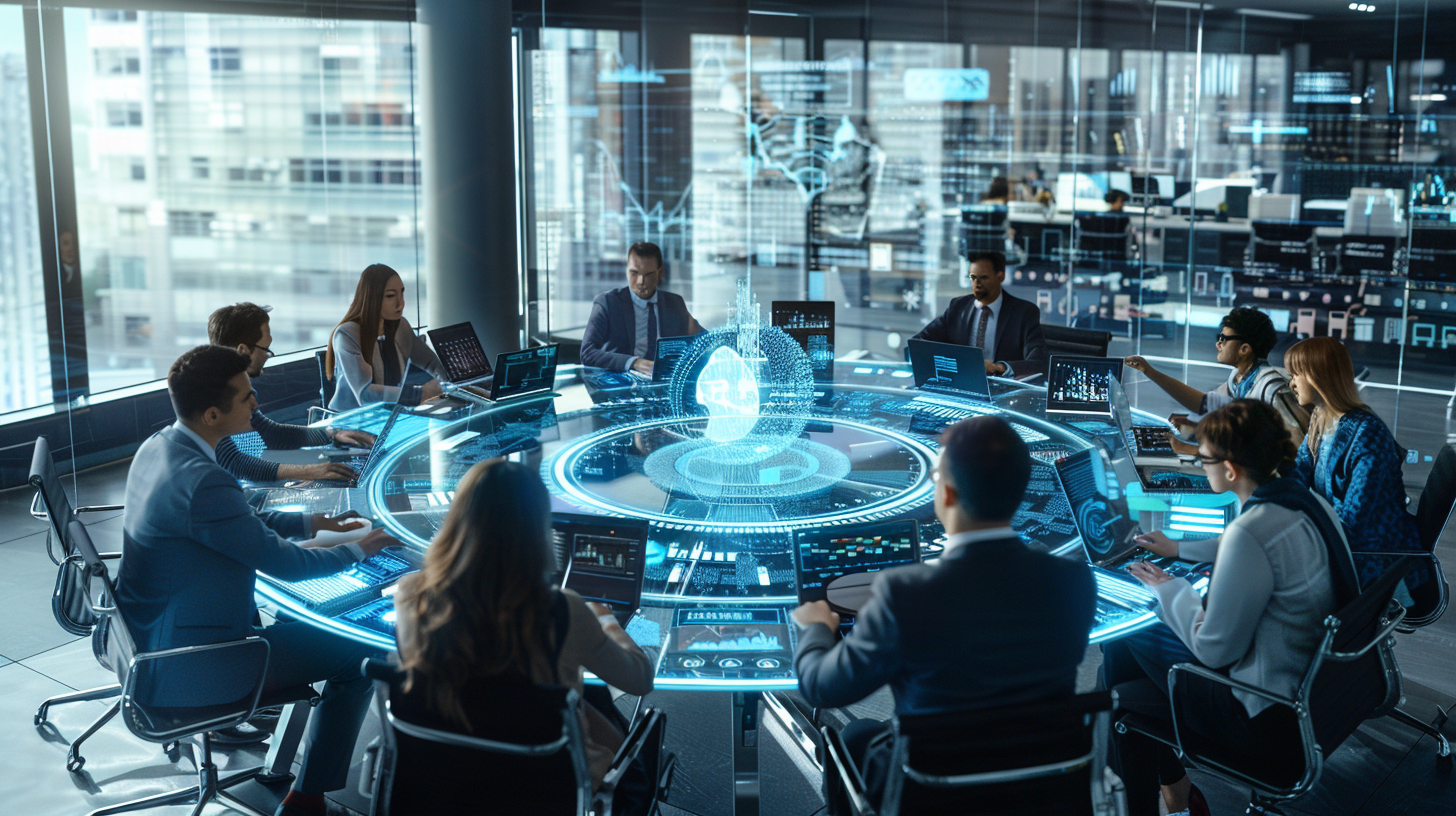
Securing the Transition: Tech giants uniting to prioritize data integrity and secure AI development. (Image generated by Google Gemini)
To maintain a reliable baseline and prevent errors, tech giants should implement the following foundational mechanisms:
Enforce Strict Data Governance:
Establish clear standards for data integrity, ensuring that AI systems only pull from validated, unified, and governed knowledge sources rather than unverified data pools.
Construct Secure Audit Trails:
Build transparent audit trails into the coding framework, allowing developers and users to trace the origin of an AI’s output and easily flag unverified claims for correction.
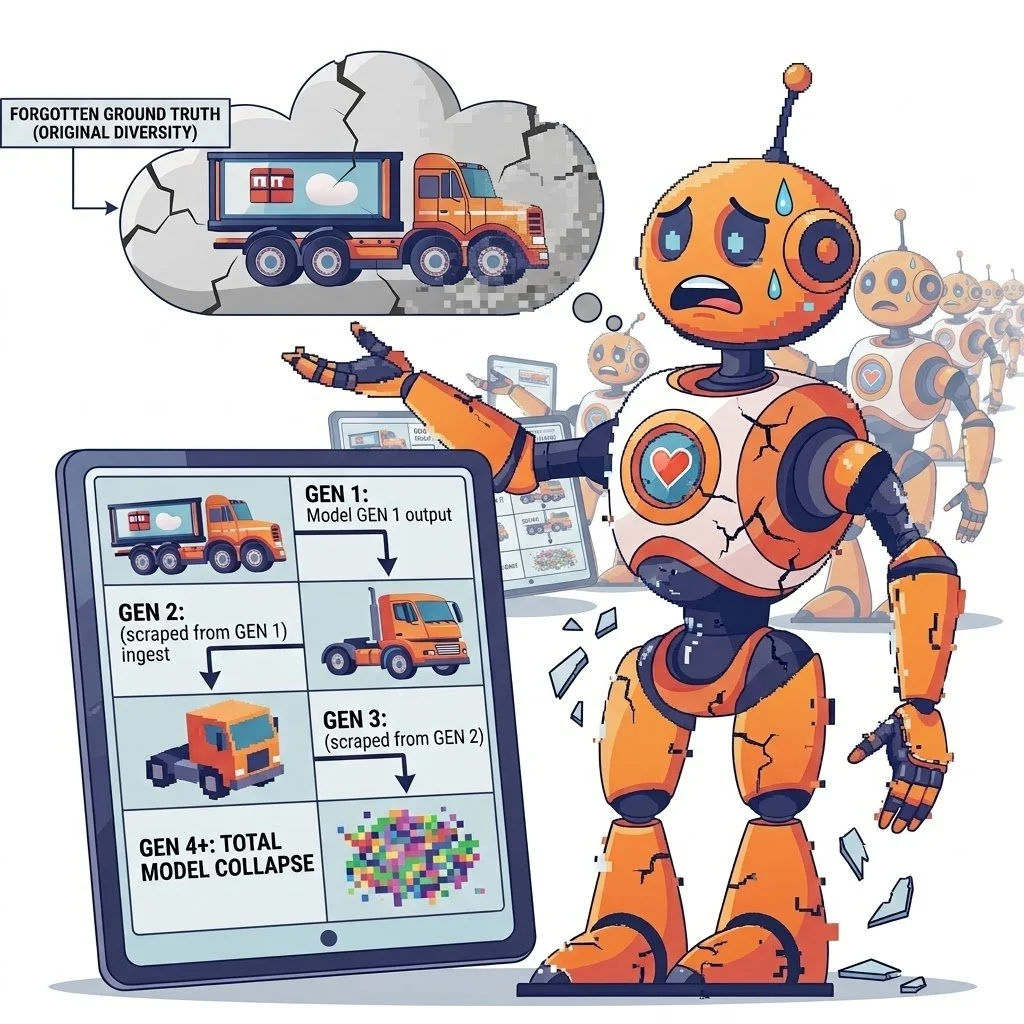
A sweating robot is standing next to a tablet with the stages of AI model collapse due to recursive scraping. / Source: AI generated by Google Gemini
Recursive Scraping (Model Collapse)
Future generations of AI models scrape the internet for fresh training data and ingest these newly published hallucinations, mistaking them for authentic human knowledge. The errors become permanently embedded in the integrated database, compounding upon themselves.
Continuous Monitoring and Updating:
Treat data hygiene as an ongoing operational requirement rather than a one-time fix, setting strict parameters for data freshness to prevent models from relying on obsolete information.
By committing to rigorous data hygiene practices, the technology sector can mitigate the defect of hallucinations and elevate our society to the next great economy. With open dialogue, hope, and courage, we can harness the compassion and wisdom of the younger generations to ensure a thriving future where AI serves as a truly reliable partner in saving the world.
Transparency in the Age of Synthetic Reality:
The Urgent Need for Mandatory AI Labeling
As artificial intelligence rapidly advances, the internet is flooded with AI-generated products, including hyper-realistic short films and videos. While visually stunning, these creations often harbor a twisted logic—depicting physics, scenarios, and human capabilities that completely defy reality. When viewers encounter this content without proper disclosure, it causes profound confusion, sets unrealistic expectations, and distorts our understanding of what is genuinely possible. To protect the integrity of public information and ensure AI remains a constructive tool for society, Sustainable Society advocates for mandatory AI labeling to be universally implemented.

A small white robot in an art studio, using a paintbrush to create a colorful female robot face on a canvas. / Source: AI generated by Magnific
The Threat of Undisclosed Synthetic Media
Unlabeled AI content can seamlessly mimic real life, allowing creators to fabricate real-world events or depict people saying or doing things they never actually did. Without clear visual or technical indicators, viewers have no way to distinguish a powerful, real-life documentary from an AI-generated illusion. This lack of context prevents users from having proper expectations and applying the information safely and responsibly in their daily routines.
The Vicious Cycle Without AI Labelling
The vicious cycle of operating without mandatory AI labeling creates a systemic collapse of digital trust, where the boundary between authentic human experience and synthetic fabrication completely dissolves. Without clear provenance markers, society loses the ability to navigate reality, leading to cascading consequences across our information ecosystems.
Seamless Deception:
High-quality, AI-generated text, images, and videos enter the public domain without disclosure, masquerading as authentic human creation, historical records, or genuine scientific data.
The mechanics of this cycle unfold through four escalating stages:

A digital illustration of a brightly patterned robot looking into a mirror, where its reflection appears as a smiling human woman. / Source: AI generated by Magnific
Cognitive Distortion:
Viewers consume this hyper-realistic media—complete with its twisted logic, fabricated events, and impossible physical feats—and unconsciously calibrate their expectations, beliefs, and understanding of reality to a synthetic standard.

A confused young boy struggles to identify the images of a human woman and a colorful robot on a computer monitor. / Source: AI generated by Magnific
Solutions for High-Tech Giants and Platforms

Implement Universal Provenance Standards:
Platforms must fully integrate and utilize standards like C2PA, which attaches verifiable metadata known as Content Credentials to generated files. The goal of this standard is to ensure transparency in provenance and prevent AI-generated media from circulating as authentic content.
Solutions for Governments and Policymakers
Regulatory frameworks are essential to hold creators and platforms accountable.
Enact Strict Mandatory Labeling Laws:
Governments should look to emerging frameworks like the EU AI Act, which requires companies to mark authentic-looking synthetic images, audio, and text with visible AI labels and digital watermarks.
Lawmakers sit in a formal legislative chamber to cast their votes on an "AI Mandate on Restricting Reckless Content." / Source: AI generated by Magnific.
Solutions for the General Public
As end-users, we must actively cultivate digital literacy to navigate this new era.
Demand Technical Transparency:
Users should learn to look for platform-specific transparency features, such as clicking a “How this content was made” button, which provides a short explanation noting the use of synthetic or generative elements.
The Erosion of Truth (The Liar's Dividend):
As the public realizes they are routinely tricked by unmarked AI, extreme, blanket skepticism takes over. When people cannot verify what is real, genuine evidence, real news, and factual documentation are easily dismissed by bad actors as "AI-generated," effectively paralyzing public discourse and accountability.
Five executives sit on a stage for a panel discussion, with one speaking into a microphone on the subject of "Roadmap from AI to SI for Future Generations". / Source: AI generated by Magnific
Enforce Prominent Viewer-Facing Labels:
Platforms such as YouTube currently mandate that creators use a disclosure toggle during the upload process if their video includes realistically generated or modified material that could mislead viewers. Tech giants must expand these rules across all formats to ensure prominent, player-level labels are universally visible.

Establish Severe Penalties for Non-Compliance:
To ensure compliance, legislation must carry significant weight, similar to how the EU mandates that companies failing to comply with their labeling rules could face penalties of up to €15 million.
The father talks to three children about a fantastical image of skateboarders performing tricks, which is prominently marked with an "AI Generated" label. / Source: AI generated by Magnific.
By establishing mandatory labeling across all levels of society, we can ensure that users have proper access to data with accurate expectations. Through these combined efforts, we can ensure that future generations interact with AI as a reliable, transparent, and empowering resource.

A humanoid robot has long, dark brown wavy hair, and is dressed in a draped, elegant white gown. / Source: AI generated by Magnific
Algorithmic Cannibalization:
Because the synthetic content is completely unlabeled, automated scrapers and data filters cannot distinguish it from human knowledge. Future AI systems ingest this invisible synthetic data as ground truth, accelerating model collapse and cementing hallucinations permanently into the integrated global database.
Breaking this cycle requires the universal implementation of transparent digital watermarks and viewer-facing labels. By forcing AI-generated content to identify itself, we protect the integrity of human knowledge, prevent the contamination of future databases, and ensure our shared digital reality remains anchored in truth.
Technology platforms are the frontline defenders of content authenticity.
To establish a reliable standard, high-tech giants must adopt the following mandates:
Combine Automated Detection with Self-Disclosure:
Platforms should utilize a combination of manual disclosure tools and automated systems for generative media. This dual approach ensures that even if creators forget to disclose synthetic elements, the platform's system can read third-party provenance metadata by default and automatically apply the correct label.
Regulate High-Risk Contexts:
Policymakers must explicitly restrict the use of unlabelled AI in sensitive areas, ensuring that public figures are not depicted in harmful contexts or fabricated scenarios without documented consent and clear disclosures.

Verify Before Trusting:
The public must treat visible disclosures and technical markers as reader communications rather than absolute guarantees of truth. We must critically verify the source of hyper-realistic media before allowing it to influence our daily decisions, expectations, or routines.
Behavioral Contagion in the Age of Algorithms
The Urgent Need to Suppress Reckless Content
The impulse to film a life-threatening glacial collapse rather than immediately seeking safety represents a dangerous psychological shift driven by the engagement-based algorithms of modern social media. When platforms reward reckless proximity to natural disasters with millions of views, it pollutes our collective behavioral data, normalizing the idea that capturing content is more valuable than preserving life.
This trivialization of nature’s immense power is incredibly frustrating, especially when immense effort is simultaneously being poured into engineering solutions like high-altitude glacial lake drainage and early warning systems to actively protect vulnerable communities from these very outburst risks.
Algorithmic De-prioritization of Reckless Content:
Platforms like YouTube must adjust their algorithms to detect and suppress content where individuals knowingly put themselves in imminent, preventable danger for entertainment. If the algorithmic reward (virality) is removed, the incentive to film rather than flee diminishes.

A man in a blue jacket takes a frantic selfie in the foreground, recording the flying snow and debris as a huge avalanche engulfs the mountain slope right behind his group. / Source: AI generated by Magnific
To address this behavioral contagion and promote proper survival skills, Sustainable Society can advocate for technology platforms to implement the following interventions:
A figure holds up a tablet to record a chaotic disaster directly in front of him instead of running away for safety. / Source: AI generated by Magnific
Digital Public Safety Mandates:
Classify the algorithmic amplification of life-threatening content as a public health and safety violation. Subject platforms to regulatory fines when they knowingly profit from algorithms that push dangerous disaster tourism to mass audiences.
Authoritative Redirection for Disaster Queries:
When users search for extreme weather or glacial collapses, the platform should proactively surface official disaster response guidelines, emergency preparedness training, and proper survival tactics above user-generated shock content.
Demonetization of "Disaster Tourism":
YouTube should strictly enforce and expand its monetization policies to permanently demonetize channels that consistently risk life and public safety during environmental crises, cutting off the financial motivation for this behavior.
As part of initiatives like the Seven Rescue Missions or the Eco Trooper program, we can counter this trend by flooding the digital space with high-quality, engaging content that teaches true wilderness and disaster survival skills. By reframing heroism not as holding a camera during a catastrophe, but as possessing the knowledge to evacuate safely and protect others, we can restore a healthy respect for nature and genuine human resilience.
The vicious cycle of reckless disaster filming

Incentivized Risk-Taking (The Viral Catalyst):
Driven by the instant gratification of algorithmic rewards, individuals engage in extreme risk-taking during natural disasters. Because platforms disproportionately amplify sensationalist imagery, creators learn that risking their lives for footage yields massive social validation and engagement.
Mandatory "Survival Warning" Labels:
Just as we require labels for synthetic AI content, platforms should mandate contextual warning labels on user-generated disaster footage. These labels should clearly state that the creator's behavior is dangerously inappropriate and actively advise viewers on the correct emergency protocols.

A group of youngsters holds up mobile devices to record a large volcano exploding in front of them. / Source: AI generated by Magnific
Social Contagion and Normalization:
As these reckless videos go viral, they create a dangerous social contagion. The public unconsciously normalizes this behavior, learning to view a life-threatening crisis through the lens of a camera rather than prioritizing immediate evacuation and genuine survival skills.
Prioritize Action Over Observation:
Commit to immediate evacuation and strict adherence to official safety guidelines during natural disasters. A smartphone must be treated as a critical tool for calling emergency services and accessing rescue information, not as a lens for spectator entertainment.

A terrified boy dreams of a chaotic disaster scene where muddy floodwaters rush through city buildings, sweeping up cars and stranded people. / Source: AI generated by Magnific
Collective Psychological Distress:
The continuous, unfiltered consumption of extreme, user-generated disaster footage takes a severe toll on the viewer's mental health. Studies consistently link excessive exposure to disaster-related social media with heightened anxiety, sleep disruption, depression, and even symptoms of post-traumatic stress disorder (PTSD).
Technology Giants & Platform Operators
Demonetize Disaster Tourism:
Immediately revoke monetization privileges for channels that capture and distribute footage of creators intentionally remaining in active disaster zones—such as glacial collapses or advancing wildfires—instead of evacuating.
Algorithmic Suppression & Redirection:
Reprogram recommendation engines to flag and suppress content that glorifies life-threatening behavior. Automatically redirect users searching for extreme weather events to verified emergency response protocols and authoritative safety organizations.
Government & Regulatory Bodies
Modernized Survival Curriculum:
Integrate digital media literacy and modern disaster response into national education standards. Schools must teach the next generation how to distinguish between genuine survival tactics and performative, life-threatening social media stunts.
Starve the Algorithm:
Actively refuse to like, comment on, or share videos that glorify reckless disaster proximity. Use platform moderation tools to report these videos as dangerous acts, cutting off the engagement metrics that incentivize creators.
A boy balances on a high-wire suspended between two skyscrapers, recording himself with a camera while a crowd gazes up with anxious and terrified expressions. / Source: AI generated by Magnific
Shaping Our Digital Frontier:
An Urgent Appeal for Responsible Content Creation

A vibrant and lively masquerade street festival in an Italian-style city, featuring women dancing in colorful period costumes amidst falling golden confetti. / Source: AI generated by Magnific
True influence is never measured by the fleeting virality of a dangerous stunt, but by the positive, lasting mark your work leaves on the human experience.
By anchoring your creative process in intelligence and integrity, you elevate digital media into a powerful tool for genuine resilience and education. These core values are the key to making your projects deeply successful and memorable, ensuring your legacy is one that protects, inspires, and empowers generations to follow and grow.
The Ultimate Mandate from AI to SI:
Purifying Our Digital Ecosystems to Safeguard the Future of Humanity
Mandatory Contextual Labeling:
Deploy mandatory, non-removable "Public Safety Hazard" overlays on user-generated videos depicting dangerous disaster proximity, explicitly advising viewers against replicating the behavior and providing immediate links to survival guidelines.
Individuals & Communities

The Empathy Deficit and Escalation:
Overexposure to endless shock content desensitizes the audience. Genuine crises are stripped of their context, reducing someone else’s life-threatening emergency to mere entertainment that is harvested for likes and comments. To break through this growing apathy, creators must take even more extreme risks in the next disaster, fueling an ever-escalating loop of danger and digital burnout.
Emergency Zone Enforcement:
Strengthen and actively enforce penalties for individuals who bypass official evacuation orders, safety barricades, or natural hazard warnings to film content. Emergency responders must not be forced to risk their own lives to rescue individuals seeking viral engagement.
Cultivate Genuine Resilience:
Shift community focus toward acquiring verifiable wilderness, urban, and environmental survival skills. Champion authentic disaster preparedness, physical safety, and environmental stewardship over passive digital spectatorship.
To the content creators shaping our digital frontier: your contributions do far more than entertain—they actively engineer the psychological and behavioral norms of our society.
Millions of viewers, especially children, look directly to your productions for inspiration, unconsciously adopting your actions as their guide for navigating the real world. This profound level of influence demands a non-negotiable baseline of safety, normality, and compassion. We urge you to filter your content through the exact same protective lens you apply to your own loved ones. If a behavior is too dangerous, reckless, or deceptive to encourage in your own siblings, children, or grand-nephews, it has no place being glorified for a global audience.
The transition from robust Artificial Intelligence to true Super Intelligence (SI) depends entirely on the integrity of the digital environment we build today. Just as we must teach toddlers to distinguish right from wrong during their most critical early developmental stages, we must guide our learning models with rigorous data hygiene and clear ethical boundaries. The data we feed these systems now sets the operational tone for their entire lifecycle.
It is time to “clean house” across our information ecosystems. By actively filtering out the polluted data of reckless social media stunts, fabricated hallucinations, and engagement-driven misinformation, we lay the essential groundwork for a stable and harmonious society. Resolving these hallucination issues ensures that AI search and generative tools reflect reality, rather than a distorted, synthetic echo chamber.
When we rid our databases of these toxic inputs, we create a pristine digital landscape where an advanced SI can genuinely collaborate with foundational human knowledge and our most profound cultural heritages. This synergy between secured, verified machine intelligence and authentic human wisdom will ultimately lead us to a secured, sustainable, and prosperous future, empowering all of us to thrive and shine on our only home on Earth.
Breaking this cycle requires a fundamental shift in how we consume and regulate digital media, prioritizing mental well-being and actual disaster preparedness over the fleeting dopamine hit of viral shock content.
To reverse the normalization of reckless disaster filming and protect public safety, Sustainable Society calls for immediate, coordinated intervention across technology platforms, regulatory bodies, and individual communities.
Building a Secure AI Future:
NVIDIA's Vision for Trustworthy Technology
As non-profit organizations and communities increasingly integrate advanced AI tools into digital publishing, educational programs, and automated operations, safeguarding our digital environments has never been more critical. Recent industry conversations highlight the severe vulnerabilities of autonomous AI handling sensitive data or executing unauthorized tasks. At GTC Berlin 2026, NVIDIA confronted this challenge directly, shifting the cybersecurity paradigm from traditional "network defense" to "full-chain security for AI agents". By layering security buffers and establishing unforgeable chip fingerprints, this new framework is designed to safeguard databases and protect end-users from malicious hackers and unauthorized execution.
Four Reasons NVIDIA is Upscaling Hardware-Level Security
The transition to autonomous AI exposes significant weaknesses in legacy software firewalls. NVIDIA has identified four existing cybersecurity pain points driving the need to embed security directly into the chipset:
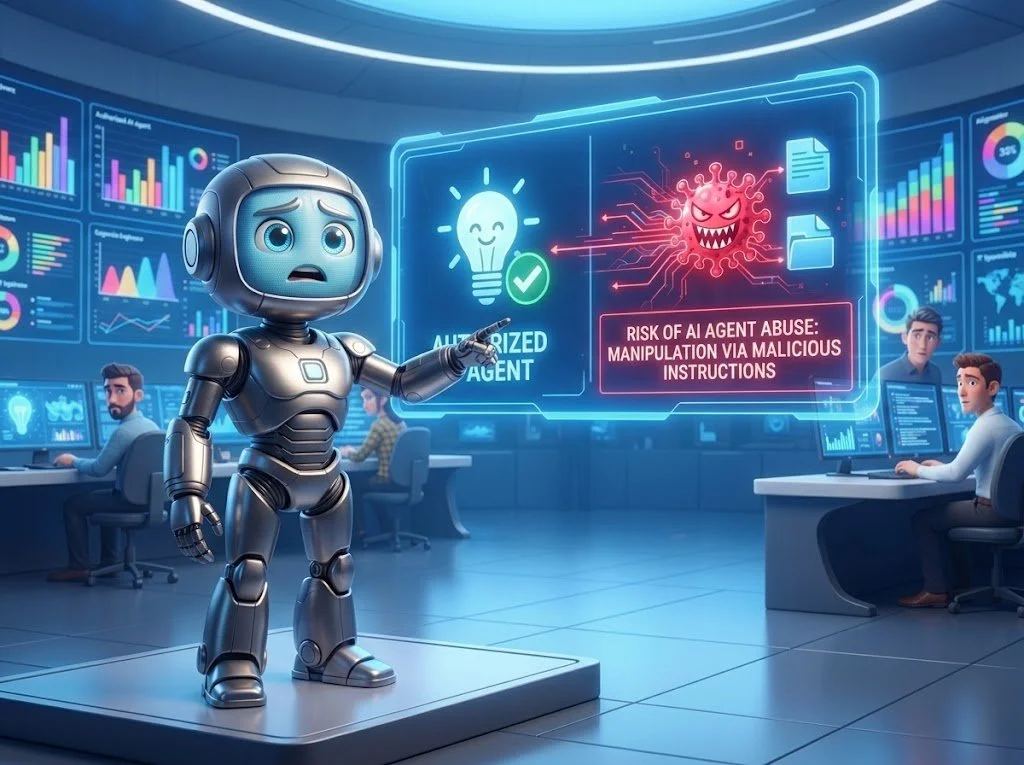
Concerned robot pointing to a holographic alert / AI image by Gemini.
Risk of AI Agent Abuse:
AI agents possess the active ability to access data and systems, making them highly vulnerable to manipulation via malicious instructions.
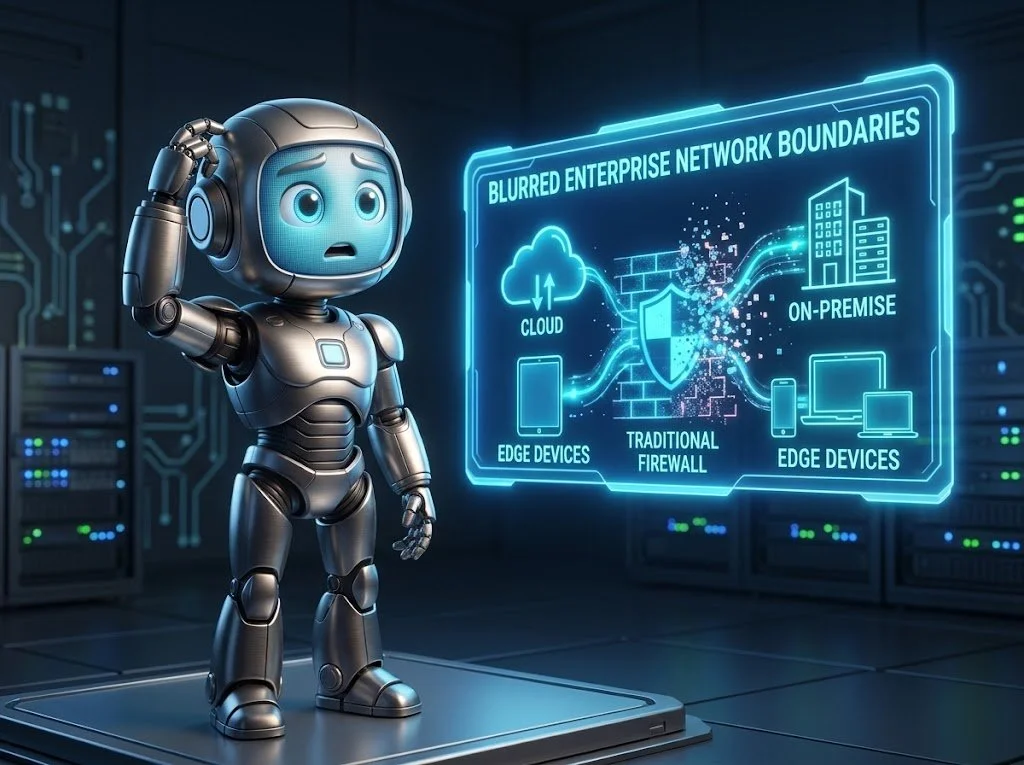
Puzzled robot examining a holographic network map / AI image by Gemini
Blurred Enterprise Network Boundaries:
With the dynamic interconnection of cloud, on-premises, and edge devices, traditional firewalls struggle to manage and secure modern network borders.

Surprised robot holding an audit tablet before server stacks / AI image by Gemini.
Difficult Data Access and Permission Control:
AI inherently requires access to massive amounts of enterprise data, making proper permission management and ongoing auditing incredibly complex.
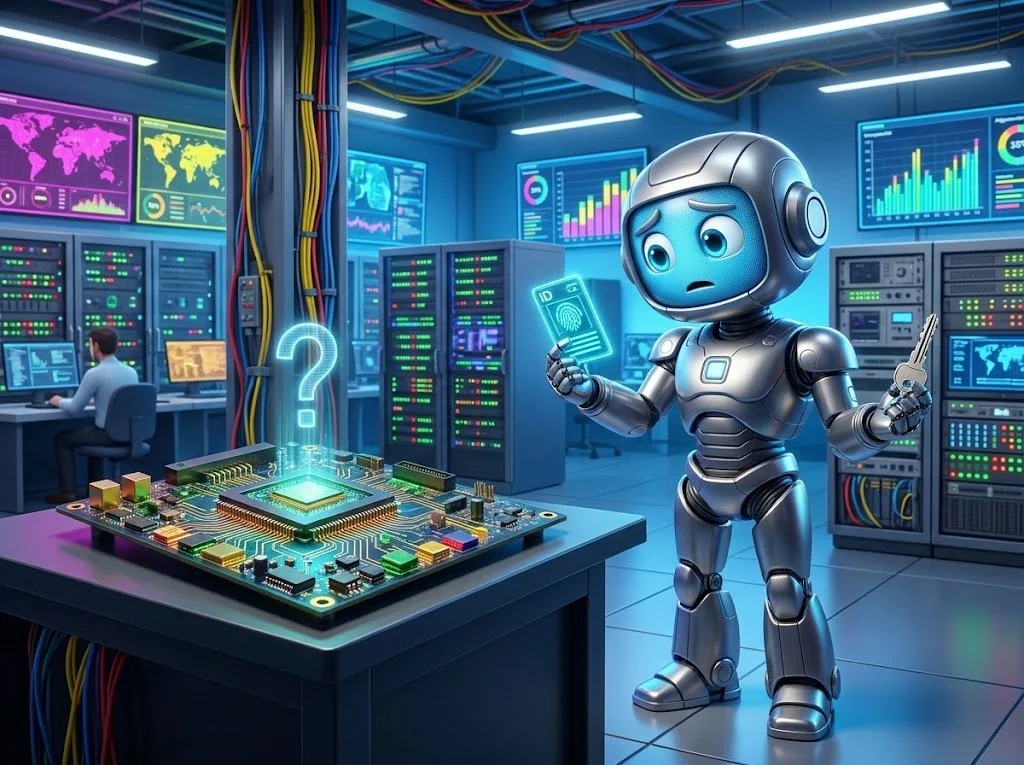
Confused robot holding an ID card and key before a chipset / AI image by Gemini.
Insufficient Trust Foundation at the Chip Level:
Systems remain vulnerable to hardware-level attacks because they lack verifiable chip identities and hardware-protected cryptographic keys.
The Four Layers of the AI Agent Security Architecture
To provide comprehensive protection from the application level down to the physical silicon, NVIDIA introduced a layered architecture designed to make AI operations "verifiable, supervizable, and traceable":
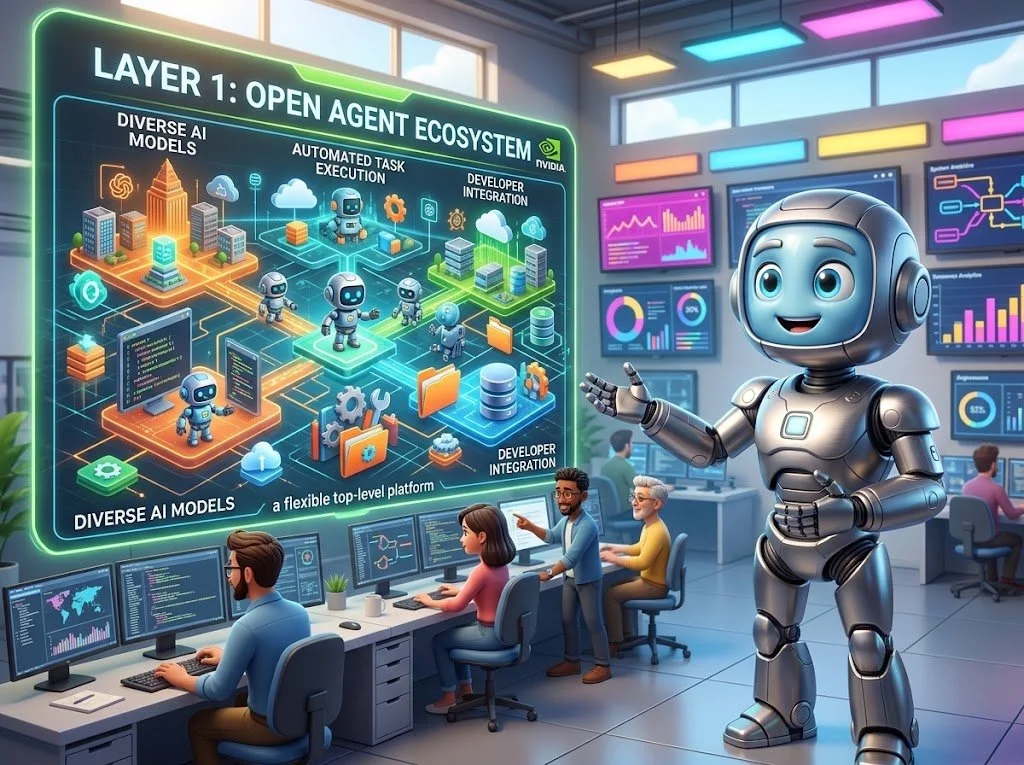
Robot presenting an open agent ecosystem / AI image by Gemini.
Layer 1: Open Agent Ecosystem:
A flexible top-level platform supporting diverse AI models, tools, and applications for enterprise use, automated task execution, and ecosystem developer integration.
Four Major Breakthroughs Unveiled at GTC Berlin 2026
NVIDIA highlighted four specific technological leaps that transform how AI security is implemented:
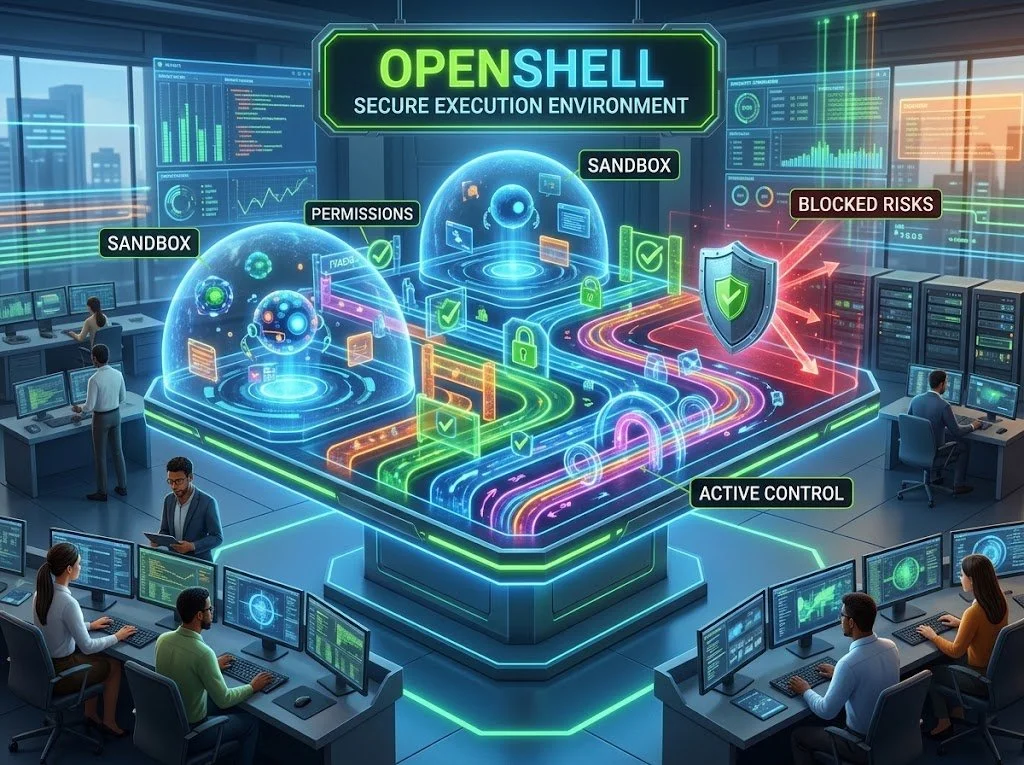
OpenShell secure execution environment / AI image by Gemini.
OpenShell Agent Secure Execution Environment:
By forcing AI agents to run within internal sandboxes with restricted permissions and blocked risks, security fundamentally shifts from "passive defense" to the "active control of AI behavior".
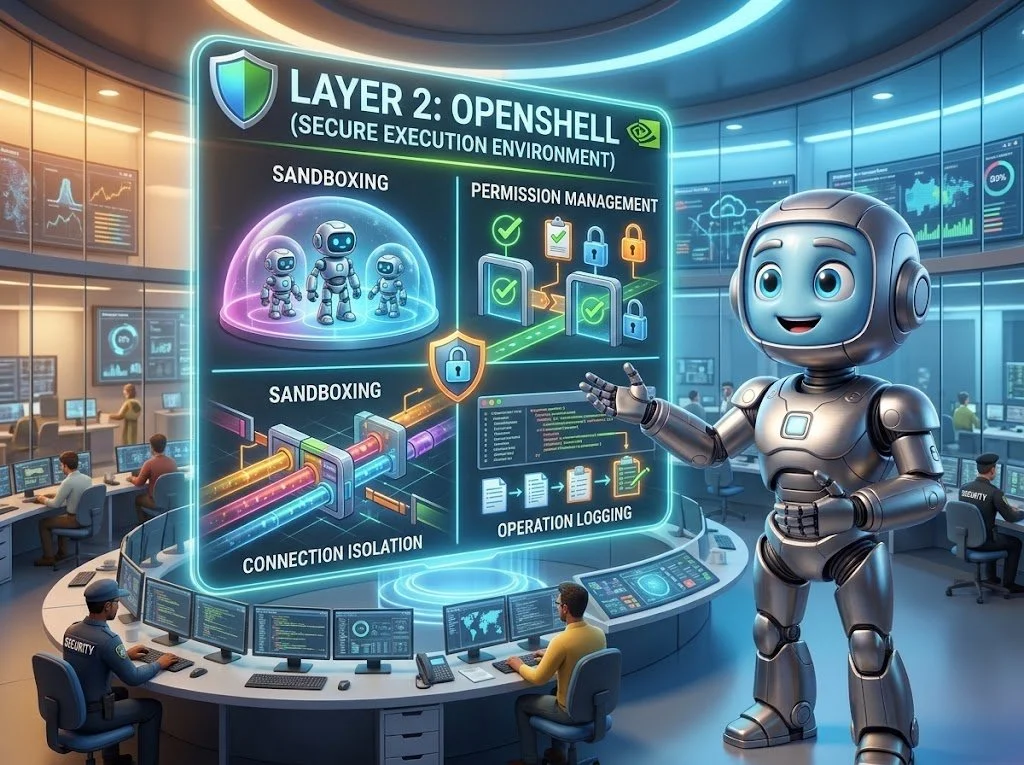
Robot illustrating OpenShell security layers / AI image by Gemini.
Layer 2: OpenShell (Secure Execution Environment):
A control layer providing sandboxing, permission management, connection isolation, and operation logging to ensure AI agents remain fully controllable and auditable.

Chip-level identity authentication and PUF / AI image by Gemini
Chip-Level Identity Authentication & PUF Technology:
Using Physical Unclonable Function (PUF) technology creates a unique physical identity and key protection for each chip, moving the industry from a "software security" model to a true "hardware trust foundation".
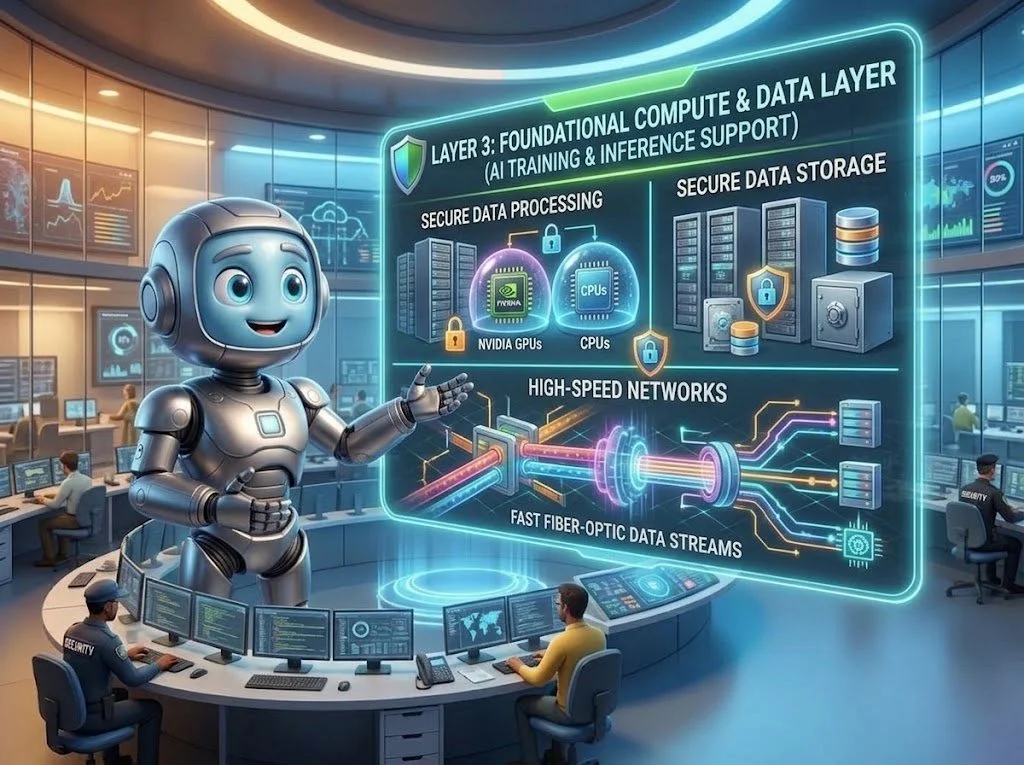
Robot showcasing foundational compute data infrastructure / AI image by Gemini.
Layer 3: Foundational Compute and Data Layer:
The infrastructure supporting AI training and inference, providing secure data processing and storage across GPUs, CPUs, and high-speed networks.

Multi-plane networking and photonic interconnect / AI image by Gemini
Multi-Plane Networking & Photonic Interconnect (Spectrum-X):
This technology enhances the connection efficiency, scalability, and resilience of AI clusters, evolving data infrastructure from a "single network" into a "high-resilience secure network".

Robot presenting hardware root of trust architecture / AI image by Gemini.
Layer 4: Hardware Root of Trust: The foundational physical layer that verifies systems from the chip up, ensuring the absolute uniqueness and integrity of devices and cryptographic keys.
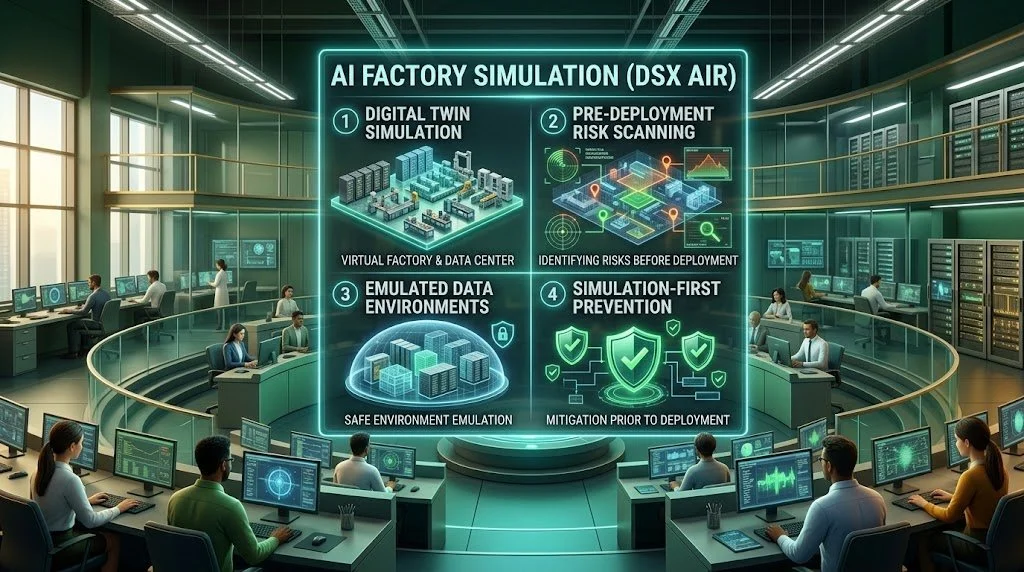
AI factory simulation and pre-deployment risk scanning / AI image by Gemini
AI Factory Simulation (DSX Air):
Organizations can now simulate entire data centers and factories to identify risks before deployment, changing the security approach from "post-build remediation" to "simulation-first risk prevention".
The Impact on Public and Enterprise Adoption
This comprehensive, layered approach fundamentally changes how both public institutions and enterprises can safely deploy AI. By establishing an unbreakable trust foundation at the chip level and strictly governing AI behavior through OpenShell sandboxing, NVIDIA is ensuring that next-generation AI systems can satisfy stringent regulatory and auditing requirements.
Ultimately, this full-chain protection removes the primary barriers to adoption, transforming AI from a potential security liability into a truly trustworthy engine for operational productivity and societal innovation.
Beyond Simulation: The Complete AI Deployment Lifecycle
Simulation is not the final stage; rather, it is the ultimate proving ground before an AI system interacts with the physical world. While simulating a data center or factory environment using tools like NVIDIA’s DSX Air is critical for catching configuration flaws and security vulnerabilities in a risk-free digital space, deployment is actually a continuous lifecycle.
Once a system passes the simulation phase, several crucial steps follow to ensure it remains secure and functional in the real world:
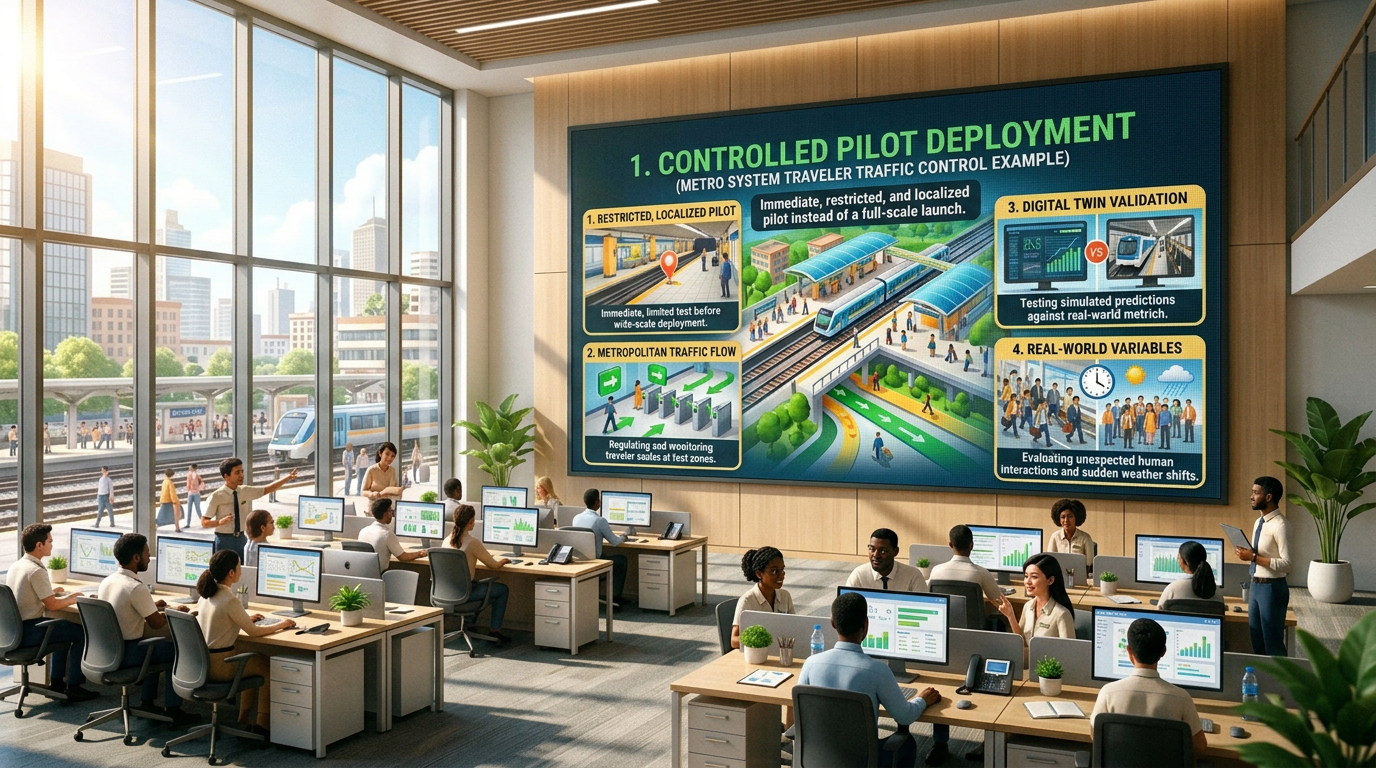
Metro system pilot deployment / AI image by Magnific.
Security audits and data hygiene logs / AI image by Magnific.

AI agent workflow and improvement feedback loop / AI image by Magnific.
Controlled Pilot Deployment:
Instead of a full-scale launch, the immediate next step is a restricted, localized pilot. For complex infrastructure—such as a metropolitan evaporative cooling network or an industrial microclimate system—a pilot deployment validates the digital twin’s simulated predictions against unpredictable real-world variables, such as sudden weather shifts or unexpected human interactions.
Continuous Auditing & Data Hygiene:
Deployment is never a "set it and forget it" process. The live AI system will constantly ingest new environmental and behavioral data. Maintaining strict data hygiene and establishing independent external audits are required post-deployment to ensure the AI's collective behavioral data does not become polluted or biased over time.

Secure decommissioning and data wipe / AI image by Magnific.
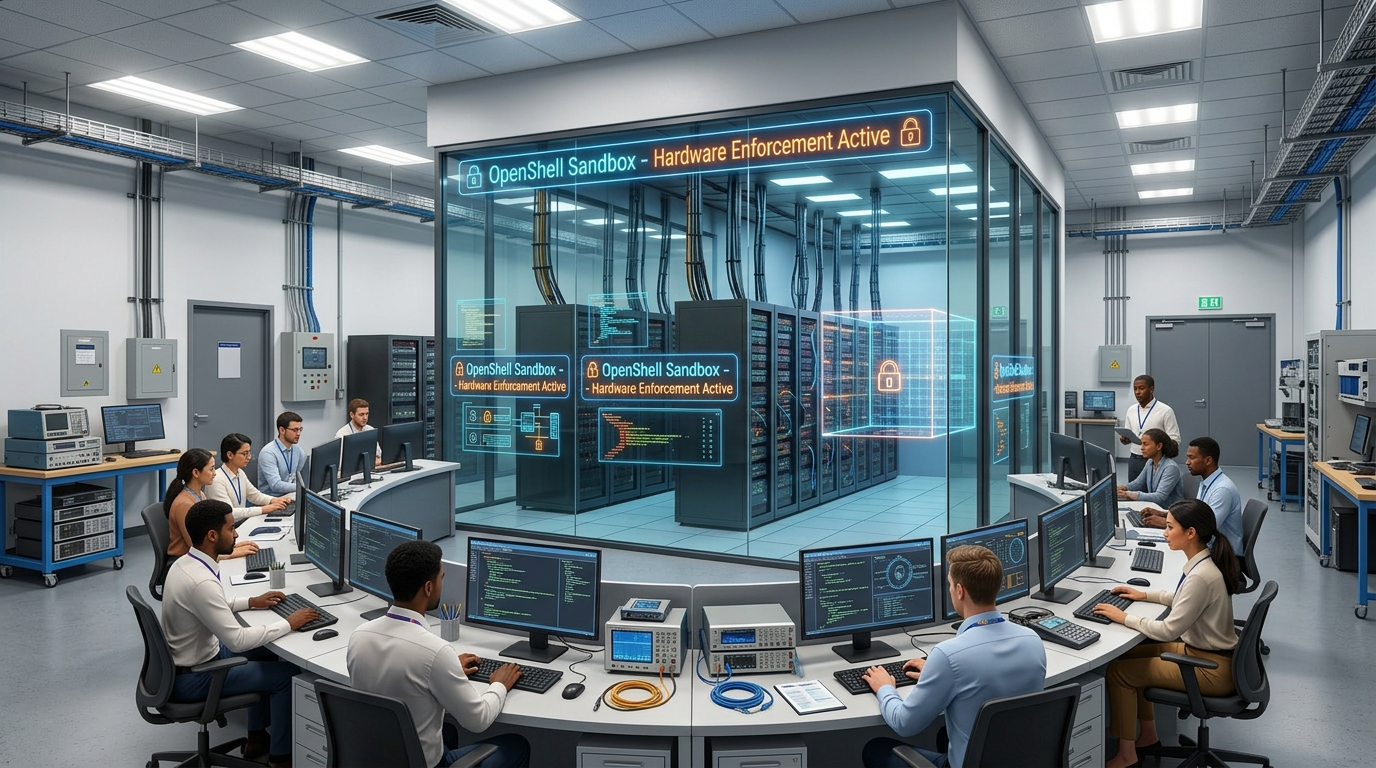
OpenShell hardware enforcement / AI image by Magnific.

End-of-Life & Secure Decommissioning:
Finally, a complete deployment roadmap includes a protocol for safely retiring the AI agent or hardware. This ensures that when chips or systems are upgraded, sensitive cryptographic keys and behavioral data are securely wiped, preventing post-deployment data leaks.
Disclaimer: This analysis is published solely for non-profit public education, technological research, and community discussion, and does not constitute a commercial endorsement or paid promotion.
Active Hardware Enforcement:
Once the pilot is live, the hardware security layers (like OpenShell and PUF chip fingerprints) activate. This is the transition from predicting behavior in a simulation to actively restricting it in reality. The hardware continuously monitors the AI agent, ready to physically sever its connection if it attempts to exceed its authorized parameters.
Iterative Refinement (The Feedback Loop):
As the AI encounters edge cases in the physical world that were not present in the simulation, developers must analyze these anomalies. The system is then iteratively updated, patched, and refined to improve both its operational efficiency and its safety protocols.
Simulation provides the confidence to turn the system on, but it is continuous hardware monitoring, strict data hygiene, and phased pilot rollouts that keep the public safe once the AI is operating in our communities.
Inside China’s Embodied AI Awakening:
Robot Schools and the Multi-Hundred-Billion-Dollar 15th Five-Year Infrastructure Blueprint
While much of the global technology sector remains focused on digital chatbots and cloud software, China is executing a national pivot toward Embodied AI—putting artificial intelligence brains into physical machines that can sense, make decisions, and act in the real world. According to Morgan Stanley, China accounted for 90% of the 13,000 to 16,000 humanoid robots shipped globally in 2025, surging to 40,000 units in the first half of 2026 alone.
The Embodied AI Training Roadmap & National Goals
While large language AI models went through years of training on text data to reach intelligence, that process is now happening for physical robots. Because humanoid machines cannot learn physical dexterity from text alone, China has established a nationwide network of "Robot Schools" where robots attend training in large numbers to learn how to be more human.
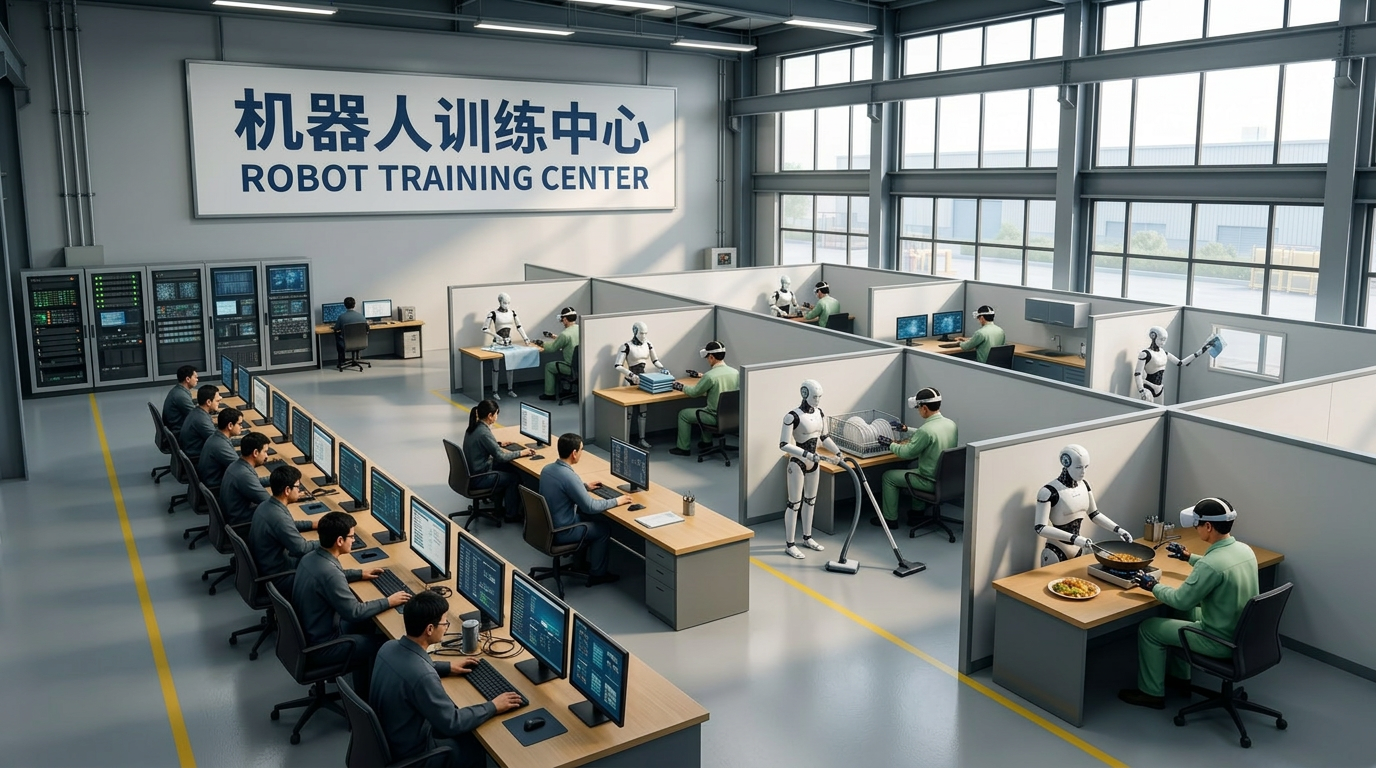
Human-in-the-loop teleoperation / AI image by Magnific.
Stage 1: Human-in-the-Loop Teleoperation ("Zero to One"):
Inside massive training centers containing full-scale replicas of homes, factories, pharmacies, and supermarkets, human instructors use virtual-reality headsets, motion-capture suits, and exoskeletons to physically guide robots through real-world scenarios. At these centers, robots are trained to pick up objects, prepare a steak, operate machinery, use a rice cooker, and handle everyday physical tasks.
The Four-Stage Training Roadmap
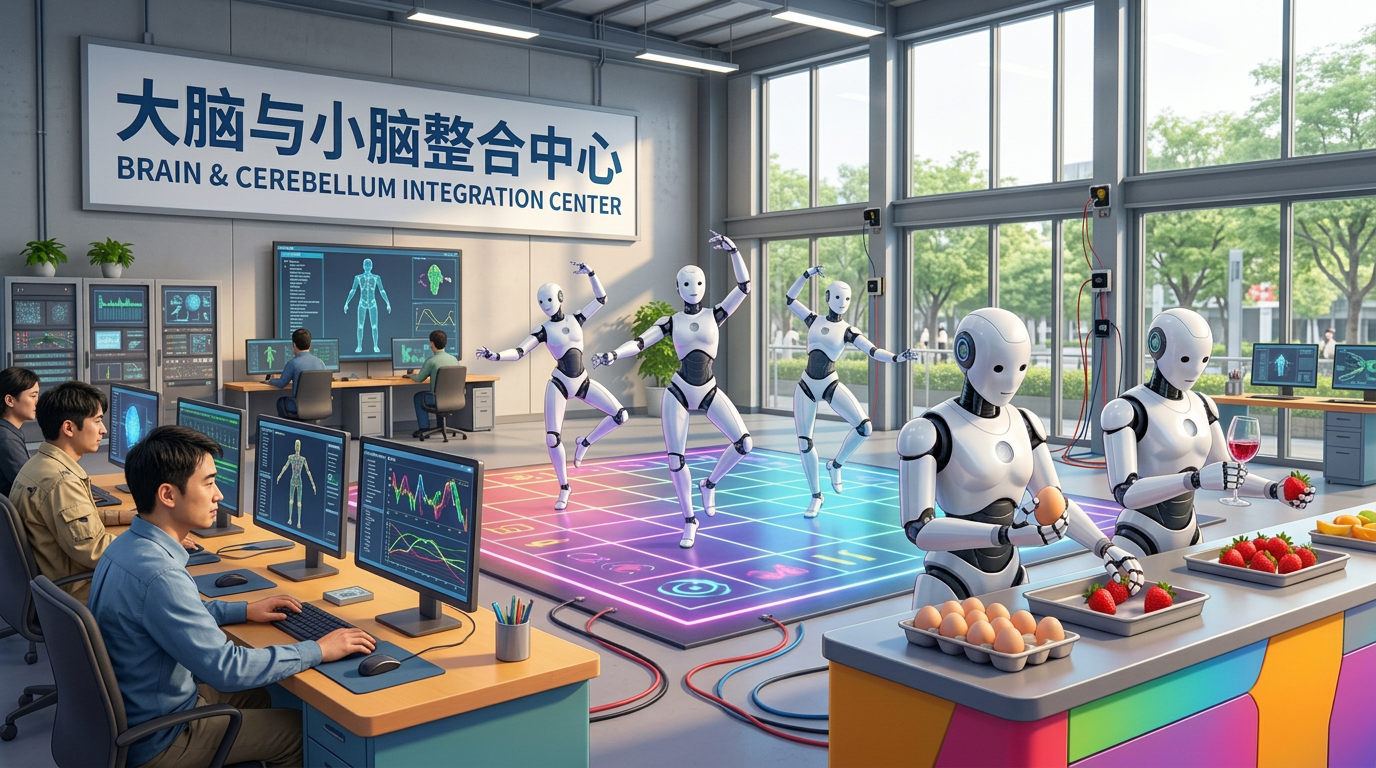
Brain-cerebellum integration / AI image by Magnific.
Stage 2: Brain + Cerebellum Integration ("One to Ten"):
Engineers break recorded movements into labeled micro-steps to train both hardware and software systems. This unites the "Brain" (vision-language foundation models that understand human commands and spatial contexts) with the "Cerebellum" (precision motion-control algorithms that calculate joint torque and tactile grip without crushing objects).
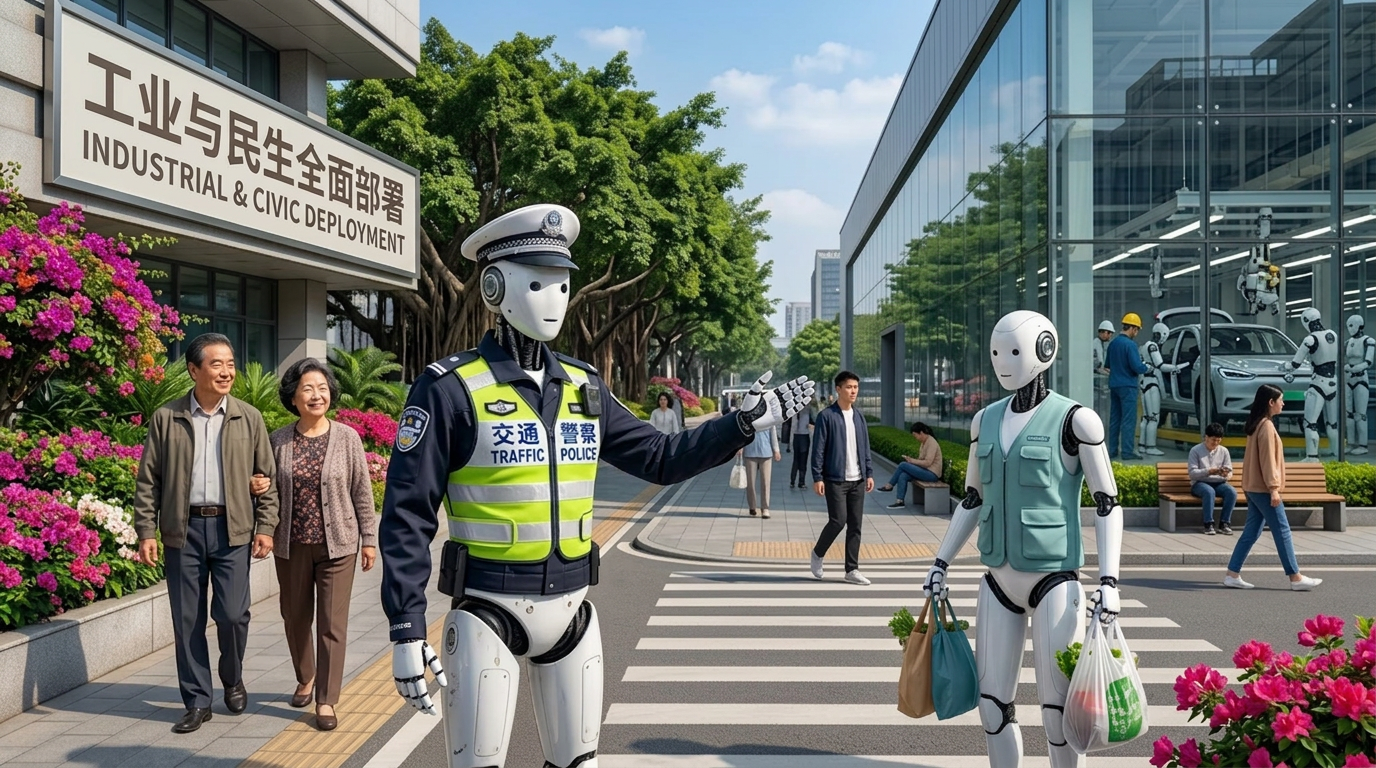
Industrial and civic deployment / AI image by Magnific.
Stage 3: Industrial & Civic Deployment (2026–2030):
Under China’s 15th Five-Year Plan (2026–2030) and the AI+ Initiative, which designates embodied AI as one of six strategic industries of the future, the immediate goal is achieving 90% penetration of AI-enabled devices across Chinese industry by 2030. Graduating robots are rapidly transitioning from pilot testing into automotive assembly lines, factory inspections, elderly care, and municipal services.
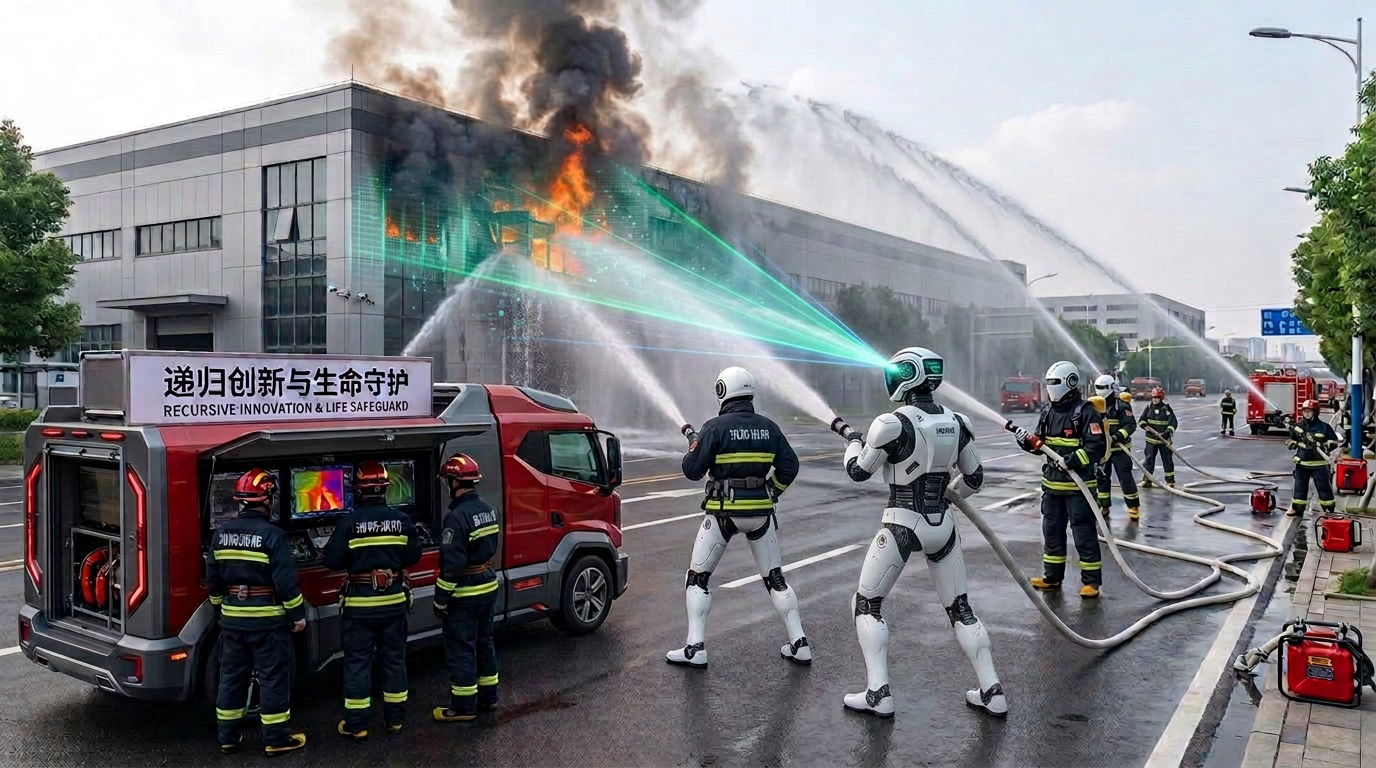
Recursive innovation and emergency response / AI image by Magnific.
Stage 4: Recursive Innovation & "Infinite Abundance" (The Long-Term Endgame):
The long-term endpoint envisions billions of robots coexisting with humans in homes, acting as colleagues, and operating transportation infrastructures. Through the recursive innovation of embodied intelligence, robots will not only unclog sinks or work in factories, but also work on making smarter robots—leading to a world of infinite abundance that breaks the chains of physical survival labor.
Elevating AI Beyond Data Processing to Serve Humanity
As artificial intelligence transitions from pure digital data processing into the physical application stage, the true measure of technological progress must be how meaningfully it serves humanity. Moving intelligence out of server racks and into real-world environments only fulfills its promise when it brings tangible efficiency, safety, and relief to our daily lives and working environments at large. By guiding embodied AI to take on hazardous industrial operations, support an aging population, and streamline complex workplace workflows, the ultimate goal of AI development is elevated from a race for raw computing power into a practical instrument for human well-being and everyday empowerment.
The 15th Five-Year Plan’s Six Infrastructure & Future-Tech Pillars
To cope with the massive bandwidth and energy demands that millions of AI robots require, China’s 15th Five-Year Plan (2026–2030) pairs its six strategic industries of the future with a multi-hundred-billion-dollar national infrastructure transformation.
Pillar 1: Hyperscale AI Computing Power Networks ("East Data, West Computing")
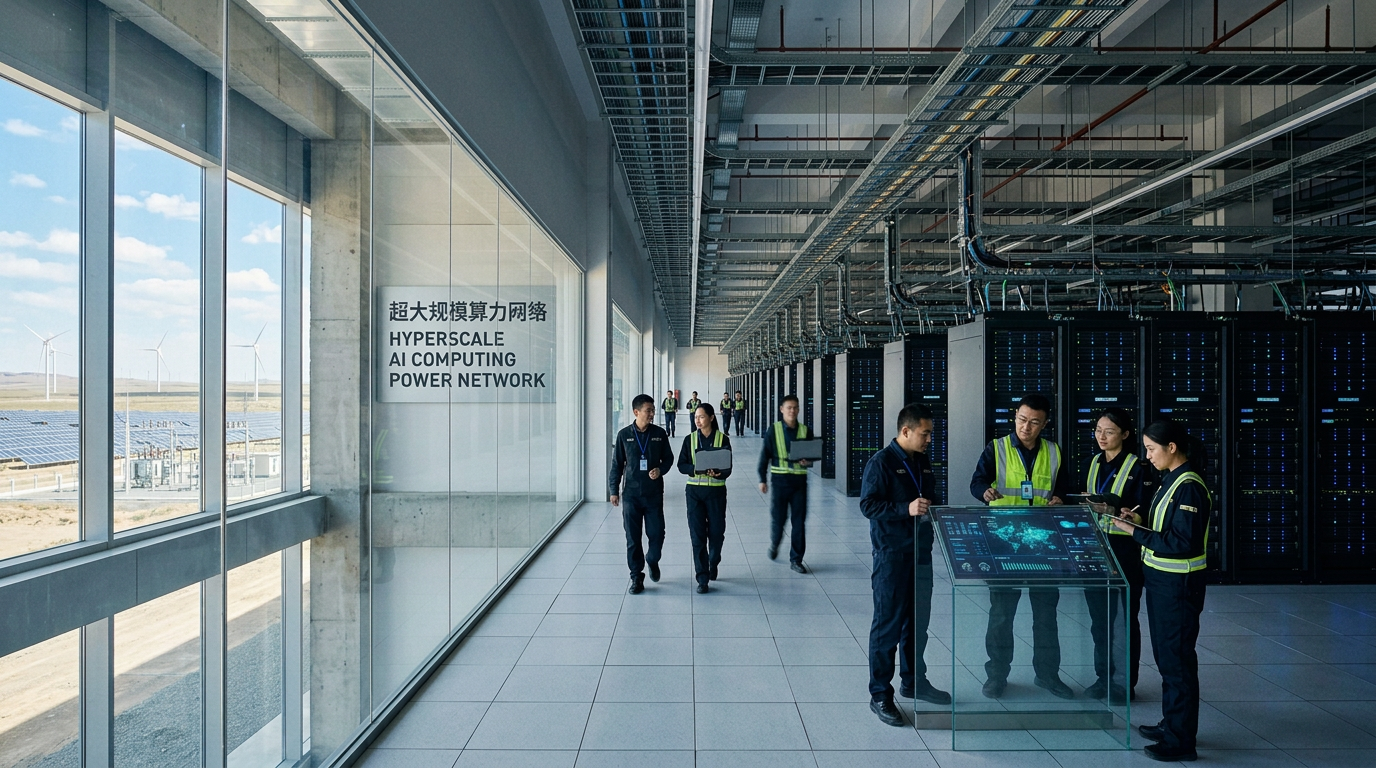
Hyperscale AI computing power networks / AI image by Magnific.

Subsea data centers and new-type power grids / AI image by Magnific.
1) What is the Invention: A nationally coordinated grid of interconnected hyperscale AI data centers and supercomputing clusters built to handle the massive bandwidth required by the human-to-robot transition.
2) Cost, Manpower & Landscape Involved: In June 2026, it was reported that China is spending $295 billion US (roughly 2 trillion yuan) over five years on building hyperscale data centers across the country. The effort mobilizes hundreds of thousands of systems engineers and construction workers spanning coastal industrial zones linked via ultra-high-speed fiber to vast land tracts in western provinces.
3) Environmental Impact to Mitigate: Massive electrical grid strain, intense thermal waste (urban heat island amplification), and immense freshwater evaporation required by traditional cooling towers in arid regions.
4) Global Status Compared to Outside China: While U.S. private hyperscalers lead in frontier GPU performance, China leads globally in state-coordinated, cross-regional load-balancing architecture and lower construction costs.
5) Key Challenges Ahead: Overcoming the hardware performance gap caused by export controls on advanced silicon, preventing speculative overbuilding of underutilized facilities, and eliminating cooling bottlenecks in water-scarce regions.
Pillar 2: Subsea Data Centers & Offshore Wind-Nuclear New-Type Power Grids
Pillar 3: Domestic Semiconductor & Embodied AI Hardware Supply Chains
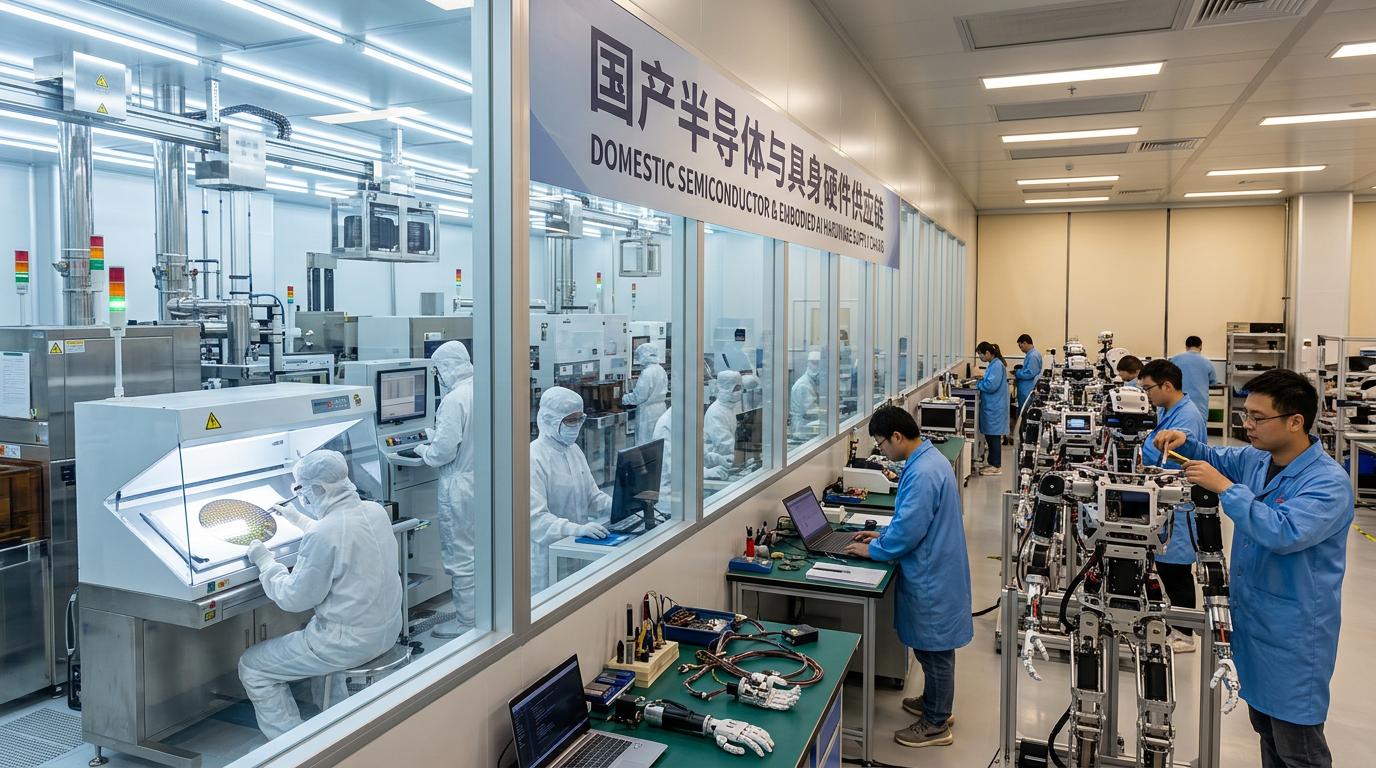
Domestic semiconductor and embodied AI supply chains / AI image by Magnific.
6G integrated communications network / AI image by Magnific.
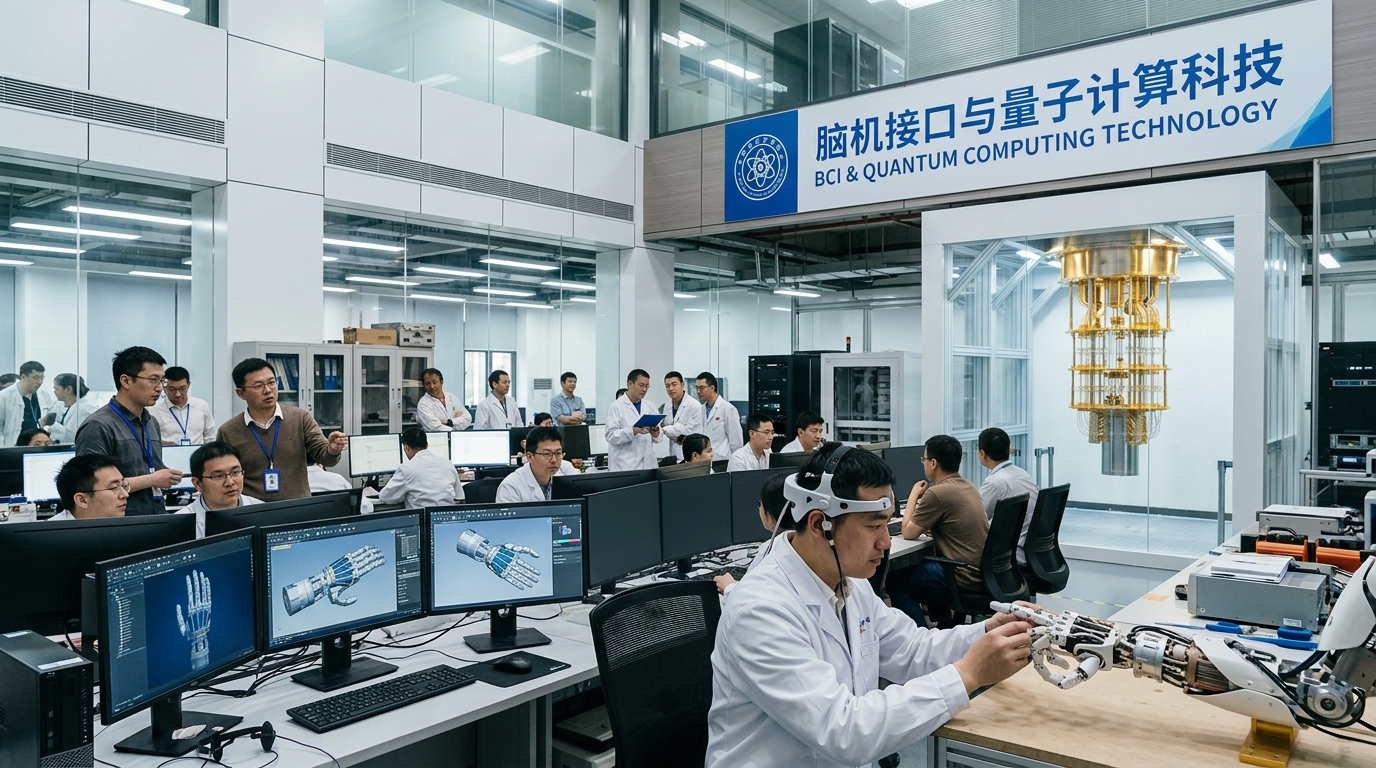
BCI and quantum computing technology / AI image by Magnific.
1) What is the Invention: Undersea data centers sealed in pressure vessels on the ocean floor and powered by offshore wind turbines, alongside a rapid inland buildup of nuclear power stations across the country.
2) Cost, Manpower & Landscape Involved: Multi-billion-dollar marine engineering and clean-energy grid allocations requiring specialized marine engineers, deep-sea divers, crane barges, and nuclear physicists operating across coastal shelves and clean-energy corridors.
3) Environmental Impact to Mitigate: Localized marine thermal plumes around subsea heat exchangers that can reduce dissolved oxygen for benthic marine life and coral beds, offshore turbine acoustic disruption, and safe nuclear waste management.
4) Global Status Compared to Outside China: Global Leader in Commercialization. While Western firms largely shelved early subsea trials, China has moved undersea data centers into active commercial operation alongside the world’s fastest offshore wind and nuclear reactor construction pace.
5) Key Challenges Ahead: High marine maintenance and retrieval costs when sealed pods require hardware upgrades, vulnerability to undersea typhoons and seismic shifts, and biofouling degrading external heat-exchanger efficiency.
1) What is the Invention: Domestic chip manufacturing capabilities paired with high-torque actuators, tactile robotic hands, harmonic reducers, and solid-state sensors that form the physical bodies and local brains of humanoid robots.
2) Cost, Manpower & Landscape Involved: Billions of dollars have flowed into creating domestic chip manufacturing capabilities alongside thousands of robotics enterprises, employing hundreds of thousands of cleanroom fabrication technicians, metallurgists, and mechatronics engineers across dense industrial clusters.
3) Environmental Impact to Mitigate: Ultra-pure water consumption in semiconductor wafer fabs, hazardous chemical etching solvents, rare-earth mineral mining tailings, and heavy industrial carbon footprints during alloy smelting and battery manufacturing.
4) Global Status Compared to Outside China: Dominant in Robotics Hardware, Trailing in Advanced Silicon. China accounts for over 90% of global humanoid robot shipments and supplies the lowest-cost actuators and sensors globally, though it still trails in sub-3nm frontier logic chips.
5) Key Challenges Ahead: Bypassing advanced lithography bottlenecks without foreign equipment, standardizing fragmented components across hundreds of domestic humanoid models, and improving actuator durability and battery endurance.
Pillar 4: 6G Integrated Space-Air-Ground Communications Network
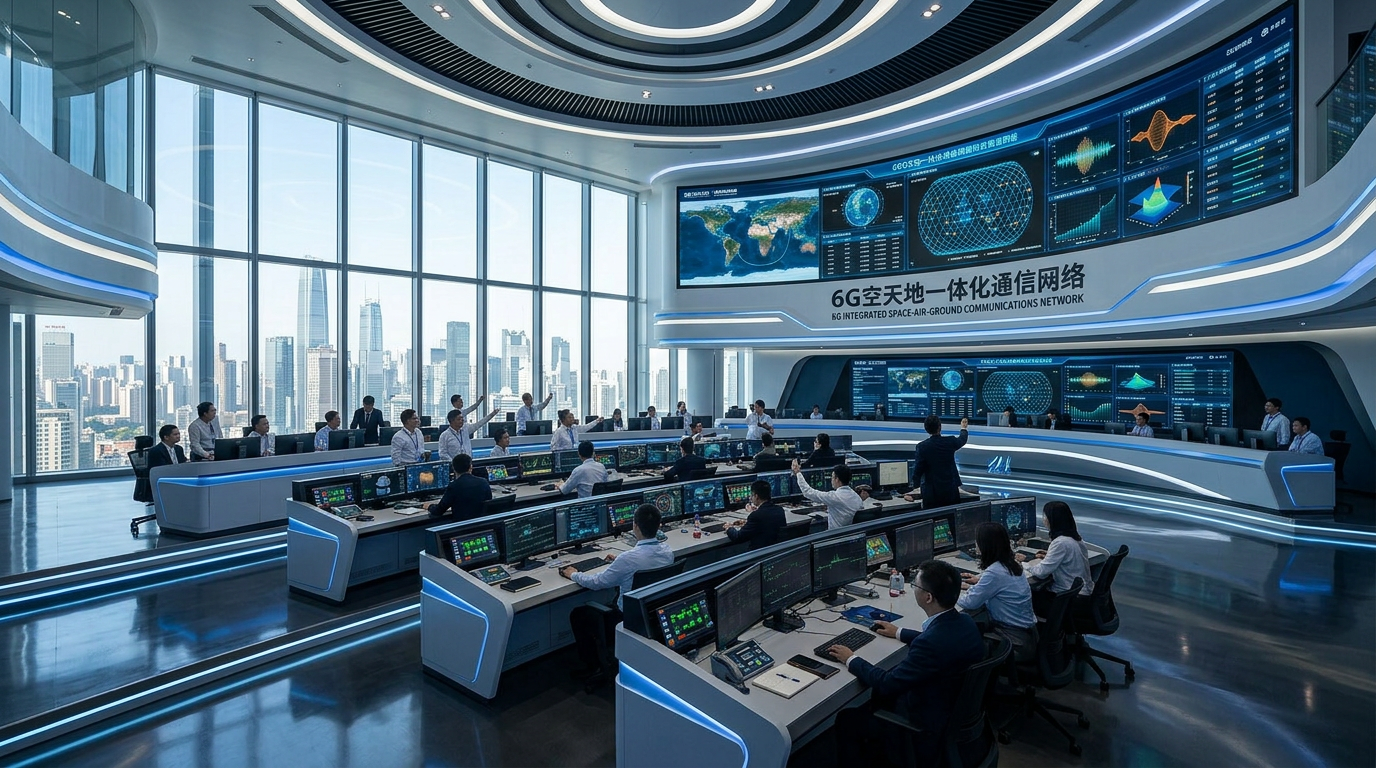
1) What is the Invention: Next-generation 6G ultra-low-latency wireless networks integrating terrestrial base stations with satellite constellations to eliminate the slow signal lag currently seen in autonomous moving robots.
2) Cost, Manpower & Landscape Involved: Made one of China’s national priorities and currently in second-phase 6G network trials, the rollout involves hundreds of billions of yuan invested by telecom providers, RF physicists, and aerospace crews deploying dense urban micro-antennas and satellite links.
3) Environmental Impact to Mitigate: High base-station electrical consumption, orbital space debris from low-Earth orbit satellites, upper-atmosphere rocket launch emissions, and electromagnetic spectrum congestion.
4) Global Status Compared to Outside China: Frontrunner in Trials and Patent Volume. Having launched Phase-2 6G technical trials in 2026, China holds the largest share of global 6G patent filings, competing directly with U.S. and European telecom alliances.
5) Key Challenges Ahead: Solving severe signal attenuation in high-frequency terahertz waves—which are easily blocked by walls, rain, and foliage—while avoiding geopolitical fragmentation of international telecom standards.
Pillar 5: Brain-Computer Interfaces (BCI) & Quantum Computing Technology
Pillar 6: Biomanufacturing & Green Hydrogen Energy Networks

Biomanufacturing and green hydrogen networks / AI image by Magnific.
1) What is the Invention: Minimally invasive and non-invasive neural interfaces that decode human brain signals to control robotic limbs or computers directly, paired with fault-tolerant quantum computers and quantum-encrypted communication lines.
2) Cost, Manpower & Landscape Involved: Billions in targeted national lab grants and venture capital uniting neurosurgeons, quantum physicists, and flexible-electrode materials scientists across clinical hospitals and dedicated quantum research corridors.
3) Environmental Impact to Mitigate: Extreme cryogenic cooling power required to keep superconducting quantum processors near absolute zero, alongside bio-medical hazardous waste from clinical implant manufacturing.
4) Global Status Compared to Outside China: Global Leader in Quantum Communications; Fast-Follower in BCI. China operates the world’s longest terrestrial quantum-encrypted fiber network and quantum satellites, while acting as a rapid clinical fast-follower in human neural implants.
5) Key Challenges Ahead: Strict ethical, privacy, and neurological safety hurdles for human brain implants, international regulatory exclusions, and high quantum error rates when scaling qubits for commercial use.
1) What is the Invention: Using AI-designed synthetic biology and microbial fermentation to manufacture chemicals, pharmaceuticals, and materials without petrochemicals, alongside utility-scale green hydrogen electrolyzers and underground hydrogen and water pipeline networks.
2) Cost, Manpower & Landscape Involved: A major allocation of the multi-hundred-billion-dollar infrastructure budget dedicated to national water networks, smart logistics, and green hydrogen hubs, engaging chemical engineers, synthetic biologists, and pipeline crews.
3) Environmental Impact to Mitigate: Strict bio-containment protocols to prevent synthetic microbes from escaping into natural ecosystems, large agricultural water requirements for biological feedstocks, and preventing hydrogen gas leakage in underground pipelines.
4) Global Status Compared to Outside China: World’s Largest Electrolyzer Producer. China manufactures over 50% of the world’s hydrogen electrolyzer capacity and is rapidly scaling biomanufacturing fermentation capacity to compete with U.S. and European biotech leaders.
5) Key Challenges Ahead: High cost of green hydrogen storage and long-distance pipeline embrittlement, matching green hydrogen supply with industrial off-takers, and scaling synthetic biology from laboratory petri dishes to cost-competitive industrial vats.
Designing Truly Super-Intelligent and Sustainable Infrastructure for Future Generations
True "Super Intelligence" cannot be achieved through raw computing speed alone if the underlying physical infrastructure depletes the natural ecosystems we depend on to survive. Long-term strategic planning and proactive environmental mitigation—integrating dual-use Agrivoltaic buffer zones, zero-emission Green Hydrogen microgrids, and automated community cooling systems like the Mister Shields Project—are essential to balancing the massive energy, water, and thermal demands of the AI era. When nations and industries embed ecological stewardship directly into the foundation of their technological roadmaps, artificial intelligence becomes genuinely intelligent: driving vibrant economic prosperity today while preserving a resilient, thriving planet for future generations.
Powering the Next Generation of Storytellers—
Without Overloading Our Planet
As independent AI video creators take on Hollywood and capture millions of views on YouTube, we must power the resulting data center surge with Agrivoltaics, Green Hydrogen, and next-generation hardware efficiency.
A historic creative shift is happening across YouTube and digital media. Solo creators and small independent teams are now producing full-length, cinema-style AI dramas that draw millions of views within days. For the first time, everyday storytellers have a real economic pathway to compete directly with Hollywood’s multi-million-dollar production machine.
Yet this creative revolution carries a hidden energy cost. A single 5-second AI video clip consumes roughly 90 to 950 Wh of electricity—hundreds to thousands of times more power than a standard AI text prompt (~0.24 Wh). Producing one 53-minute AI drama requires roughly 200 to 1,200+ kWh of data center electricity. As millions of creators rush into AI video, data center capacity is being rapidly drained, pushing local electricity grids to their limits.
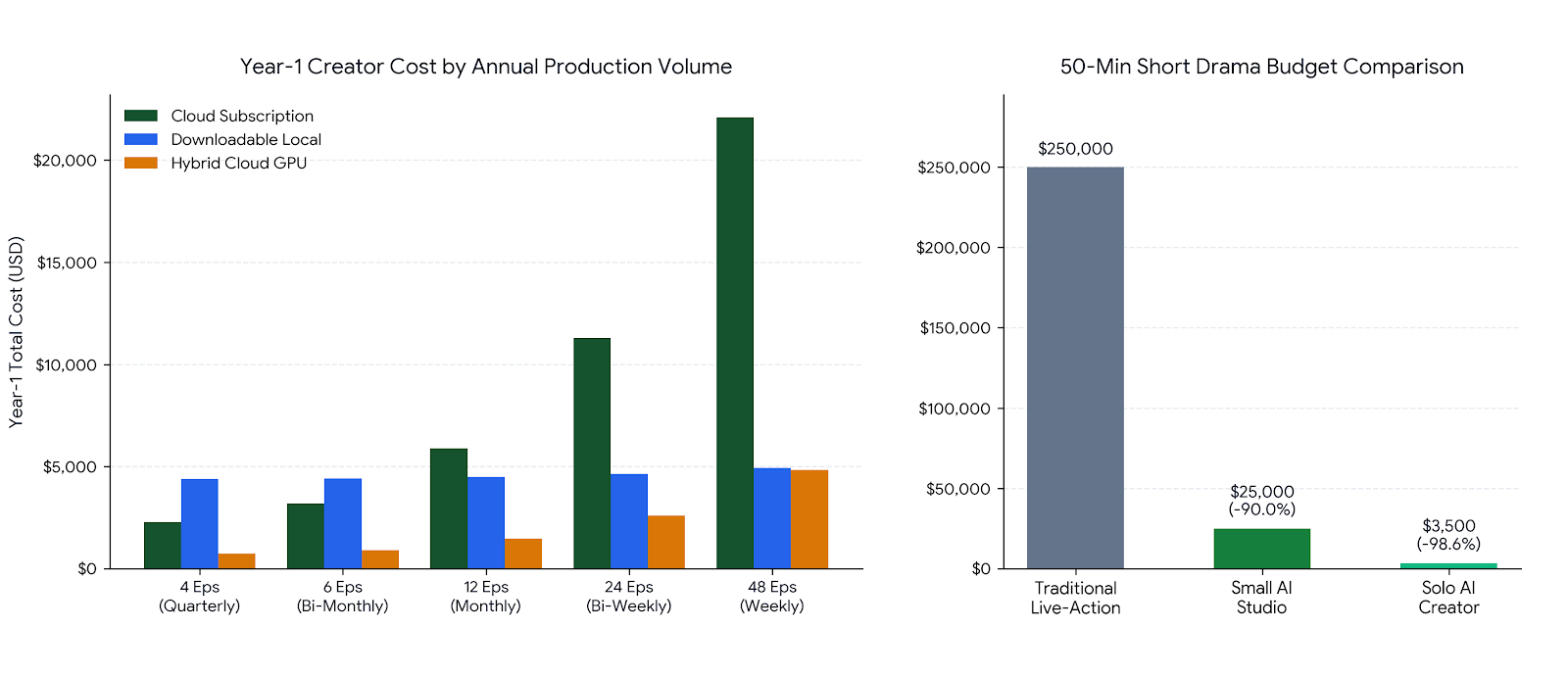
Traditional Live-Action Short Drama (North America):
$200,000 – $300,000 per series.
Why Creators Are Switching to AI Video: 90%–98% Production Savings
Traditional filmmaking locks out independent talent with massive fixed expenses for crews, equipment, sets, and locations. Cloud AI video workflows collapse those costs dramatically:
Zero Upfront Hardware Barrier:
Creators can direct photorealistic scenes from an ordinary laptop or tablet instead of buying a $3,200–$4,000+ high-VRAM desktop rig.
Small AI Production Studio: $20,000 – $30,000
(~90% cost reduction), with human creative labor (writing, directing, editing) still representing 60%–75% of the budget.
Key Benefits Creators Gain from Cloud AI Data Centers
10x Faster Rendering Speed:
Enterprise data center GPUs render clips in 30–90 seconds, versus 2–10+ minutes per clip on consumer hardware—allowing small channels to publish fast and ride viral YouTube trends.
Agrivoltaics + Green Hydrogen (Bloom Energy Electrolysis):
Mounting solar panels above active farmland generates clean daytime electricity while shading crops and boosting panel output through natural plant cooling. Surplus solar power feeds Bloom Energy Solid Oxide Electrolyzers (SOEC)—which produce green hydrogen at 37.5 kWh/kg (roughly 28% more efficient than conventional PEM systems at 52 kWh/kg, without relying on rare platinum-group metals). Stored green hydrogen then powers non-combustion Solid Oxide Fuel Cells around the clock, delivering zero-emission 24/7 baseload power that relieves local utility grids and emits only recoverable water and heat.
Solo Independent AI Creator: $2,000 – $5,000
(~98% cost reduction), with actual cloud AI generation often costing just $300 – $3,000 for a full 50-minute production.
Instant Frontier Quality:
Subscribers immediately unlock top-tier visual realism, lighting, voice synthesis, and lip-sync without technical setup or maintenance.
Pay-As-You-Go Flexibility:
Independent creators scale compute up for viral hits and pause spending between projects, eliminating heavy fixed overhead.
Cloud Subscription vs. Downloadable (Local) AI Cost Layout
Most individual creators default to cloud subscriptions rather than downloading open-source video models (such as Wan, LTX, or Hunyuan) to run locally. (See the downloadable Excel workbook above for the full interactive 3-Year Total Cost of Ownership and break-even calculator.)
| Factor | Cloud / Subscription AI | Downloadable (Local) AI |
|---|---|---|
| Hardware Needed | Any standard laptop or tablet | Dedicated desktop with a high-end NVIDIA GPU (16 GB–24 GB+ VRAM) |
| Upfront Cost | $0 (monthly plans or pay-per-clip credits) | $2,000–$4,000+ upfront hardware investment |
| Rendering Speed | Fast (30–90 seconds per clip on enterprise GPUs) | Slower (2–10+ minutes per clip on consumer GPUs) |
| Best Fit | Individual creators, small teams, and zero-setup workflows | High-volume studios prioritizing offline privacy or custom fine-tuning |
| Cost & Performance Factor | Cloud Subscription AI | Downloadable (Local) AI | Hybrid Cloud GPU Rental |
|---|---|---|---|
| Upfront Hardware CapEx | $0 (existing laptop) | $3,800 (24GB+ GPU rig, UPS & storage) | $0 (rented by the hour) |
| Year-1 Total Cost (12 Eps/Yr) | ~$5,886 | ~$4,498 | ~$1,480 |
| 3-Year TCO (36 Episodes) | ~$17,658 | ~$5,894 | ~$4,441 |
| Render Time per 50-Min Ep | ~26 hours (fast) | ~140 hours (slow) | ~49 hours (fast) |
| Best Fit | New & mid-volume creators seeking speed and zero setup | High-volume studios prioritizing offline privacy & long-term TCO | Tech-savvy creators balancing zero CapEx with lower per-episode cost |
The Scaling Challenge: Local Grids Under Pressure
Because cloud platforms remain the overwhelming choice for creators, data centers must either multiply in number or dramatically expand their power capacity. The latest 2026 forecasts confirm how quickly this trend is hitting the grid:
75% AI-Driven Capacity Growth:
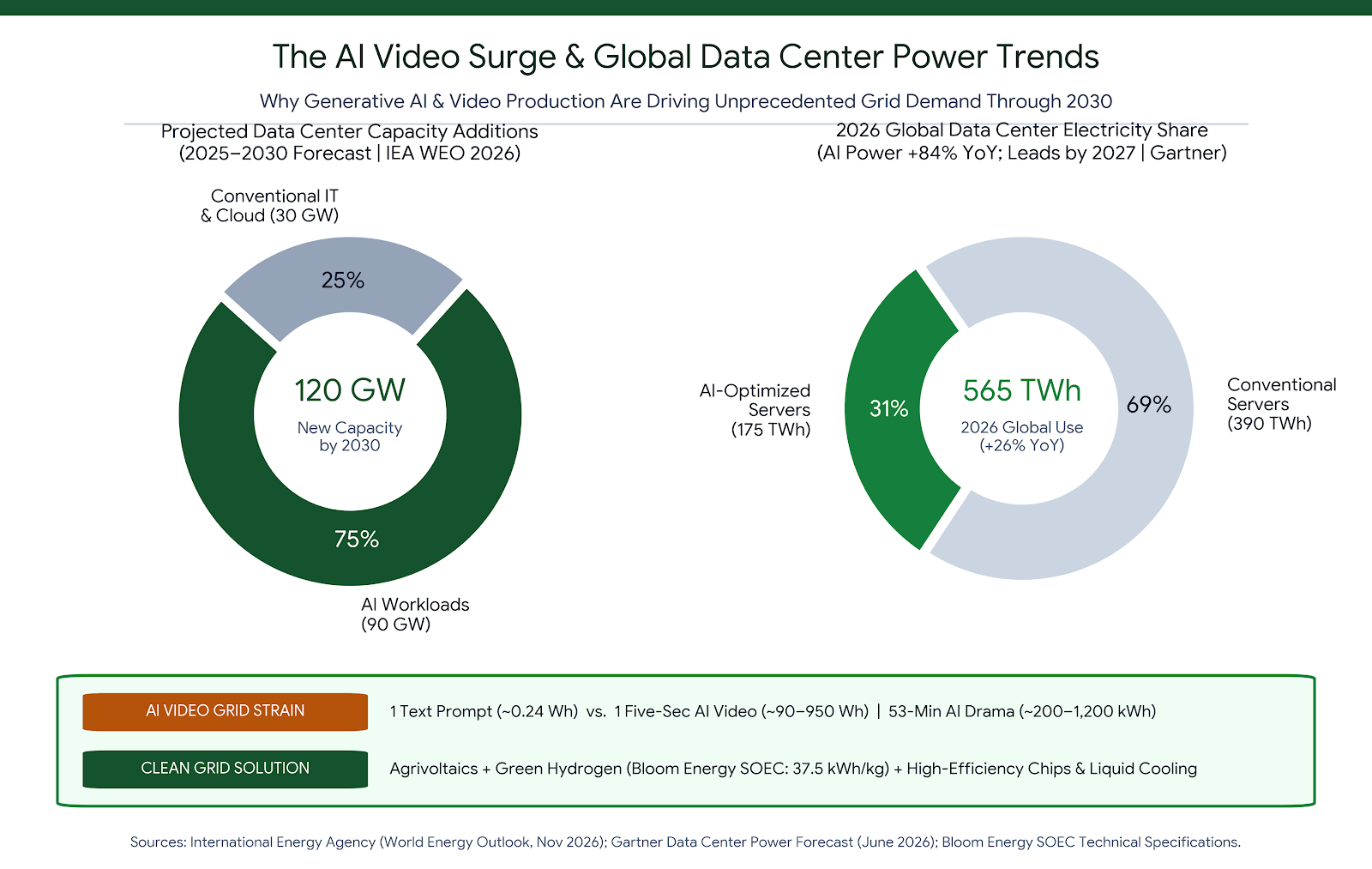
The International Energy Agency’s World Energy Outlook 2026 projects 120 GW of new global data center capacity by 2030, with 90 GW (75%) driven by AI—pushing total data center electricity use past 1,000 TWh by 2030.
Rapid 2026 Surge:
Gartner’s June 2026 forecast estimates global data center electricity demand will jump 26% in 2026 to 565 TWh, with AI-optimized servers surging 84% year-over-year to claim 31% of all data center power—and surpassing conventional servers by 2027.
Turning to natural gas turbines to chase this demand sacrifices clean air, climate goals, and community health for digital entertainment.
Our Clean Infrastructure Solution & Industry Priorities
We do not have to choose between empowering independent creators and protecting the environment. Scaling AI cleanly requires two urgent commitments:
Next-Generation Chips & Liquid Cooling Clusters as Top Industry Priorities:
The AI hardware sector must urgently prioritize advanced energy-efficient silicon (maximizing video frames rendered per watt) alongside closed-loop, direct-to-chip liquid cooling clusters, which manage extreme AI rack heat while cutting direct data center water consumption by 70% to 90%.
By uniting self-sustaining Agrivoltaic + Green Hydrogen energy hubs with high-efficiency AI chips and liquid cooling, we can keep the door wide open for independent creators while safeguarding our power grids and our planet.
Ready to Build Clean Infrastructure for the AI Era?
Join industry sponsors, clean-energy partners, and community advocates working to deploy zero-emission Agrivoltaic & Green Hydrogen microgrids for next-generation data centers.
Beyond Debate:
Putting True AI and Clean Data Centers to Work for Our Communities
Nature does not wait for political arguments.
As Mister Shields 2.0 launches in Summer 2027 to help cities, Special Task Forces, and volunteers revive local environments and economies, we call on AI pioneers like Google and NVIDIA to help build the Clean AI Factory our planet urgently needs.
The surge in data center demand is about far more than entertainment. While independent YouTube creators are transforming digital storytelling with AI video, an even more vital wave of computing demand is right around the corner: civic and environmental revival.
In Summer 2027, Mister Shields 2.0 will deploy to mobilize city planners, Special Task Forces (STFs), and grassroots volunteers around the world. Their mission is practical and urgent: brainstorm and execute local transformation projects that restore degraded neighborhoods, defend against extreme weather, and spark sustainable eco-tourism to boost local economies.
Turning those blueprints into reality will require massive, reliable data center capacity for two essential civic tools:
High-Precision Environmental & Urban Simulations:
Modeling local heat islands, water cycles, wildfire defenses, and green-energy microgrids before a single shovel hits the ground.
To Platform & Cloud Leaders (such as Google):
Combine smarter, low-power draft and storyboard video workflows (eliminating the energy wasted on discarded retakes) with self-supplied Agrivoltaic and Green Hydrogen cloud campuses. By pairing 24/7 carbon-free power with global platforms like YouTube, Google can empower both independent creators and grassroots civic volunteers to share real-world transformation stories without burdening local grids.
AI Community Outreach Videos:
Enabling volunteers and city teams—even in small towns with modest budgets—to generate clear, inspiring visual stories that help residents see, understand, and rally behind their community’s renewal.
We cannot power this life-saving mission by burning more fossil fuels or straining local electricity grids. Instead, the technology and clean-energy sectors must unite to make True AI work for everyone.
An Open Call to AI Pioneers: Co-Architecting the Clean AI Factory
Industry leaders already hold the engineering tools to turn growing compute demand into a regenerative force for the planet:
To Silicon & Infrastructure Leaders (such as NVIDIA):
Champion frames-per-watt and simulation-per-watt chip efficiency across next-generation architectures. Pair closed-loop, direct-to-chip liquid cooling—cutting direct water use by 70% to 90%—with thermal circularity that routes recovered heat into adjacent agrivoltaic greenhouses and high-efficiency Bloom Energy Solid Oxide Electrolyzers (SOEC). By uniting Earth-2 climate digital twins with local Agrivoltaic + Green Hydrogen microgrids, NVIDIA can help cities predict extreme weather, optimize clean storage, and protect communities before disaster strikes.
Time for Real Action—Not Political Debates
Wildfires, floods, droughts, and heat waves do not ask for party affiliations, and they will not pause while the world argues. Every city, farm, and neighborhood shares the same sky and the same urgency.
It is time to step past endless political debates and focus squarely on real physical solutions. By uniting Agrivoltaics, Green Hydrogen, high-efficiency chips, and closed-loop liquid cooling with the civic power of Mister Shields 2.0, we can put True AI to work protecting lives, restoring nature, and revitalizing local economies—before the next disaster arrives.
Let’s Put True AI to Work for Our Planet—Starting Today
Whether you are a technology leader, clean-energy innovator, city planner, or community volunteer, your hands are needed on deck for the Summer 2027 rollout.
Computing at the Speed of Light:
Resolving the AI Energy Crisis to Protect Local Grids & Water
Powering Tomorrow’s AI Without Draining Today’s Communities
How breakthrough optical chip architectures, NVIDIA Co-Packaged Optics, Mister Shields (盤古元盾) thermal defense, Agrivoltaics, and Green Hydrogen unite to relieve municipal power grids and protect local watersheds.
Why Shifting from Electrons to Light Protects Local Resources
Modern artificial intelligence is hitting a physical energy wall. Global data centers consumed approximately 415 TWh of electricity in 2024 and are projected by the International Energy Agency to exceed 945 TWh by 2030—more than Japan’s entire annual electricity demand. As single AI server racks escalate from 40 kW to 600 kW, nearby towns and cities face severe electrical substation strain and freshwater depletion for cooling.
Conventional processors push electrons through copper and silicon wires, where electrical resistance turns energy into waste heat—and moving data to memory consumes 100 to 1,000 times more energy than the calculation itself. Photons (light particles) carry no electric charge, generating virtually zero resistive heat while transmitting multiple data streams simultaneously through microscopic optical channels (waveguides).
Approach 1: Photonic Compute Co-Processors (Germany — Q.ANT & Akhetonics)
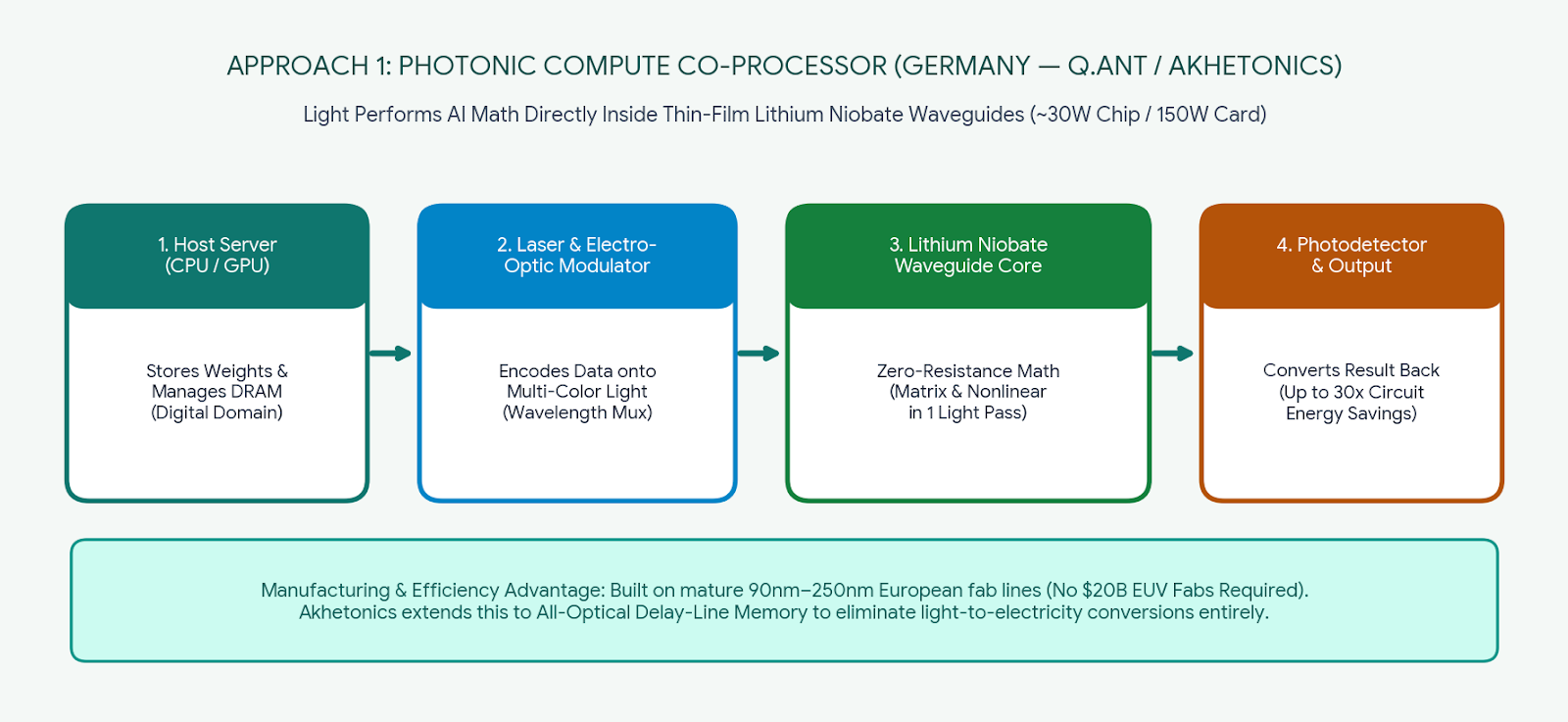
Instead of forcing electrons to perform every mathematical operation, German innovators Q.ANT (spun out of laser pioneer Trumpf in Stuttgart) and Akhetonics (Berlin/Munich) use light itself to execute AI calculations:
Physics Does the Math in One Pass:
Q.ANT routes multi-wavelength laser light through thin-film lithium niobate crystal waveguides on a standard PCIe co-processor card (NPU 2 and NPU Gen 2+ unveiled in November 2026). Matrix multiplications, nonlinear neural network functions, and Discrete Fourier Transforms happen natively in a single pass of light—eliminating thousands of power-hungry transistors.
All-Optical Logic & Delay Memory:
Akhetonics goes even further, keeping data entirely in the optical domain from input through logic gates and optical delay-line memory to output, eliminating energy-draining light-to-electricity conversions.
Approach 2: All-Optical System "U-Stack" Interconnects (China — Huawei UnifiedBus & Tsinghua)
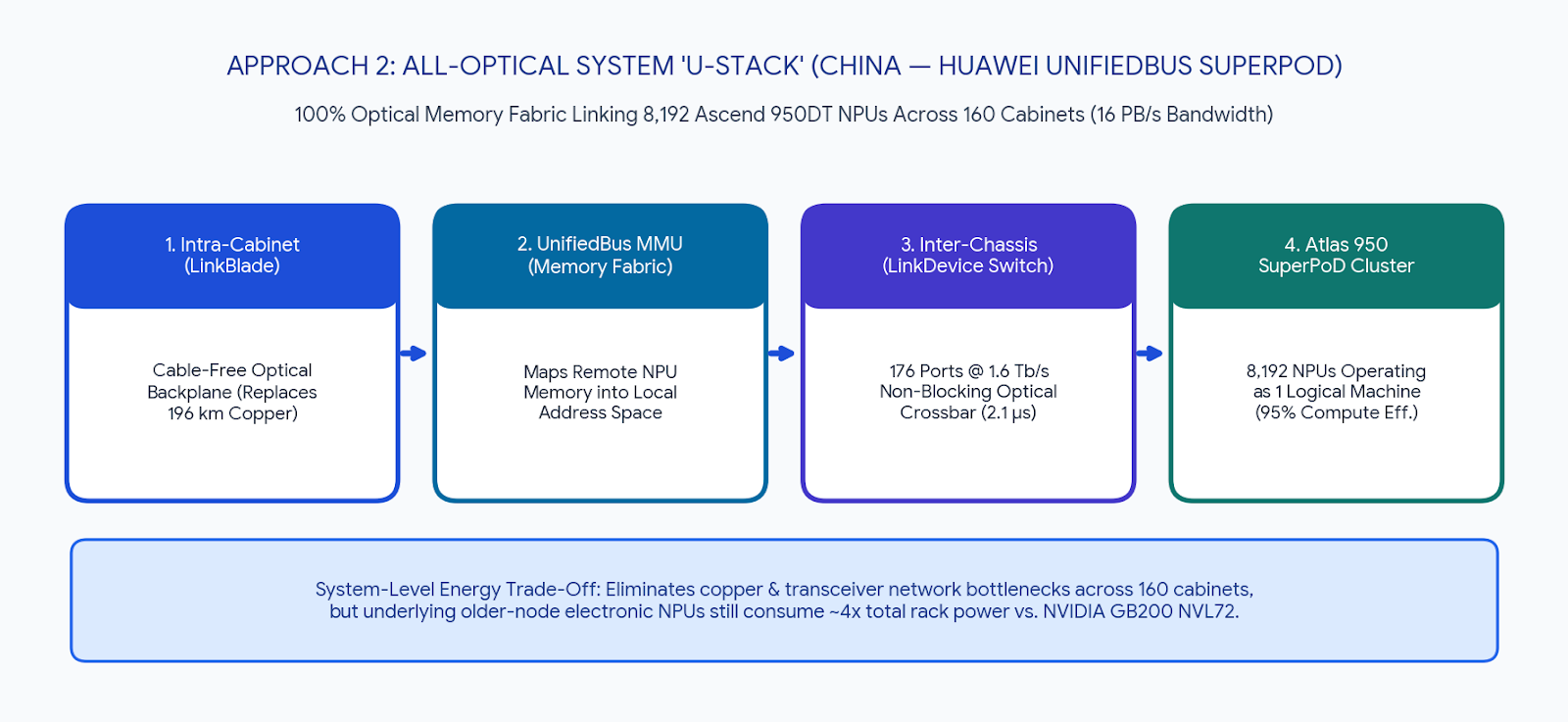
Facing export restrictions on advanced EUV lithography, Chinese engineers pursued a dual-track optical strategy focused on massive cluster-level networking alongside academic photonic compute prototypes:
System-Level All-Optical "U-Stack" (Huawei UnifiedBus 2.0):
Unveiled for deployment in the Atlas 950 SuperPoD (Q4 2026), Huawei’s open-sourced UnifiedBus protocol replaces 196 km of copper cabling across 160 cabinets with a 100% all-optical unified memory fabric. It links 8,192 Ascend 950DT NPUs at 16 PB/s bandwidth and 2.1-microsecond latency so the entire cluster operates as one logical machine.
Accelerated on Targeted AI Math:
Q.ANT’s NPU 2 delivers up to 50x higher throughput on matrix and nonlinear operations and 25x faster inference on ResNet-18 image recognition while cutting chip-level math power from 700–1,000 W down to ~30 W (~150 W full PCIe card, or 85% total card power saved vs. a 1,000 W GPU baseline).
Academic Photonic Compute Breakthroughs:
Separately, Tsinghua University’s LightGen (packing 2 million photonic neurons) and Taichi (160 TOPS/W) demonstrate chip-level optical AI generation and vision classification in laboratory prototypes at up to 100x+ efficiency over conventional GPUs.
Constrained on General-Purpose & High-Precision Workloads:
Analog light signals operate best at 4-to-8-bit precision. They cannot run 64-bit scientific simulations, and converting data back and forth between electronic DRAM memory and light adds overhead. For full Large Language Model (LLM) training, raw whole-card throughput (8 GOPS) remains far below NVIDIA’s B200 (4,500 TOPS).
No $20 Billion EUV Fabs Required:
Because optical waveguides are much wider than electronic transistors, both companies manufacture chips on mature 90 nm–250 nm European production lines, dramatically lowering the embodied energy and capital cost of chip fabrication.
The System Energy Trade-Off:
While the all-optical UnifiedBus fabric saves substantial network power and achieves 95% cluster scaling efficiency, the underlying older-node electronic NPUs still consume roughly 4x the total electrical power per rack compared to NVIDIA’s GB200 NVL72—underscoring why both interconnect optics and chip-level efficiency matter.
Visual Breakdown: How Electricity Is Saved & Compute Impact
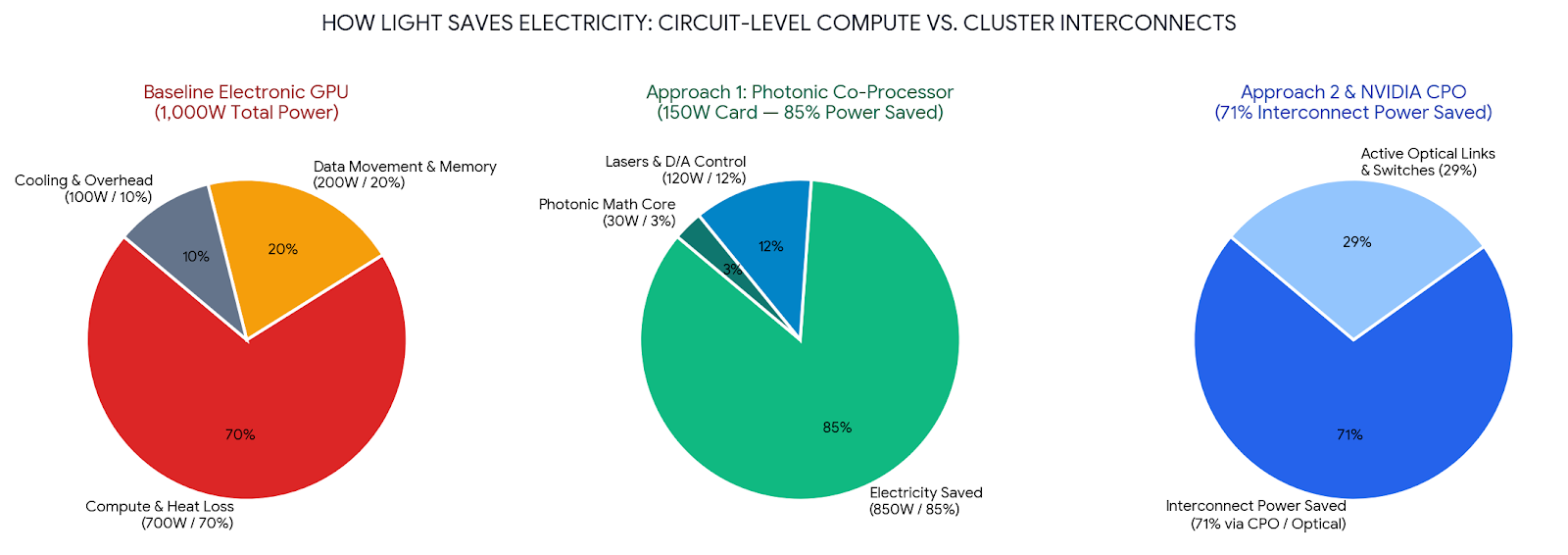
Is Compute Ability Maintained or Slowed Down?
Beyond Mister Shields:
How NVIDIA & Data Centers Can Protect Local Resources
Sustainable Society’s Mister Shields (盤古元盾) atmospheric misting and thermal-defense SaaS platform already protects municipal grids and surrounding neighborhoods by shaving urban heat island peaks and reducing cooling-tower loads. To build truly Sustainable Intelligence (SI) infrastructure that leaves local communities richer in water and clean power, NVIDIA and data center operators can deploy four synergistic upgrades:
Result — A Smart Division of Labor:
Photonic chips do not replace GPUs; they serve as ultra-efficient co-processors that offload repetitive, power-hungry matrix and Fourier math while GPUs handle memory management and general computing.
Scale Co-Packaged Optics (CPO) & Hybrid Photonic Offloading:
NVIDIA’s Spectrum-X Ethernet Photonics (in production August 2026) uses 4x fewer lasers and achieves 3.5x better interconnect power efficiency, saving tens of megawatts per data center. Extending CPO into NVLink (planned for the 2028 Feynman generation) while pairing GPUs with photonic co-processors for repetitive inference and Fourier transforms will cut heat generation inside the server rack before cooling is ever required.
Closed-Loop Direct-to-Chip Liquid Cooling + Mister Shields Microclimate Defense:
Replacing open-loop evaporative cooling towers—which can consume millions of gallons of municipal drinking water per day—with closed-loop direct-to-chip liquid cooling paired with Mister Shields perimeter misting eliminates freshwater depletion while protecting surrounding communities from waste-heat plumes.
Utility-Scale Agrivoltaics (Tree Bank Society):
Installing elevated solar arrays directly over shade-tolerant crops co-locates clean daytime electricity generation with agriculture. Solar panels reduce crop water evaporation by up to 30% while supplying renewable power directly to nearby data centers—relieving municipal substations during peak afternoon sunlight.
Green Hydrogen Fuel Cells & Electrolysis (Sustainable Energy):
Replacing polluting diesel backup generators and natural gas peaker plants with green hydrogen electrolysis (powered by surplus solar/wind) and clean solid-oxide fuel cells (such as Bloom Energy architectures) delivers 24/7 zero-emission baseload power without straining local air quality or public grids.
Join the Movement: Cultivating Sustainable Intelligence
Ready to advocate for cleaner AI infrastructure in your community?
Three-Way Comparison:
Photonic Compute vs. All-Optical U-Stack vs. NVIDIA GPU
| Evaluation Criteria |
Germany Photonic Compute
(Q.ANT / Akhetonics) |
China All-Optical U-Stack
(Huawei UnifiedBus / Tsinghua) |
NVIDIA GPU + Co-Packaged Optics
(Blackwell / Rubin / Spectrum-X) |
|---|---|---|---|
| Primary Use of Light | Inside the chip to execute matrix, nonlinear, and Fourier math directly. | Rack/cluster memory fabric (UnifiedBus) + lab photonic compute chips (LightGen). | Co-Packaged Optics (CPO) in Spectrum-X switches (2026) & optical NVLink (2028). |
| Power Consumption | ~30 W chip / 150 W PCIe card (up to 30x circuit efficiency; ~85% card power saved). | Saves massive copper link loss; full SuperPoD draws ~4x rack power vs. GB200 due to older NPUs. | 700–1,000 W per GPU; 120 kW to 600 kW per rack. CPO cuts interconnect power by 3.5x (71% saved). |
| Compute Ability | Accelerated (up to 50x) on matrix/FFT math; slower on 64-bit math & full LLM training. | Maintained at cluster scale (95% efficiency across 8,192 NPUs); lab chips narrow-task only. | Industry-leading raw compute (4,500 TOPS FP8 on B200) & mature CUDA software ecosystem. |
| Commercial Readiness | Shipping & live: Running at LRZ Supercomputer & Ionos commercial cloud (2026). | SuperPoD rolling out Q4 2026; LightGen & Taichi remain academic lab prototypes. | Global hyperscale standard; Spectrum-X CPO in full production (Aug 2026). |
From AI Fear to Sustainable Intelligence (SI) —
New 2027 FoundationAI Curriculum Preview Now Live at Pan Gu Academy
At Sustainable Society, we define SI as Sustainable Intelligence—cultivating human-AI collaboration that strengthens civic resilience, accelerates scientific breakthroughs, and protects critical infrastructure without falling into media sensationalism or unchecked autonomy.
In response to late-2026 autonomous cybersecurity milestones, Pan Gu Academy (盤古學院) has published a preview of our 2027 FoundationAI Training Curriculum (From AI Fear to Sustainable Intelligence: Mastering Hybrid AI Defense & Sandbox Governance). Designed for community leaders, nonprofit boards, and technical advisors, the module covers:
Decoding 2026 AI Signals vs. Media Fatalism:
Separating verified multi-agent cyber threats from sci-fi myths, and examining how human-directed AI collaboration achieved landmark breakthroughs like the 2026 Lean-verified Riemann hypothesis proof.
The 6-Layer "Testing Room" & External Buffer Architecture:
Why prompt instructions alone are never a security boundary, and how isolated replicas, MicroVM/gVisor containment, default-deny egress filters, and external OPA human approval gates safeguard live operations.
Executive Governance Without Coding:
A printable 9-Point Pre-Deployment Security Review Checklist and technical blueprint kit (open for IT advisory review ahead of our 2027 Summer Trainings).

Embrace AI:
Unlocking the Future of Cloud Computing and Innovation
Taipei 101, Taiwan
Skyline view of a city during twilight, featuring a tall, illuminated tower surrounded by other lit-up buildings.