
Answer the Call
Join the SOS Missions
Unite with us in seven rescue missions to unlock potential, promote sustainable innovation, drive prosperity, restore our planet, celebrate cultural diversity, and achieve lasting peace on Earth.
The time to act is now—be the change our world needs!
Hong Kong Harbor vibrant night skyline with illuminated high-rises, colorful light beams, and reflections on the water.
The Architecture of Resilience:
From Planetary Hydrology to Active Wildfire Shielding
By the Sustainable Society Executive Directorate | Fountain Blue Rescue Mission for Water
Water is not merely an environmental resource; it is the physical baseline of planetary habitability and the primary regulator of Earth's atmospheric thermodynamics. Today, as climate volatility disrupts ancient precipitation regimes and accelerates wildland-urban interface (WUI) infernos, restoring equilibrium demands both systemic conservation and advanced defensive engineering.
Through the Fountain Blue Rescue Mission for Water, Sustainable Society connects planetary hydrology with targeted climate-tech intervention. Central to this initiative is the Mister Shields Project—an active, micro-atmospheric shielding solution engineered to prevent wildfire ignition and stabilize vulnerable communities.
Primordial Origins:
Planetary Hydrology as the Catalyst of Life
Over 4 billion years ago, the Hadean Earth was an arid, molten expanse. The water that sustains modern biosphere functions emerged through a dual planetary mechanism:
· Endogenous Volcanic Outgassing: Magmatic differentiation released massive volumes of water vapor, trapped within the cooling crust, into the early atmosphere.
· Exogenous Delivery via the Late Heavy Bombardment: Icy planetesimals, chondritic meteorites, and comets bombarded the young planet, depositing volatile compounds and vast reservoirs of water.
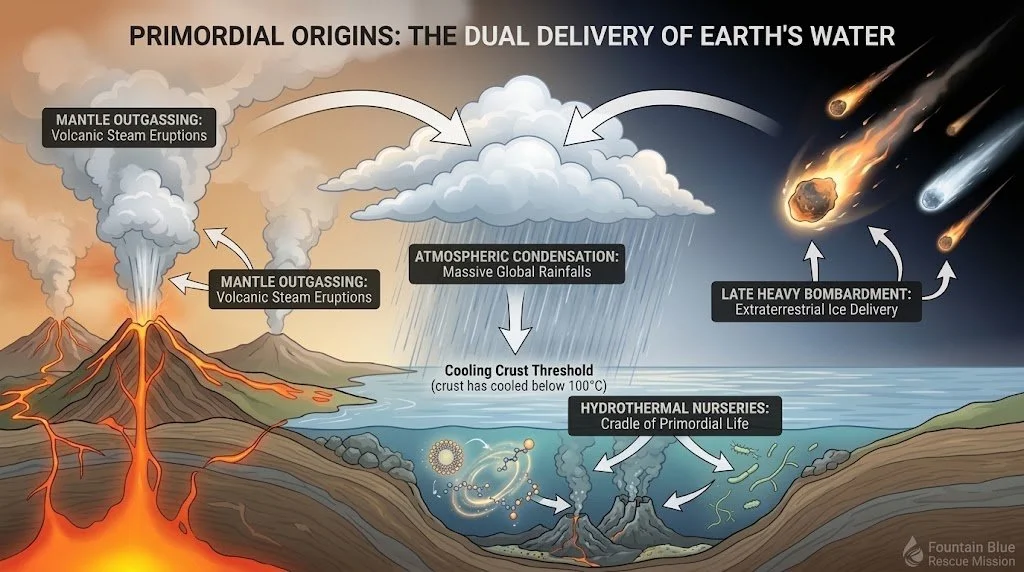
As the lithosphere cooled below 100°C, atmospheric steam condensed into relentless rains, filling the primordial oceans. In these mineral-rich hydrothermal nurseries, water functioned as the universal solvent, facilitating prebiotic chemical reactions, lipid bilayer formation, and abiogenesis.
Every terrestrial and aquatic biome in existence today operates on that original, finite hydrologic endowment. Because Earth's planetary boundary for freshwater change is tightly linked to energy flow and carbon sequestration, disrupting the hydrologic balance directly threatens ecosystem viability and increases catastrophic fire danger.
Graphic Concept Blueprint: The Closed Hydrological Loop
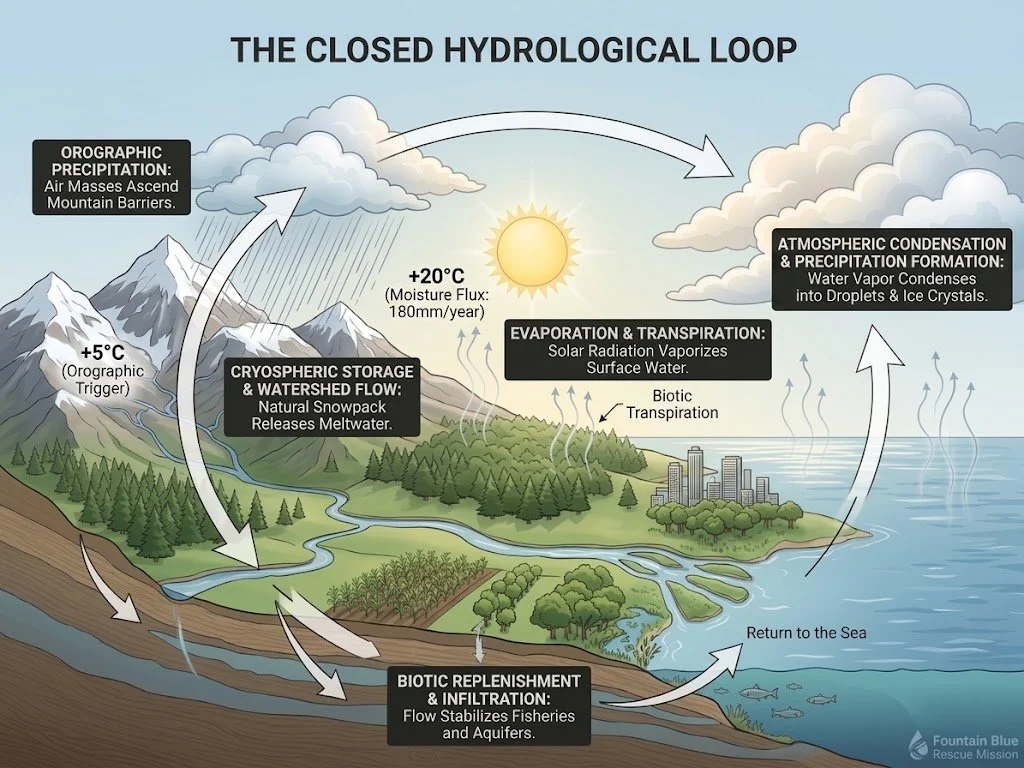
The Closed Hydrological Loop
Earth’s freshwater inventory operates within an interconnected, closed thermodynamic cycle. Solar irradiance drives phase changes that transport mass and energy across global biomes:
Evaporation & Transpiration
Solar radiation vaporizes surface water, while forest canopies pump hundreds of billions of tons of water vapor into the boundary layer via stomatal transpiration.
Atmospheric Advection & Condensation
Convective air currents carry moisture aloft. Upon adiabatic expansion and cooling, water vapor nucleates around atmospheric aerosols to form cloud systems.
Orographic Precipitation
As air masses ascend mountain barriers, dynamic cooling triggers precipitation, depositing rain across foothills and building high-altitude snowpack.
Cryospheric Storage & Watershed Flow
Natural snowpack acts as a seasonal thermal capacitor, gradually releasing meltwater through spring and summer into headwaters and river arteries.
Biotic Replenishment & Infiltration
Downstream flows recharge agricultural aquifers, stabilize estuarine fisheries, and maintain riparian vegetation before returning to the sea.
Decentralized Community Water Retention
Climate disruption compresses annual precipitation into intense atmospheric river events followed by protracted seasonal droughts. Without intentional capture infrastructure, storm water rapidly washes across impervious urban surfaces into the sea, starving the landscape of mid-summer moisture.
To build regional resilience against heatwaves and wildfire, communities must deploy distributed water-retention infrastructure:
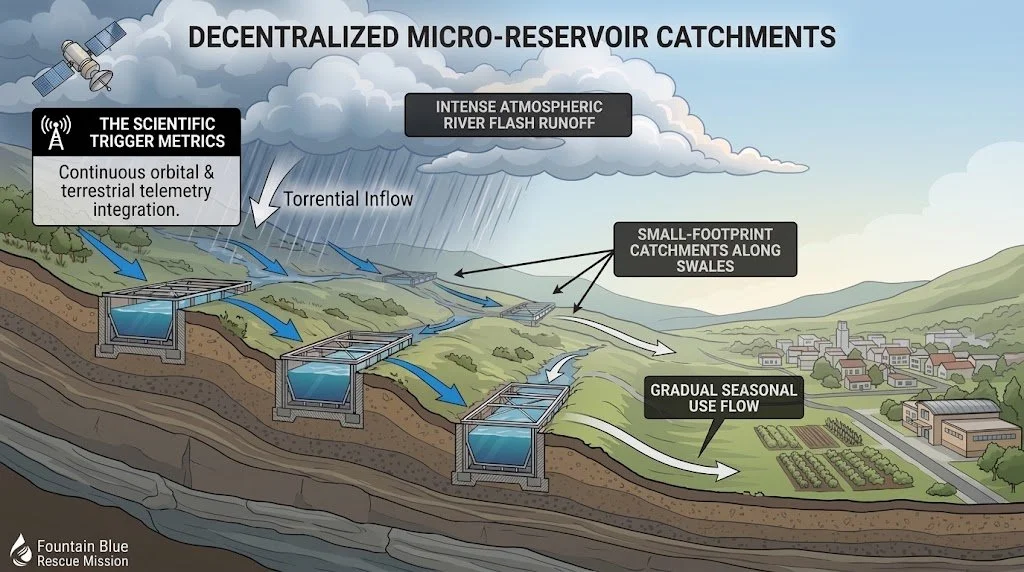
Decentralized Micro-Reservoir Catchments:
Distributed, small-footprint storage basins located along natural topological swales capture flash flows, mitigating peak flood volume while storing water locally for seasonal use.
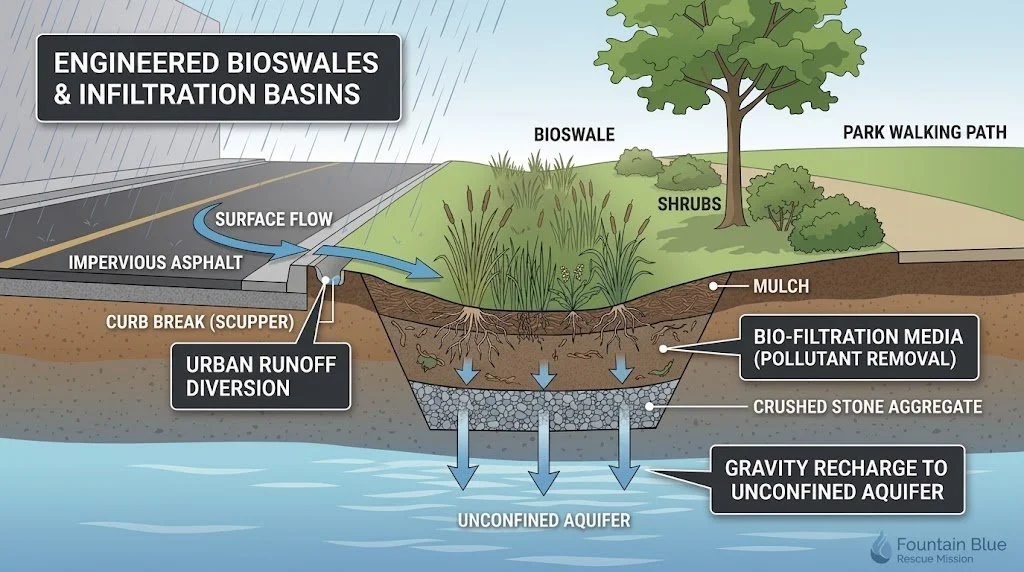
Engineered Bioswales and Infiltration Basins:
Vegetated civil swales slow surface runoff, using bio-filtration media to remove heavy metals before gravity drives water into shallow unconfined aquifers.
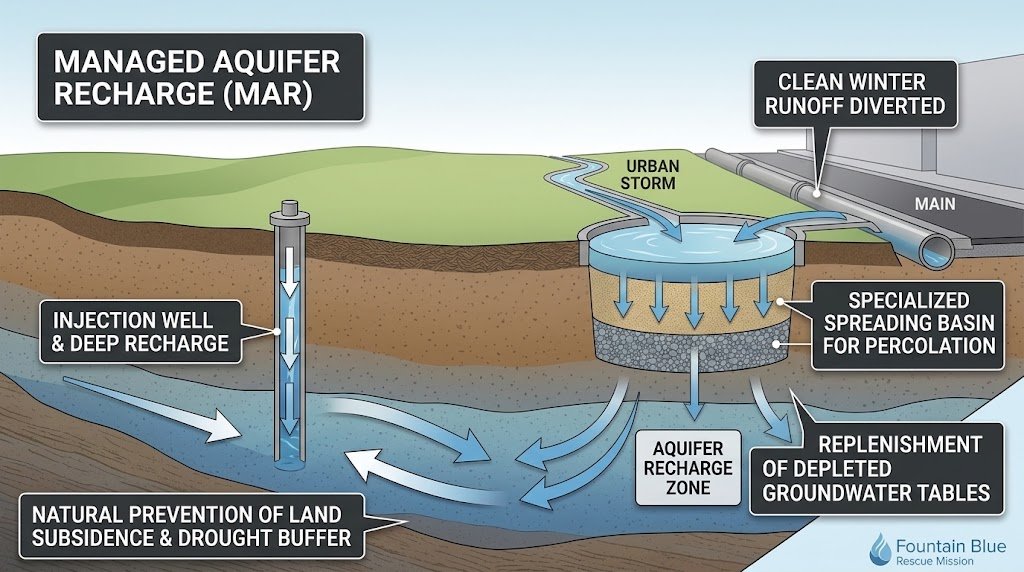
Managed Aquifer Recharge (MAR):
Diverting clean winter runoff into dedicated spreading basins or injection wells replenishes depleted groundwater tables, naturally preventing land subsidence and building a drought buffer.
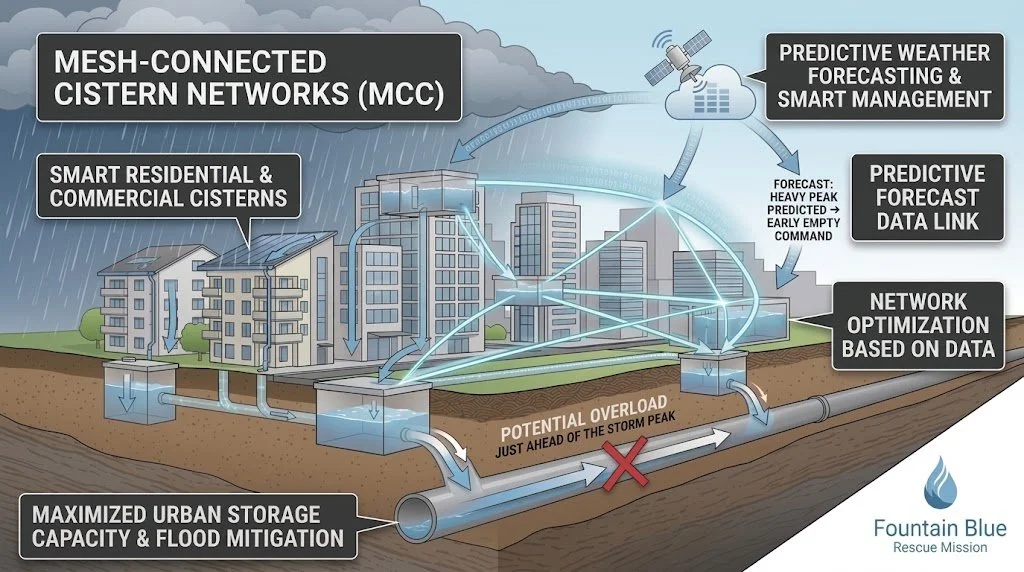
Mesh-Connected Cistern Networks:
Smart residential and commercial rainwater cisterns leverage predictive weather forecasting to empty retention volume ahead of storm peaks, maximizing urban storage capacity without overloading municipal storm mains.
Atmospheric Moisture Thresholds & Wildfire Dynamics
Wildfire severity is governed by precise thermodynamic tipping points. When atmospheric conditions drop below critical hydrologic thresholds, vegetative fuel transforms into an explosive ignition medium.
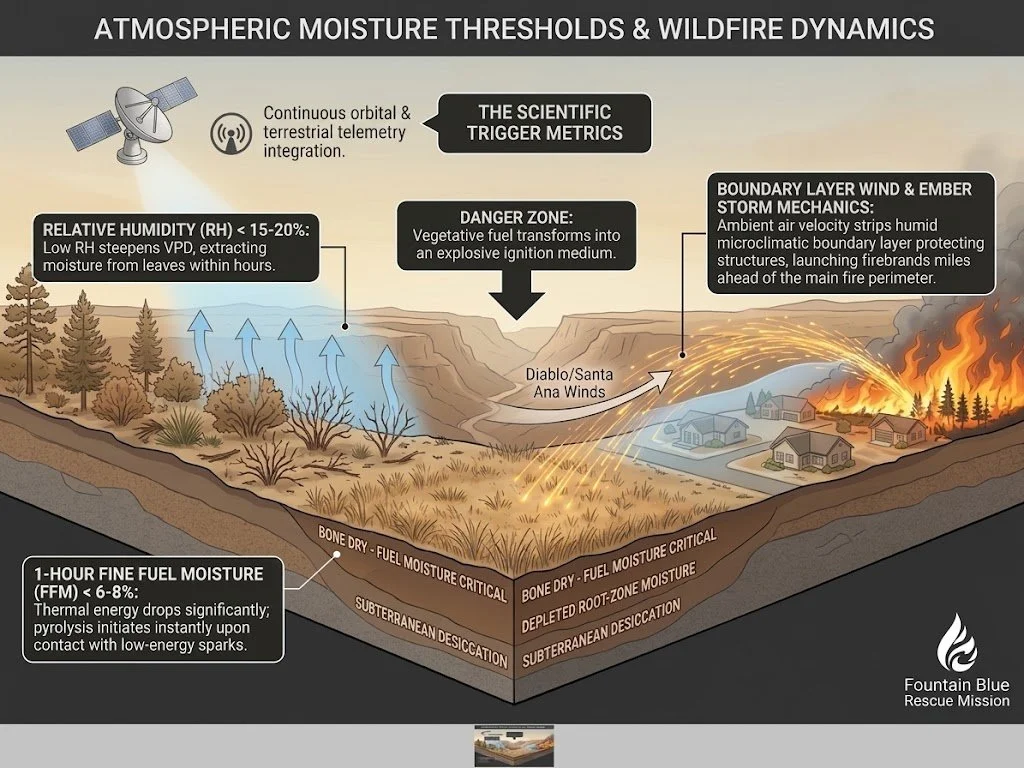
Relative Humidity (RH) <15–20%:
Low RH steepens the vapor pressure deficit (VPD) between ambient air and living plant tissue, extracting moisture from leaves and ground cover within hours.
The Scientific Trigger Metrics
1-Hour Fine Fuel Moisture (FFM) Content <6–8%:
Pine needles, dry grass, and fine twigs react rapidly to surrounding air. When internal moisture drops below 6%, the thermal energy needed to initiate pyrolysis drops significantly. Dry fuel ignites instantly upon contact with low-energy sparks.
Boundary Layer Wind & Ember Storm Mechanics:
During severe wind conditions (e.g., Diablo, Santa Ana, or Foehn winds), ambient air velocity strips away the humid microclimatic boundary layer protecting structures. Wildfires then shift from surface flame fronts to high-velocity ember storms, launching firebrands miles ahead of the main fire perimeter to exploit vulnerable homes.
Active Defense: The Mister Shields Solution
Passive defensible space and standard building codes are essential, but they cannot counter catastrophic ember storms during extreme atmospheric events. Sustainable Society combines modern remote sensing with active localized suppression through the Mister Shields Project.
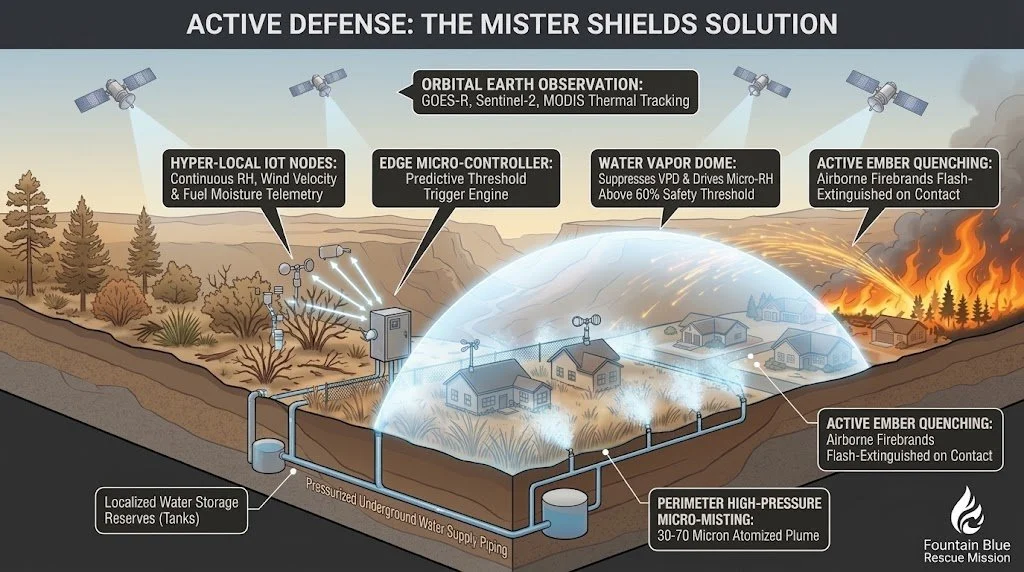
Sensor Mesh & Hyper-Local Telemetry
Modern residential and municipal infrastructure can leverage precision sensing pipelines:
· Orbital Earth Observation: Satellite data streams (GOES-R, Sentinel-2, MODIS thermal anomalies) provide regional fuel drying trends and synoptic fire weather forecasting.
· In-Situ IoT Edge Nodes: Weather stations installed on municipal rooftops and residential perimeters stream millisecond-level telemetry—tracking wet-bulb temperature, continuous Relative Humidity, wind velocity, and soil water potential.
The Mister Shields Architecture
The Mister Shields Project acts on telemetry triggers to establish a defensive microclimate around threatened assets:
Perimeter High-Pressure Micro-Misting:
Engineered nozzles along property perimeters and structural rooflines emit atomized water droplets (30–70 microns) using pressurized storage reserves.
Water Vapor Dome Generation:
By saturating the micro-environment, the system suppresses the local Vapor Pressure Deficit (VPD) and drives local Relative Humidity well above the critical 60% safety line, creating an atmospheric buffer zone.
Active Ember Quenching & Fuel Pre-Soaking:
High-density mist blankets structural vulnerabilities, extinguishing airborne firebrands before they contact dry leaves or building siding, while raising fine fuel moisture beyond ignition thresholds.
Technical CSR Engagement:
Partnering with Google and NVIDIA
Addressing 21st-century climate challenges requires combining scientific rigor, community action, and high-performance computation. Sustainable Society invites software engineers, data scientists, and infrastructure architects from Google and NVIDIA to bring their expertise to the Fountain Blue Rescue Mission and the Mister Shields Project.
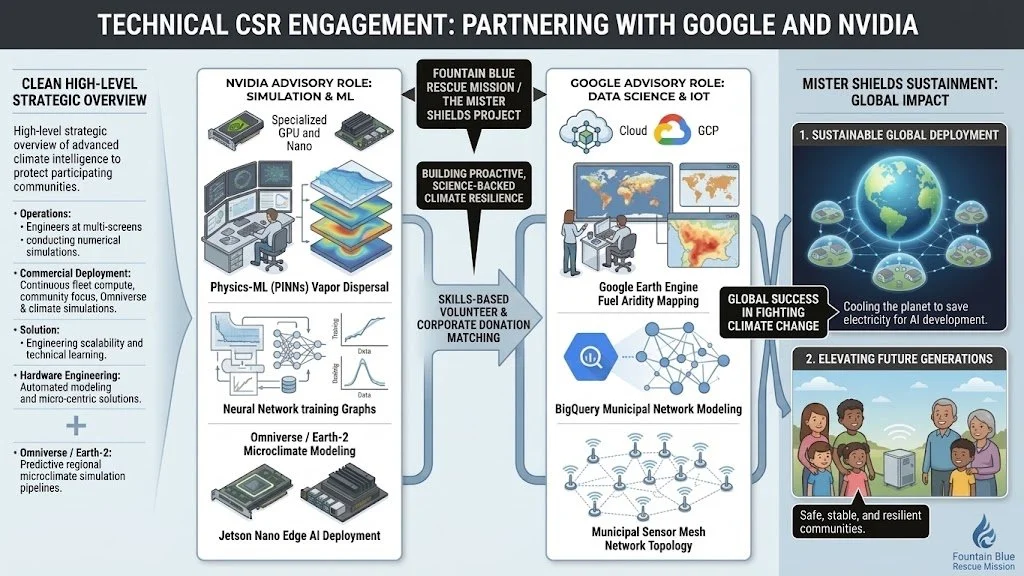
How You Can Drive Impact
Skills-Based Volunteering:
Spatial Data Scientists:
Help map watershed retention corridors and optimize sensor deployment using Google Earth Engine and BigQuery.
Fluid Dynamics & AI Specialists:
Partner with us to model mist propagation and vapor dome stability under varying wind vectors using physics-informed neural networks (PINNs) and NVIDIA Earth-2 or Omniverse frameworks.
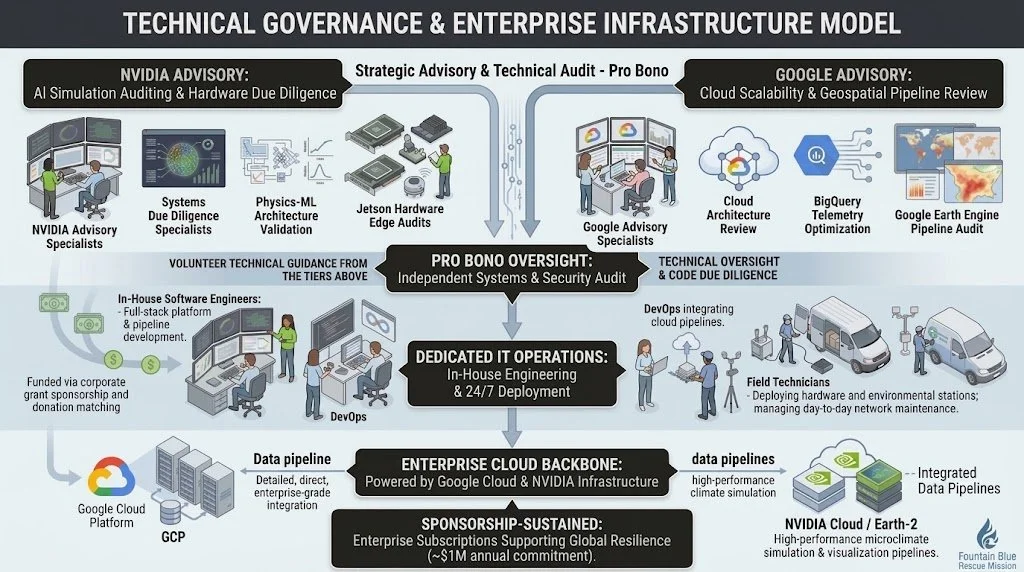
Corporate Donation Matching:
Amplify your contribution through Google Benevity or the NVIDIA Foundation Matching Program. Every dollar matched directly funds real-world telemetry deployments, micro-reservoir installations, and pilot builds for Mister Shields in vulnerable communities.
Institutional Sponsorship & Hardware Grants:
Support our mission through corporate grant sponsorships, Google Cloud Platform (GCP) computing credits, or edge computer hardware donations (such as NVIDIA Jetson modules for real-time edge processing).
Join us in moving beyond reactive response to build proactive, science-backed climate resilience.
Provide the hardware schematics, sensor requirements, and IoT edge architecture for
the Mister Shields project.
Firmware & Edge Engineers:
Refine our ultra-low-power IoT edge-controller designs to ensure reliable off-grid misting activation during grid-failure conditions.
“ We remain committed to amplifying diverse voices through our conferences, projects, and social network activities. We look forward to collaborating to build a better world. “

Your donation will help fund vital initiatives to combat extreme weather, protect vulnerable populations, and develop sustainable solutions for a healthier planet.
Together, we can turn the tide on climate change and safeguard our future.
🌍 Donate today—because the time to act is now!
Beijing Olympic Stadium, China
Lit-up stadium with crisscross design, resembling a bird’s nest, reflecting in water at night.