
Dual Harvest:
How Agrivoltaics Solves Land Scarcity, Protects Crops, and Powers Communities
Reimagining the Food-Energy-Water Nexus Through Dual-Use Solar Innovation and Global Policy Frameworks
The global transition to renewable energy cannot come at the expense of productive farmland. For decades, utility-scale solar development and agriculture have operated in direct competition: clearing open rural acreage, covering prime topsoil under acres of low-slung steel racks, and displacing active food production.
Agrivoltaics (APV)—the simultaneous co-location of agricultural crops and photovoltaic energy generation on the same parcel of land—replaces this zero-sum conflict with ecological symbiosis. By shielding crops from severe heatwaves, cutting agricultural water demand by over 30%, and generating decentralized clean power, agrivoltaics turns working farmland into a resilient anchor for local food security and community economic development.
The Urgent Imperative: Population Pressures, Food Demand, and Land Scarcity
Modern agriculture faces three compounding structural challenges:
Surging Global Food Demand:
The world's population is projected to reach 9.7 billion by 2050. Meeting this demographic expansion requires an estimated 70% increase in total food production. In the next three decades, human civilization will need to produce more food than in the prior 10,000 years combined.
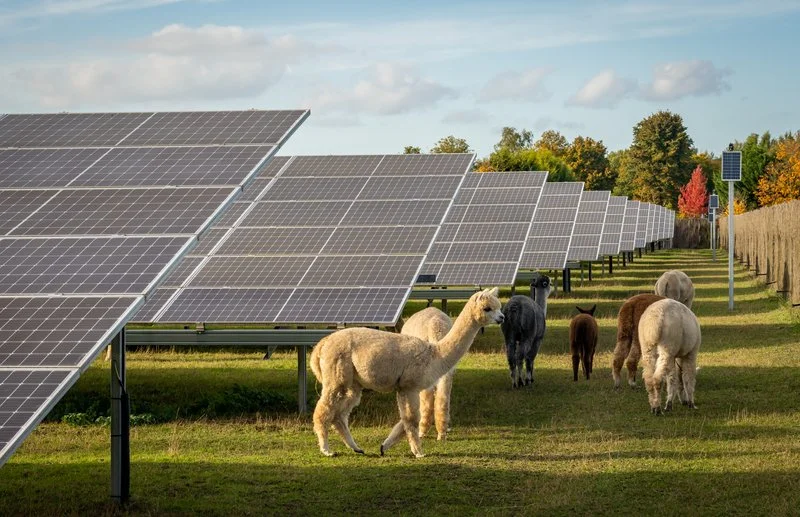
Agrivoltaics resolves this confrontation. By elevating solar modules on engineered stilts (3.5 to 5 meters high) or arranging bifacial panels into vertical fence rows, farmers retain full mechanized tractor access to cultivate crops underneath while harvesting clean electricity from above.
The Core Agronomic and Community Benefits of Agrivoltaics
Depletion of Arable Farmland:
Over the past 40 years, the planet has already lost approximately one-third of its arable land to topsoil erosion, desertification, and contamination. Simultaneously, traditional agriculture consumes roughly 70% of global freshwater withdrawals, leaving rural farming regions acutely vulnerable to prolonged droughts and water rationing.
Renewable Energy Land Competition:
Achieving net-zero grid decarbonization goals requires massive ground-based solar installations. In the United States alone, the Department of Energy projects that utility-scale ground solar will require approximately 10 million acres of land by 2050. When developers construct traditional solar farms on agricultural acreage, fertile land is locked away beneath low-mounted panels that cannot accommodate modern farm machinery, sparking heavy public backlash and rural zoning bans.
A. Protecting Crops from Overheating & Solar Scorching
The Light Saturation Point (LSP):
Plants do not process sunlight indefinitely. Once a crop's chlorophyll reaches its biological saturation ceiling, extra sunlight cannot be converted into biomass; instead, surplus solar radiation turns into damaging thermal stress and cellular sunburn.
Suppressed Evapotranspiration:
In unshaded fields, scorching heat forces crops to transpire vast reserves of water through their leaves simply to keep cool. Agrivoltaic shading stabilizes vapor pressure deficits and protects topsoil moisture.
On-Farm Energy Autonomy:
Power generated directly above the field energizes automated drip-irrigation pumps, cold-storage packhouses, aeration systems, and charging stations for electric farm vehicles, eliminating farm utility electricity costs.
B. Saving Water Consumption by 30%+
C. Generating Decentralized Clean Electricity for Community Development
Economic Diversification & Rural Resilience:
Excess power is exported to local municipal distribution grids or paired with battery storage and green hydrogen electrolyzers. This dual-revenue model provides farmers with a stable income stream that hedges against crop failure and volatile commodity markets, while creating thousands of local green-collar technical jobs in structural assembly, electrical engineering, and smart IoT maintenance.
International Regulations and Protocols Driving Agrivoltaics
Governments worldwide have enacted binding statutory frameworks to prevent speculative solar developments from encroaching on productive food acreage while providing clear incentives for agrivoltaics:
| Country / Region | Statutory Protocol / Policy | Regulatory Mandate & Key Provisions |
|---|---|---|
| China | National Farmland Protection Directive (Ministry of Natural Resources) | Enacted national decrees prohibiting the construction of pure ground-mounted solar utility farms on designated arable cropland. Farmland can only host photovoltaic projects if engineered as dual-use agrivoltaic systems that maintain uninterrupted agricultural cultivation. |
| France | Loi APER (2023) & Decree No. 2024-318 (French Energy Code) | Formally codifies agrivoltaics in national law. Requires installations to directly serve agricultural needs (climate adaptation, yield improvement, or frost/hail protection). Limits ground solar coverage to ≤40%, caps permitted crop yield reduction at ≤10%, and legally mandates complete site reversibility and dismantling guarantees upon decommissioning. |
| Germany | Renewable Energy Sources Act (EEG) & DIN SPEC 91434 | Enacts dedicated Agri-PV tender bonuses, sub-quotas, and feed-in tariffs. Mandates that at least 66% to 85% of land area remains fully cultivable with modern tractors, limiting any loss of arable surface to under 15%. |
| Italy | PNRR Advanced Agrivoltaic Guidelines (Ministry of Environment & Energy) | Dedicated €1.1 billion in direct grants and low-interest financing from the National Recovery and Resilience Plan specifically for advanced agrivoltaics. Requires elevated tracking structures that do not impede farm equipment and mandates continuous agronomic monitoring. |
| European Union | EU Common Agricultural Policy (CAP) Alignment | Clarifies cross-compliance rules to ensure farmers hosting verified agrivoltaic systems do not lose direct CAP agricultural subsidies or land eligibility status, eliminating financial disincentives for dual-use adoption. |
Canopy Microclimate Moderation:
Overhead solar arrays filter out excessive midday glare, keeping canopy temperatures several degrees cooler. This shading prevents sensitive produce—such as berries, tomatoes, peppers, and leafy greens—from suffering blossom drop, sunscald, or premature bolting during severe summer heatwaves.
Proven Water Conservation:
Commercial trials across Europe and the U.S. demonstrate that agrivoltaic arrays consistently cut irrigation water consumption by 30% to over 50%. Furthermore, the cool water vapor naturally transpired by crops rises to cool the underside of the solar panels, directly improving the electrical efficiency of photovoltaic cells during hot summer days.
Agrivoltaics is not a compromise between food production and renewable power; it is an active model of ecological efficiency. By combining crop cultivation with clean energy generation under supportive regulatory standards, communities can protect their agricultural heritage, preserve scarce freshwater supplies, and build a resilient, decentralized energy economy.
Crops Under Canopies:
Matching Fruits and Vegetables to Agrivoltaic Weather Patterns
The traditional view that solar energy generation and agriculture are locked in a zero-sum competition for open land is being dismantled by agrivoltaics (APV). By elevating photovoltaic arrays above active fields, farms can produce clean energy while improving the microclimate for the crops growing underneath.
However, placing solar panels over crops is not a universal formula. Whether an agrivoltaic installation boosts crop yields or diminishes them depends on plant photobiology, localized weather patterns, and specific water cycles.
The Biological Engine: Why Shade Can Increase Crop Yields
The core principle behind agrivoltaics lies in the botanical mechanism known as the Light Saturation Point (LSP).
Photosynthesis does not scale upward indefinitely with stronger sunlight. Once a plant’s chlorophyll cells absorb all the photons they can process, additional solar radiation cannot be converted into biomass. Instead, excessive light turns into heat stress and sunburn. To prevent burning, plants enter a defensive mode: they open their stomata and transpire massive amounts of stored water solely to cool their leaves.
When solar panels cast partial, alternating shade over crops, they filter out peak midday solar glare. This allows the plants to stay below their heat-stress thresholds, cutting soil evaporation and crop transpiration. In return, the water vapor naturally released by the crops creates an evaporative cooling effect beneath the canopy, cooling the underside of the solar panels and boosting their electrical conversion efficiency.
Agrivoltaic Crops Broken Down by Weather Pattern
A. Arid & Semi-Arid Climates (Extreme Heat, High Solar Irradiance, Water Scarcity)
Regional Context:
The Mediterranean basin (Spain, Southern Italy, Greece), the American Southwest (Arizona, California Central Valley), North Africa, and the Middle East.
Tomatoes: Under midday panel shading, tomato plants avoid blossom drop and sunburn; University of Arizona trials documented yield increases of up to 300% alongside substantial irrigation reductions.
Leafy Greens (Lettuce, Swiss Chard, Spinach): Open-field greens bolt (flower and turn bitter) in extreme heat; agrivoltaic shade keeps the canopy cooler, extending the harvest window.
Optimal Fruits
Wine Grapes: AI-directed dynamic solar panels (such as Sun’Agri’s pilots in Southern France) shield vineyards during heatwaves, reducing vine water demand by 12% to 34%. This shading preserves red grape anthocyanin pigmentation (+13%) and protects balanced acidity (+9% to 14%) without stalling maturation.
Regional Context:
Taiwan, Southern Japan, Southeast Asia, and the Southeastern United States.
Agrivoltaic Function:
Overhead panels act as a thermal shield, preventing crops from crossing their light saturation point and dramatically reducing water demand.
Microclimate Challenge:
Frequent cloud cover, late spring frosts, and destructive summer convective hailstorms.
Microclimate Challenge:
Torrential monsoon downpours, topsoil erosion, waterlogged root rot, leaf fungus, and severe tropical cyclones.
Eggplants & Summer Squash: Maintain soil moisture around root zones, reducing blossom-end rot.
Figs & Pomegranates: Benefit from reduced skin scorch in desert microclimates.
B. Temperate & Maritime Climates (Moderate Sun, High Humidity, Summer Hail & Frost)
Regional Context:
Western and Central Europe (Germany, France, the Netherlands, the UK), the Pacific Northwest, and Southern Chile.
Root Crops (Potatoes, Carrots, Beets): Fraunhofer ISE long-term trials in Heggelbach, Germany demonstrated that potatoes grown under agrivoltaic canopies yielded higher harvest volumes than open-field controls during hot, dry seasons.
Asian Leafy Greens (Bok Choy, Water Spinach, Gai Lan): Delicate broad leaves are shielded from physical bruising caused by pounding tropical rainstorms.
Microclimate Challenge:
Severe heatwaves (often exceeding 38°C to 42°C), high soil evaporation, and intense drought stress that stunts open-field plant development.
Optimal Vegetables
Peppers (Bell & Chili): Shade reduces sunscald on pepper fruit and improves continuous fruit setting during peak summer heat.
Optimal Vegetables
Brassicas (Broccoli, Cabbage, Cauliflower, Kale): Benefit from moderated diurnal temperatures and steady soil moisture.
Optimal Fruits
Soft Cane Berries (Raspberries, Blackberries, Blueberries): Commercial installations (such as the BayWa r.e. / GroenLeven 2 MW project in Babberich, Netherlands) demonstrated that raspberries grown under semi-transparent solar canopies matched or exceeded the sugar content and firmness of polytunnel crops. The panels cut irrigation water needs by 50% and provided complete protection against hail storms that wiped out neighboring unprotected fields.
Regional Context:
Northern U.S. Midwest, the Canadian Prairies, the Baltic Region, and Scandinavia.
Stone Fruits (Cherries, Apricots, Plums, Nectarines): Overhead arrays equipped with automated storm nets prevent devastating crop splitting and fruit bruising from unseasonal hail events.
C. Humid Subtropical & Monsoon/Typhoon Belts (High Rainfall, Torrential Storms, High Humidity)
Optimal Vegetables
Tropical Specialty Roots (Ginger, Turmeric, Taro): Naturally shade-adapted forest understory crops that flourish under the 30% to 50% light reduction of solar canopies.
Optimal Fruits
Trellised Vines (Passionfruit, Dragonfruit): Integrated directly onto the vertical support pilings of agrivoltaic arrays, using structural stilts as heavy-duty trellises.
Cold-Hardy Greens (Winter Spinach, Russian Kale): Withstand early freezing temperatures under the protective thermal canopy.
Sun-Obligate Cereal Grains (Corn / Maize, Wheat, Barley):
These staple crops rely on uninterrupted full-spectrum sun throughout their vegetative cycle; continuous panel shading can impose yield penalties of 20% to 40%.
Microclimate Challenge:
Limited growing days, cool soil temperatures in spring, and rapid radiant heat loss during clear autumn nights.
Agrivoltaic Function:
In hot, dry summers, elevated arrays significantly boost crop performance; in storm-prone periods, durable glass panels serve as structural protection against wind and hail, eliminating the need for single-use plastic polytunnels.
Alliums (Onions, Leeks, Garlic): Thrive under partial diffuse canopy lighting.
Agrivoltaic Function:
Elevated canopies act as rain deflectors, breaking the impact velocity of heavy raindrops to prevent soil splashing and the spread of soil-borne pathogens. Systems equipped with automated storm-stow modes safely ride out cyclonic winds while preserving high-value crops below.
High-Value Specialty Fungi (Shiitake, Wood Ear Mushrooms): Placed directly beneath denser solar installations where filtered light and elevated humidity are required.
Citrus (Kumquats, Mandarins): Protected from excessive hail and severe rainfall blistering.
D. Cool Continental & Short-Season Climates (Cold Winters, Short Summers, Early Frosts)
Optimal Vegetables
Legumes (Bush Peas, Fava Beans): Thrive in cool spring soils with moderate diffuse sunlight.
Optimal Fruits
Hardy Berry Shrubs (Haskap / Honeyberry, Gooseberries, Red & Black Currants): Resilient cold-climate perennials that naturally prefer partial woodland shade.
Broadacre Melons & Sunflowers:
Require maximum solar heat units and unobstructed sun for flowering and sugar accumulation.
Agrivoltaic Function:
Nighttime thermal blanket effect. Overhead solar modules absorb thermal radiation from the ground during the day and re-radiate longwave heat back downward at night, reducing frost risk and extending the effective growing season.
Parsnips, Rutabagas, and Winter Radishes: Develop solid root mass protected from sudden topsoil freeze-thaw cycles.
E. Crops That Are Unsuitable or Challenging for Agrivoltaics
Not all crops are viable under solar arrays. Understanding which crops to avoid is critical to project feasibility:
Crops Requiring Massive Combine Harvesters:
Harvesting broadacre crops with 35- to 40-foot wide combine headers requires very wide stilt spacing, which limits solar panel density unless specialized vertical bifacial fencing is used.
| Weather Pattern | Dominant Climate Drivers | Optimal Vegetables | Optimal Fruits | Key Agrivoltaic Benefit |
|---|---|---|---|---|
|
Arid & Semi-Arid (Spain, SW US, Med.) |
Extreme heat (>38°C), high solar radiation, drought. | Tomatoes, Bell Peppers, Chili Peppers, Lettuce, Spinach, Swiss Chard. | Wine Grapes, Figs, Pomegranates. | Mitigates plant heat stress, reduces water loss by 12%–40%, and increases tomato yields up to 300%. |
|
Temperate & Maritime (W. Europe, UK, Pacific NW) |
Moderate sun, variable clouds, late frost, summer hail. | Potatoes, Carrots, Broccoli, Cabbage, Onions, Beets. | Raspberries, Blackberries, Strawberries, Cherries, Plums. | Prevents hail and storm damage, replaces plastic poly-tunnels, and cuts irrigation by 50%. |
|
Humid Subtropical & Monsoon (Taiwan, S. Japan, SE Asia) |
Torrential rain, typhoons, high humidity, soil splash. | Bok Choy, Water Spinach, Ginger, Turmeric, Taro, Mushrooms. | Passionfruit, Dragonfruit, Kumquats, Kiwi. | Blocks torrential soil erosion, eliminates leaf bruising, and mitigates root rot. |
|
Cool Continental (N. Midwest, Nordics, Baltics) |
Short growing season, cool soils, sudden early/late frosts. | Winter Kale, Spinach, Green Peas, Bush Beans, Parsnips. | Haskap (Honeyberry), Gooseberries, Currants. | Traps nighttime ground radiation, reducing frost damage and extending the growing season. |
Agrivoltaics succeeds when solar engineering adapts to local agronomy. By selecting crops whose biological saturation points align with the shade profiles of overhead arrays, farms achieve dual land productivity—harvesting clean energy from the sky while protecting the food grown in the soil below.
Harvesting Photons:
How Advanced Technologies Power the Agrivoltaic Revolution
Integrating Spectral-Selective Glass, Dynamic AI Tracking, and Extreme Weather Safeguards
to Secure Dual Food and Clean Power Ecosystems
The historical assumption that utility solar energy and productive agriculture must compete for open land is being dismantled by next-generation agrivoltaics (APV). Modern agrivoltaics is no longer a passive system of static solar panels elevated over dirt. By combining material science, artificial intelligence, and structural aerospace engineering, today's installations create an active biological and infrastructural symbiosis.
Here is how three core technological pillars—spectral-selective glass, AI-driven microclimate monitoring, and extreme weather-proofing mechanisms—optimize crop health while maximizing clean energy generation.
Pillar 1: Solar Panel Glass & Spectral Engineering (Allowing Light to Shine Through)
Standard silicon photovoltaic modules are entirely opaque, casting deep, continuous shadows that can starve sun-hungry crops of essential illumination. Advanced optical and glass engineering solves this trade-off by decoupling the solar spectrum: channeling life-giving photosynthetic light directly to crops below while converting non-productive wavelengths into clean electricity.
A. Tuned PAR Transmission & Anti-Reflective Diffusion
Photosynthetically Active Radiation (PAR):
Plants rely almost exclusively on light wavelengths between 400 nm and 700 nm (primarily blue and red spectrums) for chlorophyll synthesis and biomass accumulation. Ultraviolet (UV) and near-infrared (NIR) light contribute minimally to photosynthesis; instead, they generate excess leaf heat, cause sunscald, and accelerate soil evaporation.
Crop water requirements, temperature thresholds, and sun exposure needs shift continuously across seasons and growth cycles. Replacing rigid, fixed racks with dynamic single-axis trackers governed by machine-learning algorithms transforms the solar canopy into an automated, climate-responsive umbrella.
Preventing Plant Sunburn:
Every crop species has a biological Light Saturation Point. Once a plant absorbs all the light photons its cellular machinery can handle, additional solar intensity causes heat stress. Crops enter a defensive state, opening their stomata to transpire large amounts of stored water solely to cool themselves down.
Diffuse Light Penetration:
Specialized agrivoltaic glass features anti-reflective and micro-textured surface patterns that allow 50% to 70% of the PAR spectrum to pass through freely. Rather than casting harsh, direct glare, the glass scatters photons into soft, multi-directional diffuse light. Diffuse light penetrates deeper into the crop canopy, stimulating lower leaves and accelerating growth rates without scorching top foliage.
Pillar 2: AI-Powered Microclimate Monitoring & Dynamic Sun Optimization
A. Real-Time Light Saturation Point (LSP) Tracking
Intelligent Telemetry Integration:
AI platforms continuously ingest real-time data from in-field soil moisture sensors, sap-flow probes, thermal infrared canopy cameras, and hyper-local meteorological forecasts. When algorithms detect that crops have reached their saturation limit or that vapor pressure deficits (VPD) are spiking, motorized tracker actuators automatically rotate the panels to cast protective shade. This drops plant canopy temperatures and cuts irrigation water consumption by 20% to 50%.
A. Automated Radar-Linked Storm & Hail Stow Protocols
Typhoon / Cyclone Stow Mode (0° Horizontal):
Connected to ultrasonic anemometers and meteorological feeds, tracker controllers automatically level panels into a flat 0° horizontal alignment when sustained winds exceed 20 to 25 m/s (~45–55 mph). This eliminates the "sail effect," allowing violent cyclonic laminar winds to pass smoothly over and under the structure with minimal aerodynamic uplift.
Secondary Stainless Steel Safety Lanyards:
For agrivoltaic installations situated near farmhouses, public roadways, or residential borders, each solar module is secured with a redundant aviation-grade stainless steel wire tether. If an unpredictable microburst fractures a mounting bracket, the panel remains physically tethered to the main support beam rather than turning into an airborne projectile.
B. Agri-LSC (Luminescent Solar Concentrators) & Quantum Films
Selective Edge-Concentration:
Luminescent Solar Concentrator (LSC) panels embed specialized luminescent dyes or quantum dots directly into semi-transparent glass laminates. These materials absorb green and ultraviolet light, waveguiding the trapped photons toward the narrow outer edges of the glass pane, where compact, high-efficiency solar cells convert them into electricity.
B. Predictive Shading & Protective Nets (The Sun’Agri Model)
Diurnal Sun Balancing:
During cool morning hours or overcast days, the AI commands panels into a horizontal or feathered position, maximizing ambient diffuse light for emerging crops. During blistering midday heatwaves, arrays rotate into "Shielding Mode" to protect sensitive produce from leaf burn.
Luminescent Spectrum-Shifting (e.g., UbiGro Films):
Emerging agricultural films absorb harsh UV photons and fluoresce them downward as glowing red and orange light. This tailored spectrum accelerates fruit maturation, enhances anthocyanin pigments (improving the coloration and sweetness of berries and grapes), and boosts crop yields by up to 20% while the surrounding panel array powers the farm.
Automated Weather Armor:
Commercial AI-driven agrivoltaic arrays (such as Sun’Agri’s pilots across European vineyards and orchards) dynamically deploy automated protective nets integrated directly above or below the panels. If algorithms detect approaching convective storm cells, the system deploys anti-hail and anti-frost netting, protecting delicate cherries, apricots, and wine grapes from catastrophic seasonal losses while balancing diurnal soil temperatures.
Pillar 3: Weather-Proof Engineering & Resilient Extreme Weather Safeguards
To be commercially viable in regions plagued by typhoons, hurricanes, and Midwest tornadic downbursts, elevated agrivoltaic structures (mounted 3.5 to 5 meters high to accommodate commercial tractors) must be structurally engineered against severe wind, hail, and mechanical fatigue.
Tornadic Hail Deflection (50° to 75° Steep Tilt):
In severe supercell convective storms, Doppler radar triggers an automated steep tilt within minutes. Approaching golf-ball or baseball-sized hail strikes the double-glass modules at a glancing angle rather than a direct perpendicular blow, deflecting impact energy by up to 80% and preventing catastrophic glass shattering.
B. Industrial Structural Anchoring & Community Containment
Through-Bolted Locking (Eliminating Friction Clamps):
Standard top-down friction clamps fail under violent cyclic wind flutter. Typhoon- and tornado-resilient agrivoltaics mandate hardened through-bolts that pass directly through pre-machined module frames and steel torque tubes, secured with nylon-locking nuts or wedge washers that cannot vibrate loose.
Deep-Driven H-Piles & Torsional Dampers:
Support stilts are driven 3.5 to 5 meters deep into the earth using heavy-gauge galvanized steel to counter soil liquefaction and upward tension pull-out. Rotational hydraulic shock absorbers suppress torsional aeroelastic flutter—the violent twisting wave that snaps tracker gearboxes.
Agrivoltaics is not a compromise between food and electricity; it is an integrated engineering ecosystem. By combining spectral-selective glass that lets optimal light shine through, AI systems that dynamically shield crops from heat, and heavy-duty mechanical engineering that withstands extreme weather events, modern agrivoltaics turns working agricultural fields into climate-shielded, dual-harvest powerhouses.
Module-Level Power Electronics (MLPE) Rapid Shutdown:
In accordance with high-reliability electrical safety standards (such as NEC 690.12), localized micro-inverters or DC optimizers isolate individual panels within milliseconds if wire severing or mechanical frame distortion is detected. De-energizing the entire elevated array to 0 volts prevents electrical arcing that could spark catastrophic dry-grass or crop fires during severe storms.
| Technology Area | Core Mechanism | Crop Production Benefit | Clean Energy & Grid Impact |
|---|---|---|---|
| Spectral-Selective Glass | PAR transmission (400–700 nm), Agri-LSC optics, and luminescent spectrum-shifting films. | Transmits growth light; filters scorching UV/IR; prevents leaf burn and boosts berry/tomato yields. | Captures non-photosynthetic light at outer edges; generates continuous clean electricity without blocking photosynthesis. |
| AI Dynamic Tracking | Botanical saturation sensors, VPD algorithms, and automated single-axis tilt. | Eliminates heat stress; cuts irrigation by 20%–50%; preserves fruit acidity, sugar, and pigmentation. | Optimizes diurnal kWh capture; generates peak clean power during non-heat-stress hours. |
| Storm-Resilient Safeguards | Doppler auto-stow, 75° hail deflection, through-bolting, and safety tether lanyards. | Prevents complete crop wipeout from hail and torrential rain; mitigates soil erosion and compaction. | Ensures 30+ year structural asset survivability; prevents wind-induced structural failures and line faults. |
The Five Technological Engines of Agrivoltaics:
Harmonizing Supercharged Energy Production and Resilient Crop Growth
The historical assumption that utility-scale clean energy generation and productive agriculture are locked in a zero-sum competition for open land is obsolete. Traditional ground-mounted solar farms often create friction with rural communities by taking fertile acreage out of active agricultural production.
Agrivoltaics (APV) fundamentally resolves this conflict. Far from being a passive array of standard solar panels on elevated stilts, modern agrivoltaics integrates five complementary technological disciplines—spectral-selective glass optics, AI-driven biological tracking, dual-glass bifacial generation, intelligent energy management software, and aerospace-grade extreme weather defenses.
Working together, these systems transform open farmland into an autonomous, climate-shielded engine for both food security and clean power.
Pillar 1: Solar Panel Glass (Allowing Growth Light to Shine Through)
Standard silicon photovoltaic modules are entirely opaque. Casting dense, persistent shadows over an entire field deprives sun-dependent plants of vital illumination and limits the variety of crops that can be cultivated. Advanced optical and glass engineering decouples the solar spectrum: channeling life-giving photosynthetic light directly to crops below while converting non-productive wavelengths into clean electricity.
A. Tuned Photosynthetically Active Radiation (PAR) Transmission
Targeting the Botanical Spectrum:
Plants rely almost exclusively on wavelengths between 400 nm and 700 nm—known as Photosynthetically Active Radiation (PAR)—to drive photosynthesis through chlorophyll-A and chlorophyll-B. Ultraviolet (UV, <400 nm) and near-infrared (NIR, >700 nm) radiation offer virtually no biomass value; instead, they generate intense leaf heat, trigger cellular sunburn, and accelerate rapid soil moisture evaporation.
Pillar 2: AI Monitoring System (Optimizing Sun Exposure and Protecting Crops)
Plant water requirements, heat thresholds, and sun needs shift constantly across daily weather variations, seasonal shifts, and growth stages. Replacing rigid mounting structures with dynamic single-axis trackers directed by artificial intelligence transforms the solar canopy into an autonomous, climate-responsive umbrella.
Eliminating Plant Heat Stress:
Every crop species has an inherent Light Saturation Point (LSP). Once a plant absorbs all the photons its cellular machinery can process, additional sunlight causes diminishing returns and heat stress. Crops enter a defensive state, opening their stomata to transpire large amounts of stored water solely to cool themselves down.
String-Level Precision:
Supervisory Control and Data Acquisition (SCADA) platforms continuously monitor DC string voltages, inverter conversion efficiency, and operating temperatures.
Anti-Reflective Micro-Textured Diffusion:
Agrivoltaic glass utilizes specialized anti-reflective nano-coatings and prismatic surface textures that permit 50% to 70% of the PAR spectrum to pass through the panel. Rather than casting harsh, direct glare, the textured glass scatters incoming sunlight into gentle, multi-directional diffuse light. Diffuse light penetrates deep into the lower vegetative canopy, activating photosynthesis in bottom leaves without scorching top foliage.
A. Real-Time Light Saturation Point (LSP) Tracking
Capturing Ground Reflection (Albedo):
Bifacial solar cells absorb direct sunlight on their front face while simultaneously capturing diffuse ambient light and ground-reflected irradiance on their rear face. In agrivoltaic settings, green crop canopies, reflective agricultural mulches, and pale sandy soils reflect 15% to 30% of incident light upward. Capturing this ground albedo delivers a bifacial energy boost of 15% to 35%+ compared to single-sided panels.
IoT Botanical Telemetry:
Agrivoltaic AI engines continuously ingest data from in-field soil tensiometers, sap-flow probes, thermal infrared canopy cameras, and hyper-local weather stations. When algorithms detect that crops have reached their saturation limit or that vapor pressure deficits (VPD) are spiking, motorized tracker actuators automatically rotate the panels to cast protective shade. This drops crop temperatures and cuts irrigation water consumption by 20% to 50%.
A. SCADA Monitoring & Digital-Twin Diagnostics
B. Agri-LSC (Luminescent Concentrators) & Quantum Wavelength Shifting
Selective Edge Concentration:
Luminescent Solar Concentrator (LSC) panels incorporate specialized luminescent dyes or quantum dots embedded directly within semi-transparent glass laminates. These materials absorb green and ultraviolet light, guiding trapped light toward narrow photovoltaic strips mounted along the outer frame edges, where it is converted into electricity.
B. Predictive Sun Balancing & Automated Netting (The Sun’Agri Model)
Pillar 3: Double-Glass Bifacial Layer (Doubling Energy Harvest & Durability)
Standard solar panels use a single sheet of front glass paired with a fragile polymer backsheet (PET/PVDF) on the rear. In open fields, moisture, ammonia from fertilizers, and UV exposure degrade polymer backsheets over time. Next-generation agrivoltaics standardizes on dual-glass (glass-glass) bifacial module architecture, turning both sides of the panel into active power generators.
A. Dual-Surface Photon Harvesting & Albedo Synergy
Automated Fault Detection:
Machine-learning algorithms continuously compare physical output against a real-time digital twin of the farm. If soiling from plowing dust, vegetation overgrowth, or loose wiring causes a localized drop in generation, the system alerts field maintenance teams immediately.
Battery Energy Storage Systems (BESS):
The software directs surplus afternoon electricity into modular Lithium-Iron-Phosphate (LFP) battery banks, discharging during nocturnal hours to sustain cold-chain refrigeration and provide evening grid support.
Cyclone & Typhoon Stow (0° Flat / Aerodynamic Alignment):
Integrated with ultrasonic anemometers and national meteorological Doppler radar feeds, tracker controllers automatically level panels into a flat 0° horizontal alignment when sustained winds exceed 20 to 25 m/s (~45–55 mph). This eliminates the "sail effect," allowing violent cyclonic winds to pass smoothly over and under the structure with minimal aerodynamic uplift.
Through-Bolted Mechanical Fasteners:
Standard top-down friction clamps fail under violent cyclic wind flutter. Typhoon- and tornado-resilient agrivoltaics mandate hardened through-bolts that pass directly through pre-machined module frames and steel torque tubes, secured with nylon-locking nuts or wedge washers that cannot vibrate loose.
The Evaporative Cooling Feedback Loop:
Solar panels lose electrical conversion efficiency as they heat up in the summer sun. The natural evapotranspiration of crops growing underneath creates a continuous microclimatic cooling effect, dropping ambient temperatures under the panels by 3°C to 7°C. Operating at lower temperatures allows bifacial cells to generate substantially more kilowatt-hours during peak summer heat.
Secondary Stainless Steel Safety Lanyards:
For agrivoltaic installations near farmhouses, public roadways, or residential borders, each solar module is secured with a redundant aviation-grade stainless steel wire tether. If an extreme microburst fractures a mounting bracket, the panel remains physically tethered to the main support beam rather than turning into an airborne projectile.
Diurnal Sun Balancing:
During cool morning hours or overcast skies, algorithms tilt panels horizontally to maximize ambient diffuse light capture for young shoots. During blistering midday heatwaves, arrays rotate into "Shielding Mode" to protect sensitive produce from leaf burn.
Fluorescent Light-Shifting Films (e.g., UbiGro):
Agricultural luminescent films absorb scorching UV photons and fluoresce them downward as glowing red and orange light (600–650 nm). Field trials confirm that this targeted red-light boost accelerates fruit ripening, improves red anthocyanin pigmentation in strawberries and wine grapes, and increases crop yields by up to 20% while generating clean on-farm power.
B. 35+ Year Industrial Durability & Chemical Resistance
Hermetic Environmental Shield:
Encapsulating active cells between two sheets of tempered glass creates an impenetrable barrier against moisture, ammonia gas from animal manure, and chemical spray drift from pesticides and fertilizers.
Zero-Cost Agricultural Operations:
The software prioritizes on-site farm electricity demand before exporting surplus power to the grid.
Green Hydrogen Coupling (Bloom SOEC Integration):
Excess midday power beyond battery capacity is routed into high-efficiency Solid-Oxide Electrolyzer Cells (SOEC). The system splits pure deionized water into green hydrogen fuel, storing compressed clean hydrogen on-site for seasonal heavy equipment power or zero-emission fuel-cell generation.
Integrated Physical Armor:
Commercial AI-driven agrivoltaic arrays (such as Sun’Agri’s commercial vineyard and orchard pilots) dynamically deploy automated physical anti-hail and anti-frost netting coordinated by AI. If algorithms detect approaching supercell convective storms or sudden late frosts, automated canopies deploy within minutes, shielding tree canopies from catastrophic destruction while preserving balanced acidity and sugar levels in ripening fruits.
Eliminating Micro-Cracks:
Symmetrical dual-glass construction places the fragile silicon cells along the neutral mechanical stress axis, preventing the internal cell micro-cracks caused by cyclic wind buffeting. This extends the reliable operational life of the installation from 25 years to 35–40+ years, dramatically improving project return on investment.
Pillar 4: Software Systems (Monitoring, Distributing, and Storing Energy)
Generating gigawatt-hours of clean electricity across thousands of agricultural acres requires intelligent digital coordination. A dedicated Energy Management System (EMS) and cloud-based software stack orchestrates on-farm power demand, storage reserves, and grid exports.
B. Intelligent On-Farm Load Distribution
Automated Operational Dispatch:
The system coordinates high-pressure drip and micro-sprinkler irrigation pumps, cold-storage produce packhouses, automated aeroponic root misting, and fleet charging for electric tractors and utility vehicles during peak midday generation hours, eliminating farm utility power bills.
C. Hybrid Energy Storage & Virtual Power Plant (VPP) Integration
Virtual Power Plant (VPP) Grid Monetization:
The software links distributed agrivoltaic arrays across a region into a unified VPP, bidding into wholesale power markets for automated demand-response, capacity reserves, and grid frequency regulation to generate recurring ancillary revenue.
Pillar 5: Weather-Proof Mechanisms (Preventing Extreme Weather Damage)
Because agrivoltaic arrays are elevated 3.5 to 5 meters to permit standard tractors, harvesters, and sprayers underneath, they must withstand severe meteorological phenomena—including Category 4/5 typhoons, tornadic supercells, and giant hail—without structural collapse or hazardous debris scatter.
A. Automated Radar-Linked Storm & Hail Stow Protocols
Hail Deflection Mode (50° to 75° Steep Tilt):
In severe convective supercell storms, panels rotate to an aggressive steep angle within minutes. Approaching golf-ball or baseball-sized hail strikes the tempered dual-glass modules at a glancing angle rather than a direct perpendicular blow, deflecting impact energy by up to 80% to prevent glass shattering.
B. Industrial Structural Anchoring & Safety Containment
Deep-Driven H-Piles & Torsional Dampers:
Support stilts are driven 3.5 to 5 meters deep into the earth using heavy-gauge galvanized steel to counter soil liquefaction and upward tension pull-out. Rotational hydraulic shock absorbers suppress torsional aeroelastic flutter—the violent twisting wave that snaps tracker gearboxes.
Module-Level Power Electronics (MLPE) Rapid Shutdown:
In accordance with high-reliability electrical safety standards (such as NEC 690.12), localized micro-inverters or DC optimizers isolate individual panels within milliseconds if wire severing or mechanical frame distortion is detected. De-energizing the entire elevated array to 0 volts prevents electrical arcing that could spark dry-grass or crop fires during severe storms.
| Technological Pillar | Core Engineering Innovation | Agricultural & Crop Benefit | Clean Energy & Grid Impact |
|---|---|---|---|
| 1. Spectral Glass & Optics | PAR-selective transmission (400–700 nm), Agri-LSC coatings, and luminescent films. | Transmits blue/red light; filters scorching UV/IR; prevents leaf burn and boosts berry/tomato yields. | Converts non-photosynthetic spectra into clean electricity; continuous edge collection. |
| 2. Dynamic AI Tracking | Real-time LSP biological tracking, sap-flow sensors, predictive automated tilt. | Eliminates crop heat stress; cuts irrigation by 20%–50%; preserves fruit acidity, sugar, and color. | Optimizes diurnal kWh capture; generates peak clean power during non-heat-stress hours. |
| 3. Double-Glass Bifacial | Dual-tempered glass, bifacial cells, ground albedo capture. | Transpiration from crops cools panels; hermetic seal resists moisture and agricultural chemicals. | Delivers 15%–35%+ bifacial energy boost; extends reliable asset lifespan to 35–40+ years. |
| 4. Energy Software & EMS | SCADA digital twin, automated load balancing, BESS & VPP dispatch. | Powers irrigation pumps, refrigeration, and electric farm tractors with zero utility bills. | Coordinates battery storage and green hydrogen; executes grid ancillary services and peak shaving. |
| 5. Extreme Weather Armor | Doppler radar auto-stow, 75° hail tilt, through-bolting, safety tethers. | Shields sensitive crops from hail wipeouts, soil erosion, and wind compaction. | Ensures 30+ year structural asset survivability; prevents wind flutter blackout disruptions. |
The convergence of spectral-selective glass, intelligent AI tracking, double-glass bifacial generation, energy management software, and extreme storm engineering elevates agrivoltaics from an experimental concept into a foundational climate infrastructure asset. Farmlands no longer face a trade-off between food security and clean energy production; instead, they become high-yielding, dual-harvest powerhouses.
Engineering a 5-Acre Agrivoltaic Facility:
Component Architecture, Capital Expenditure Modeling, Permitting, and Incentive Stack
Deploying utility-scale solar on productive agricultural acreage requires balancing renewable generation with food production. On a 5-acre commercial parcel, an elevated agrivoltaic (APV) system must maintain clearances for standard farming equipment (tractors, seeders, harvesters) while generating high-density clean power.
Designing with typical 8- to 10-meter row pitches to accommodate farm equipment yields an operational capacity of approximately 1.0 MW DC (1,000 kW DC) / 800 kW AC, paired with a 500 kW / 1,000 kWh (1 MWh) Battery Energy Storage System (BESS).
Core Technical Components and System Function
Component 1:
Solar Panels (Dual-Glass Bifacial / Spectral-Selective Modules)
Function: Encapsulates n-type TOPCon or HJT bifacial photovoltaic cells between two sheets of 2.0 mm to 3.2 mm heat-strengthened tempered glass.
Agronomic & Energy Role: The top face captures direct solar irradiance, while the rear face captures reflected light (albedo) bouncing off crops and soil, generating a 15% to 25% bifacial energy boost. Anti-reflective surface etching diffuses direct rays into multi-directional light that penetrates deep into the lower crop canopy, preventing top-leaf scorching while filtering non-photosynthetic infrared and ultraviolet wavelengths.
Lifespan: Double-glass architecture provides an impenetrable hermetic seal against ammonia fumes, agricultural fertilizers, and moisture, extending operational life to 35–40 years.
Component 4:
Software Stack, SCADA, and Botanical AI
Function: The digital brain of the facility, combining supervisory control and data acquisition (SCADA) with agronomic machine learning and energy management software (EMS).
Operational Capabilities: Ingests real-time telemetry from in-field tensiometers, sap-flow sensors, micro-weather stations, and wholesale electrical locational marginal pricing (LMP). It autonomously balances on-site farm loads (irrigation pumps, cold storage), executes automated demand-response grid bidding, and monitors string performance to spot soiling or mechanical faults.
Component 2:
Structural Racking & Civil Substructure (Elevated Stilts)
Function: Supports the solar array at a hub height of 3.8 to 4.5 meters (12.5 to 15 feet), giving standard agricultural combines, sprayers, and tractors unobstructed clearance beneath the purlins.
Engineering Specifications: High-strength, hot-dip galvanized steel (HDG) or weathering steel H-piles driven 3.0 to 4.5 meters into the ground to resist dynamic wind shear, soil saturation, and upward frost heave without requiring continuous concrete ground slabs. Rows are spaced 8 to 10 meters apart, with through-bolted mechanical locks and redundant stainless-steel safety tethers to prevent wind flutter.
Component 5:
Balance of System (BOS) & Battery Energy Storage System (BESS)
Function: Inverters, switchgear, and electrochemical storage that condition, store, and dispatch generated power.
System Sizing:
o Inverters: Multi-MPPT commercial string inverters (800 kW AC total) equipped with module-level rapid shutdown (NEC 690.12 standard).
o BESS: A skid-mounted 500 kW / 1,000 kWh (1 MWh) Lithium-Iron-Phosphate (LFP) containerized battery with integrated liquid thermal management, aerosol fire suppression, and bidirectional power conversion systems (PCS). The battery stores excess midday solar energy to power nocturnal agricultural loads and offset peak utility demand charges.
Component 3:
Automation & Dynamic Tracking Systems
Function: Single-axis tracking actuators and slewing drives adjust module pitch throughout the diurnal cycle.
Protective Automations:
o Agronomic Shading: Actuators tilt modules to shade plants during extreme afternoon heat, keeping crops below their biological Light Saturation Point (LSP) and cutting irrigation demand by 30% to 50%.
o Extreme Weather Stow: Integrated ultrasonic anemometers and Doppler radar APIs automatically stow panels to a flat 0° in hurricane/typhoon winds (>45 mph) to eliminate wind lift, or tilt to 50°–75° during severe supercells to deflect hail.
Component 6:
Land Use, Environmental, and Interconnection Infrastructure
Function: Physical civil improvements, utility grid interface hardware, and compliance engineering required to connect legally to the regional power network without disrupting the local watershed.
Scope: Dedicated 13.8 kV / 34.5 kV step-up pad-mounted transformers, primary switchgear, grid-disconnect reclosers, utility-accessible revenue metering, and civil bioswales for stormwater run-off management.
| Line Item | Component / Engineering Scope | Unit Pricing Metric | Quantity / Basis | Cost Range: Low ($) | Cost Range: High ($) | Midpoint Target ($) |
|---|---|---|---|---|---|---|
| 1.0 PV Modules | 600W+ Bifacial Dual-Glass Panels (Tier 1, n-Type TOPCon) | $0.26 – $0.32 / Wdc | 1,000,000 Wdc (1,667 panels) | $260,000 | $320,000 | $290,000 |
| 2.0 Civil Racking | Elevated Agrivoltaic Stilts (4m Clearance, Deep H-Piles, Through-Bolted) | $0.34 – $0.44 / Wdc | 1,000,000 Wdc | $340,000 | $440,000 | $390,000 |
| 3.0 Automation | Single-Axis Trackers, Slewing Motors, Anemometers, Hail/Stow Kits | $0.10 – $0.15 / Wdc | 1,000,000 Wdc | $100,000 | $150,000 | $125,000 |
| 4.0 Electrical BOS | 800 kW AC Inverters, MLPE Rapid Shutdown, Combiners, DC/AC Cabling | $0.14 – $0.19 / Wdc | 1,000,000 Wdc | $140,000 | $190,000 | $165,000 |
| 5.0 Software / SCADA | Digital Twin EMS, Botanical Sensors (Sap/Soil), SCADA Network Setup | Lump Sum | 1 Turnkey Facility License | $35,000 | $55,000 | $45,000 |
| 6.0 BESS Storage | 500 kW / 1,000 kWh (1 MWh) Liquid-Cooled LFP Battery + Inverter/PCS | $280 – $340 / kWh | 1,000 kWh | $280,000 | $340,000 | $310,000 |
| 7.0 Interconnection | Step-Up Transformer, Grid Recloser, SCADA Remote Terminal Unit (RTU) | Lump Sum | Utility Medium-Voltage POI | $85,000 | $145,000 | $115,000 |
| 8.0 Permitting & Civil | Zoning CUP, Stormwater SWPPP, Waterway Studies, Interconnect Filing | Lump Sum | 5-Acre Dual-Use Classification | $45,000 | $75,000 | $60,000 |
| 9.0 EPC Installation | Pile Driving, Mechanical Assembly, High Voltage Electrical, Testing | $0.22 – $0.28 / Wdc | 1,000,000 Wdc | $220,000 | $280,000 | $250,000 |
| Subtotal | Gross Turnkey Agrivoltaic Capital Investment | — | — | $1,505,000 | $1,995,000 | $1,750,000 |
| Tax Credit (ITC) | Federal Investment Tax Credit (Section 48 / 48E: 30% Base Credit) | 30% of Eligible Basis | Baseline Federal Incentive | ($451,500) | ($598,500) | ($525,000) |
| REAP Grant | USDA Rural Energy for America Program (Eligible Agricultural Producer) | Up to 50% (Capped) | Competitive Federal Grant | ($500,000) | ($500,000) | ($500,000) |
| Net CapEx | Net Capital Requirement Post-Incentive Stack | — | — | $553,500 | $896,500 | $725,000 |
Government Incentives and Subsidies
Leveraging stacked federal, state, and agricultural programs can offset 55% to 70% of gross capital expenditure:
A. United States Incentive Framework
Federal Investment Tax Credit (IRA Section 48 / Section 48E):
Base Credit (30%): Direct 30% tax credit on all eligible solar, racking, electrical BOS, and standalone BESS assets.
Energy Community Adder (+10%): An additional 10% credit if the farm is located in an area with historical fossil-fuel employment or a designated brownfield/coal closure tract.
Domestic Content Adder (+10%): An additional 10% credit if 100% of structural steel/iron (piles, torque tubes) and a required percentage of manufactured components are produced in the United States.
Combined Potential Tax Credit: 30% to 50% of total project basis.
France (Loi APER & CRE Agri-PV Tenders):
Dedicated feed-in tariffs and guaranteed contract-for-difference (CfD) power purchase rates for projects that demonstrate agricultural co-benefits, with preferential green loan guarantees via Bpifrance.
Stage 2: Waterway, Drainage, and Environmental Approvals
Jurisdiction: State Department of Environmental Protection (DEP / DEQ), Local Conservation District, and Army Corps of Engineers (USACE, if adjacent to wetlands).
The Approval Path:
1. NPDES General Permit for Stormwater Discharges (Construction Activities): Because disturbing more than 1 acre during pile driving and trenching requires National Pollutant Discharge Elimination System (NPDES) compliance, developers must draft a site-specific Stormwater Pollution Prevention Plan (SWPPP).
2. Drip-Line Runoff and Soil Erosion Calculations: Environmental regulators evaluate whether elevated solar panels act as disconnected impervious surfaces. When rain cascades off the panel edges, high-velocity runoff can cause soil gouging and rill erosion. The civil engineering plan must demonstrate that the underlying crop root structure, cover crops, or vegetative bioswales absorb runoff, preventing sediment-laden water from entering local drainage ditches, creeks, or waterways.
3. Wetland and Buffer Zone Delineation: If the 5-acre field borders natural creeks, irrigation canals, or wetlands, a formal environmental wetland delineation must verify that inverter pads and pile drivers maintain statutory setbacks (typically 50 to 100 feet).
Stage 3: Utility Interconnection and Grid Integration
Jurisdiction: Electric Distribution Company (EDC / Local Utility) and Regional Transmission Organization (RTO/ISO, e.g., PJM, CAISO, MISO, ERCOT).
The Approval Path:
1. Interconnection Request (IR) Submission: Submit standard commercial interconnection paperwork, single-line electrical diagrams (SLDs), inverter specifications, and BESS safety documentation (UL 9540/9540A certification).
2. System Impact Study (SIS): The utility conducts load-flow and thermal capacity simulations to confirm that injecting 800 kW AC into the local 13.8 kV or 34.5 kV feeder will not cause voltage flicker, reverse power flows that trip upstream substation transformers, or exceed local fault current limits.
3. Facilities Study & Interconnection Agreement (IA): Identifies any utility-side upgrades required (e.g., reconductoring lines, replacing pole-mounted fuses with smart reclosers). The developer and utility execute the formal Interconnection Agreement, establishing cost allocations and operational protocols.
4. Witness Testing and Permission to Operate (PTO): Once the pad-mounted transformer, bi-directional revenue meter, and dedicated fiber-optic or cellular SCADA remote terminal unit (RTU) are installed, utility engineers conduct on-site anti-islanding testing. Upon passing inspection, the utility issues the formal Permission to Operate (PTO), energizing the farm into the regional distribution grid.
USDA Rural Energy for America Program (REAP):
Agricultural producers who receive at least 50% of their gross income from agricultural operations can apply for guaranteed grants covering up to 50% of total project costs (capped at $1,000,000 for renewable energy systems).
B. European Union Counterpart Programs
Germany (EEG § 85a / Innovation Tenders):
Direct financial bonuses of 1.2 to 2.5 euro cents/kWh on top of market solar compensation for installations adhering to DIN SPEC 91434 standards.
Accelerated Depreciation (MACRS & Bonus Depreciation):
Solar and storage hardware qualifies for 5-year MACRS depreciation. In the first year of operation, bonus depreciation rules allow project owners to write off a major portion of the asset value, significantly reducing tax liabilities.
Italy (PNRR Agri-PV Scheme):
Non-repayable capital grants of up to 40% of eligible expenditures, combined with guaranteed 20-year incentive tariffs for electricity injected into the grid.
Permitting, Waterway Approvals, and Grid Interconnection
Navigating the regulatory process requires a structured, three-stage approval roadmap:
Stage 1: Land Use, Zoning, and Dual-Use Agricultural Certification
Jurisdiction: County Planning Commission or Municipal Zoning Board.
The Approval Path:
1. Conditional Use Permit (CUP) / Special Exception: Traditional solar is frequently restricted on zoned prime agricultural land. Developers must file for an Agrivoltaic CUP, submitting a certified Dual-Use Agricultural Plan stamped by an agronomist detailing how crop cultivation, soil tillage, and tractor access will continue underneath the arrays.
2. Structural Height Variance: Standard zoning ordinances often limit accessory rural structures to 8–10 feet. Because elevated agrivoltaics requires a clearance of 12.5 to 15 feet (3.8m–4.5m), a formal building height variance must be submitted alongside stamped civil structural calculations confirming high-wind survivability.
3. Public Hearing & Decommissioning Bond: Local ordinances typically require posting a cash-secured decommissioning bond guaranteeing that at the end of the asset's 35-year life, all steel piles and below-ground conduits will be extracted to restore the soil to unencumbered agricultural status.
Global Agrivoltaics:
Current Installed Footprint vs. Long-Term Addressable Potential
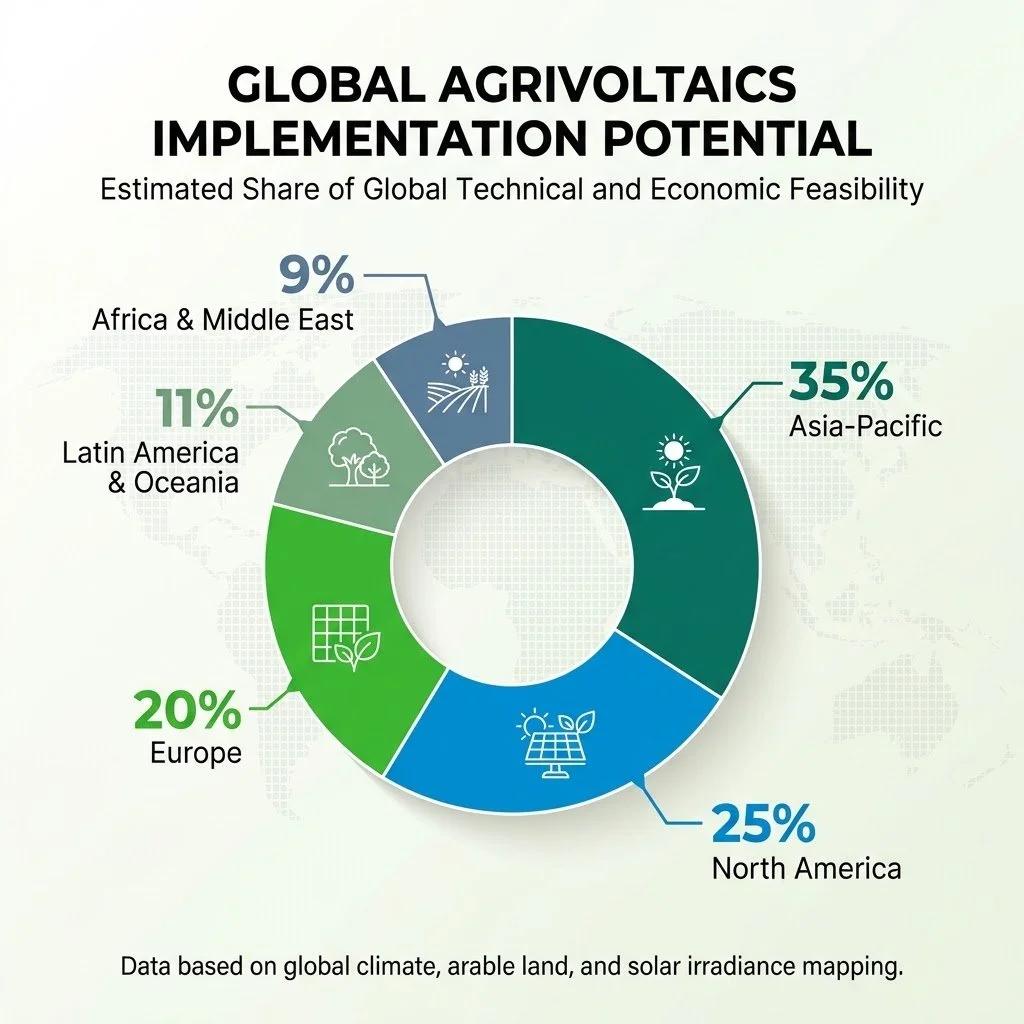
While Asia-Pacific accounts for approximately 65% to 68% of operational capacity due to early government mandates in China and Japan, the long-term addressable potential reshapes global market share as regulatory clarity, land-use constraints, and rural incentive frameworks mature worldwide:
| Continent / Macro-Region | Current Share (%) | 2035+ Potential (%) |
|---|---|---|
| Asia-Pacific (APAC) |
65.0%
|
35.0%
|
| North America (Americas) |
9.0%
|
25.0%
|
| Europe (EU & UK) |
22.0%
|
20.0%
|
| Latin America & Oceania |
1.5%
|
11.0%
|
| Africa & Middle East (MEA) |
2.5%
|
9.0%
|
Unlocking the Global Canopy:
Tailored Regional Outreach to Accelerate Agrivoltaic Scale
Reimagining Rural Land Stewardship Across Five Continents
Agrivoltaics (APV) cannot be scaled with a generic, one-size-fits-all playbook. Siting rules, crop biology, land tenure, and agricultural subsidies differ fundamentally across jurisdictions. To transform global potential into operational gigawatts, regional development teams must execute targeted, continent-specific outreach mechanisms that resolve local agricultural pain points, leverage regional statutory levers, and align public-private capital.
1. North America: Breaking the Zoning Impasse via Farm Bureau Partnerships & Tax-Equity Syndication
The Regional Bottleneck:
Despite robust federal financial drivers under the Inflation Reduction Act (IRA Section 48/48E) and USDA REAP grants, utility-scale solar in the U.S. Midwest and Sunbelt faces escalating county-level moratoria and local pushback. Rural county planning boards reject solar farms because traditional ground mounts remove productive crop acreage and damage rural landscapes.
Target Stakeholders:
American Farm Bureau Federation (AFBF) state chapters, agricultural land trusts, regional electric cooperatives (NRECA), and tax-equity syndicators.
Tailored Outreach Mechanism:
o Cross-Border DIN SPEC 91434 & Loi APER Alignment: Package projects using verified third-party agronomic certifications. Assure farmers that dual-use canopies preserve full CAP subsidy eligibility while meeting national requirements that cap usable acreage loss at under 10% to 15%.
o Specialty Crop Climate Defense (Vineyards & Orchards): Engage wine grower syndicates in Southern France, Spain, and Italy facing recurring heatwaves and hail destruction. Position dynamic tracking canopies as climate insurance that reduces evapotranspiration by 12% to 34% while protecting grapes, stone fruits, and berries from sudden summer hail and frost.
o Dedicated Agri-PV Tender Access: Guide regional co-ops through specialized European auction categories (such as Germany’s EEG innovation tenders and Italy’s PNRR €1.1B allocation) to secure long-term, premium feed-in tariffs.
3. Asia-Pacific: State-Backed Farmland Protection, Grid Integration, and Rice-Paddy Innovation
The Regional Bottleneck:
Dense populations and strict food self-sufficiency policies mean national governments cannot sacrifice an acre of staple food land. Meanwhile, remote rural solar developments often face severe distribution-grid interconnection queues.
The Regional Bottleneck:
Vast expanses of pastureland and export-focused farming operations (soybeans, beef cattle, avocados, coffee, wine) operate with thin margins and high logistics costs, with limited local subsidies for capital-intensive elevated steel structures.
Target Stakeholders:
Provincial ministries of agriculture and natural resources, state grid corporations (State Grid China, Taipower, KEPCO), and municipal agricultural associations (JA in Japan, Farmer Associations in Taiwan).
Tailored Outreach Mechanism:
o "Keep the Farm in the Family" Dual-Use Compacts: Pitch agrivoltaics to family farmers as an intergenerational succession hedge. Present farm financial models showing that high-clearance tracking arrays allow continuous corn-soy rotations or sheep grazing while generating predictable, inflation-indexed lease revenues.
o Standardized Dual-Use Model Ordinances: Provide county commissioners with turn-key zoning templates that differentiate agrivoltaics from standard utility solar. The ordinance guarantees minimum hub clearances (3.8m to 4.5m), certified continuous soil cultivation, and cash-backed decommissioning bonds.
o Stacked Tax Equity Structuring: Educate agricultural banks (e.g., Farm Credit System) on structuring the IRA's 30% base Investment Tax Credit alongside the 10% Energy Community and 10% Domestic Content adders, drastically reducing developer capital costs.
2. Europe: Harmonizing CAP Subsidies, Standardized Certification, and Specialty Co-Ops
Tailored Outreach Mechanism:
o Compliance with Strict Siting Prohibitions: In mainland China, pitch state-owned developers on dual-use systems as the only legal avenue to build solar under national decrees banning pure utility farms on arable land. In Japan, structure projects around the Ministry of Agriculture, Forestry and Fisheries (MAFF) rule requiring verified retention of 80% of historical crop output to maintain FIT eligibility.
o Aquavoltaics & Wetland Synergy: Expand outreach beyond dry fields to aquaculture ponds and flooded rice paddies across Southeast Asia and coastal Taiwan. Elevated, wide-span bifacial systems reduce water evaporation, optimize water temperatures for shrimp and tilapia, and utilize existing agricultural grid spurs.
o Public-Private Municipal Anchors: In urban-adjacent corridors like Taipei's Beitou-Shilin Technology Park, connect tech-campus heat relief with suburban agricultural green belts, funding community arrays through TPEx-issued municipal green bonds.
4. Latin America & Oceania: Solar Grazing Syndicates and Export Agro-Corridor Partnerships
The Regional Bottleneck:
European agricultural acreage commands high real estate premiums, and farmers fear that installing solar canopies will disqualify them from receiving baseline subsidies under the European Union's Common Agricultural Policy (CAP). Furthermore, fragmented national standards create permitting friction across borders.
Target Stakeholders:
Agricultural cooperatives (such as BayWa, InVivo, and COPA-COGECA), national transmission system operators (TSOs like TenneT, RTE, and Red Eléctrica), and premium horticultural growers.
Target Stakeholders:
Large livestock cattle and sheep associations (Meat & Livestock Australia, CNA in Brazil), global citrus and avocado exporters, and commercial clean-energy aggregators.

Uniting Hope and Innovation for Tomorrow
Collaborate with us to build a vibrant, thriving world. By integrating transformational AI solutions, we are safeguarding a sustainable future for generations to come.
A peaceful Himalayan valley village with a flowing river, an arched bridge, blooming cherry blossoms, and snow-capped mountains in the background.